Koyeb Review 2026: Pricing, GPU Costs and Fine Print After the Mistral Deal
Koyeb review for November 2026: no free tier for new users, the $29 Pro plan, per-second CPU and GPU prices (H100 $2.50/hr), scale-to-zero, Postgres, SLA gaps and billing fine print after the Mistral AI deal.
Koyeb has gone from a scrappy Heroku alternative with a free tier to a GPU-first serverless cloud that Mistral AI has agreed to buy. The pricing changed with it: the free Starter plan is gone for new users, the real entry point is the $29 Pro plan, and GPUs are cheaper than ever, with an H100 at $2.50 an hour.
We went through Koyeb's pricing page, instance reference, legal terms and 2026 status history to see what a new customer actually pays in November 2026 and where the fine print bites.
Verdict
Koyeb is a fast, tidy serverless platform for web services, workers, Postgres and GPU inference, billed by the second. The developer experience is genuinely good: push a Git repo or a Docker image, pick an instance and a region, and you get autoscaling, HTTPS and a global edge network without writing infrastructure code.
The catch in late 2026 is the entry price. The free Starter plan is closed to new sign-ups, so a new account starts at the $29 per month Pro plan plus compute, with $10 of compute included. Pro has no uptime SLA, there are no spending limits, and the company's future now sits inside Mistral AI. Koyeb is a strong pick for GPU inference and scale-to-zero workloads; it is a weaker pick for a hobby project or for anyone who needs a contractual SLA without paying $299 per month.
Koyeb at a glance (November 2026)
Plans: Pro $29/mo, Scale $299/mo, Enterprise from $1,000/mo, all plus compute. Cheapest CPU instance: eco-nano at $1.61/mo, standard nano at $2.68/mo. GPUs from $0.50/hr (RTX 4000 SFF Ada) to $5.50/hr (B200). Free tier for new users: none. Uptime SLA: 99.9% on Scale, 99.99% on Enterprise, none on Pro.
What Koyeb is, and the Mistral AI deal
Koyeb is a French serverless platform (Koyeb SAS, Boulogne-Billancourt) that runs containers on its own fleet of bare-metal servers across the US, Europe and Asia. You deploy web services, background workers and managed Postgres, and since 2024 it has leaned hard into serverless GPUs for AI inference.
On February 17, 2026 Koyeb announced it had "entered into a definitive agreement to join Mistral AI", the Paris-based model maker. It is Mistral's first acquisition, the terms were not disclosed, and Koyeb's own post says completion "is subject to closing conditions". Trade press reported the roughly 16-person team joining Mistral in March 2026, but we found no official closing notice from Koyeb, so treat it as an agreed deal rather than a confirmed close.
Koyeb's stated commitments to existing users are worth knowing: the platform "will continue to operate without disruption", it "will continue to bill users directly through our existing billing system", and asked whether customer data will move to Mistral AI, the answer was "Not immediately."
A signal to watch
Koyeb's public changelog has not had a new entry since February 27, 2026, ten days after the deal was announced. The platform keeps running, but public product updates have slowed noticeably.
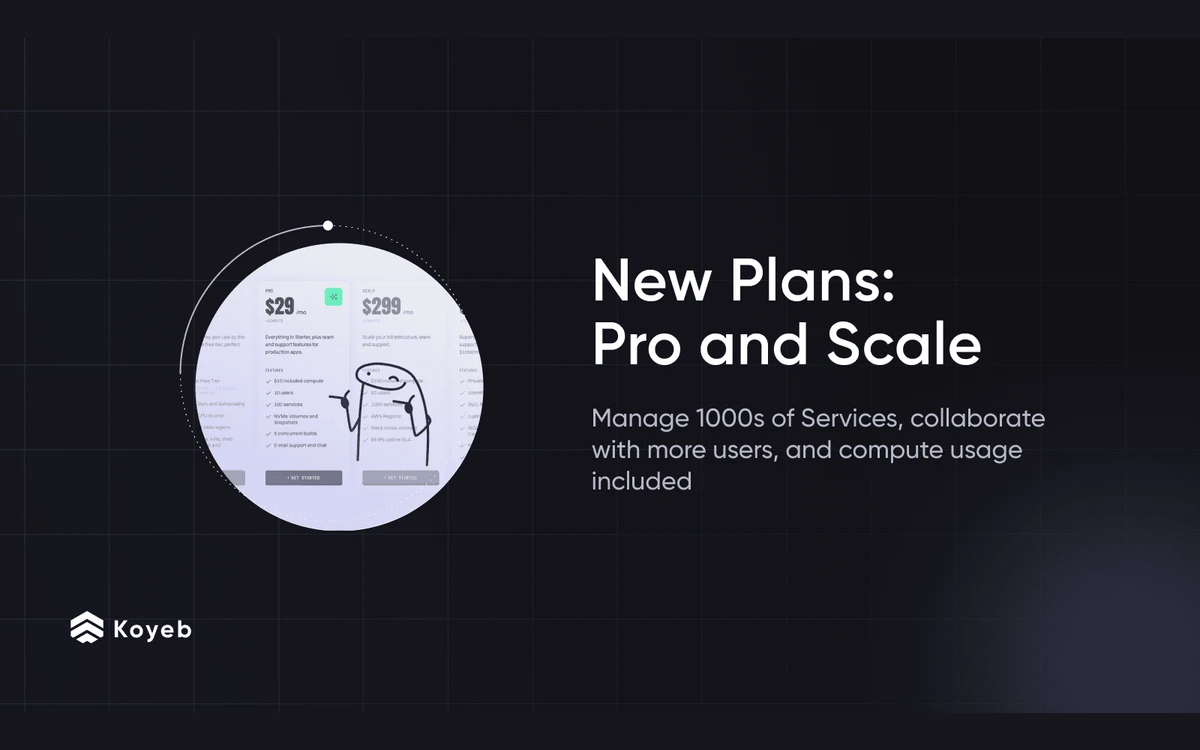
Koyeb pricing in 2026: Pro, Scale and Enterprise
Koyeb charges a monthly platform fee per organization, then bills compute on top by the second. Each plan includes some compute credit that offsets usage.
- Pro - $29/mo + compute: $10 included compute, 10 users, 100 services, NVMe volumes and snapshots, 5 concurrent builds, email and chat support. No uptime SLA.
- Scale - $299/mo + compute: $100 included compute, 50 users, 1,000 services, AWS regions, Slack cross-connect, 99.9% uptime SLA.
- Enterprise - custom, starting at $1,000/mo + compute: $500 included usage, private dedicated locations, unlimited users, SSO, RBAC and audit trail, custom RAM/CPU/GPU, ISO 27001 and SOC 2, 99.99% uptime SLA, 24x7x365 premium support.
The comparison table adds the limits that matter once you grow: CPU concurrency of 100 instances on Pro and 1,000 on Scale, GPU concurrency of 20 on Pro and 40 on Scale, 5 versus 20 concurrent builds, and 7 days of realtime logs on both (30 days on Enterprise). Pro and Scale get 7 regions in the US, EU and Asia; Enterprise lists 50 on-demand regions.
Bandwidth is generous: 1 TB per month is included, then $0.02/GB in the EU and US and $0.04/GB in Asia. Koyeb also advertises up to $30k in credits for early-stage startups and savings plans with up to 50% off on-demand prices for long-term reservations.
CPU instance prices
Monthly figures below assume an instance running 24/7 (about 744 hours). Because billing is per second, an instance that scales to zero half the time costs roughly half.
Standard instances
- nano - 0.25 vCPU, 256MB RAM, 2.5GB disk: $0.0036/hr, $2.68/mo
- micro - 0.5 vCPU, 512MB, 5GB: $0.0072/hr, $5.36/mo
- small - 1 vCPU, 1GB, 10GB: $0.0144/hr, $10.71/mo
- medium - 2 vCPU, 2GB, 20GB: $0.0288/hr, $21.43/mo
- large - 4 vCPU, 4GB, 40GB: $0.0576/hr, $42.85/mo
- xlarge - 8 vCPU, 8GB, 80GB: $0.1152/hr, $85.71/mo
- 2xlarge - 16 vCPU, 16GB, 160GB: $0.2304/hr, $172/mo
- 3xlarge - 24 vCPU, 32GB, 240GB: $0.4608/hr, $343/mo
- 4xlarge - 32 vCPU, 64GB, 320GB: $0.9216/hr, $686/mo
- 5xlarge - 40 vCPU, 128GB, 400GB: $1.8432/hr, $1,371/mo
Eco instances
Eco instances trade dedicated performance for price and are only available in Washington, D.C., Frankfurt and Singapore. The useful one is eco-nano at 0.1 vCPU and 256MB for $1.61/mo; above that, eco sizes cost the same as the standard size with the same price but give you more RAM per dollar (eco-medium is 1 vCPU and 2GB for $10.71/mo, the same price as a standard small with 1GB).
What the $10 Pro credit actually buys
Pro's $10 of included compute covers almost exactly one standard small instance (1 vCPU, 1GB) running all month at $10.71. Anything beyond that is billed on top of the $29 fee.
Serverless GPUs: the strongest part of the offer
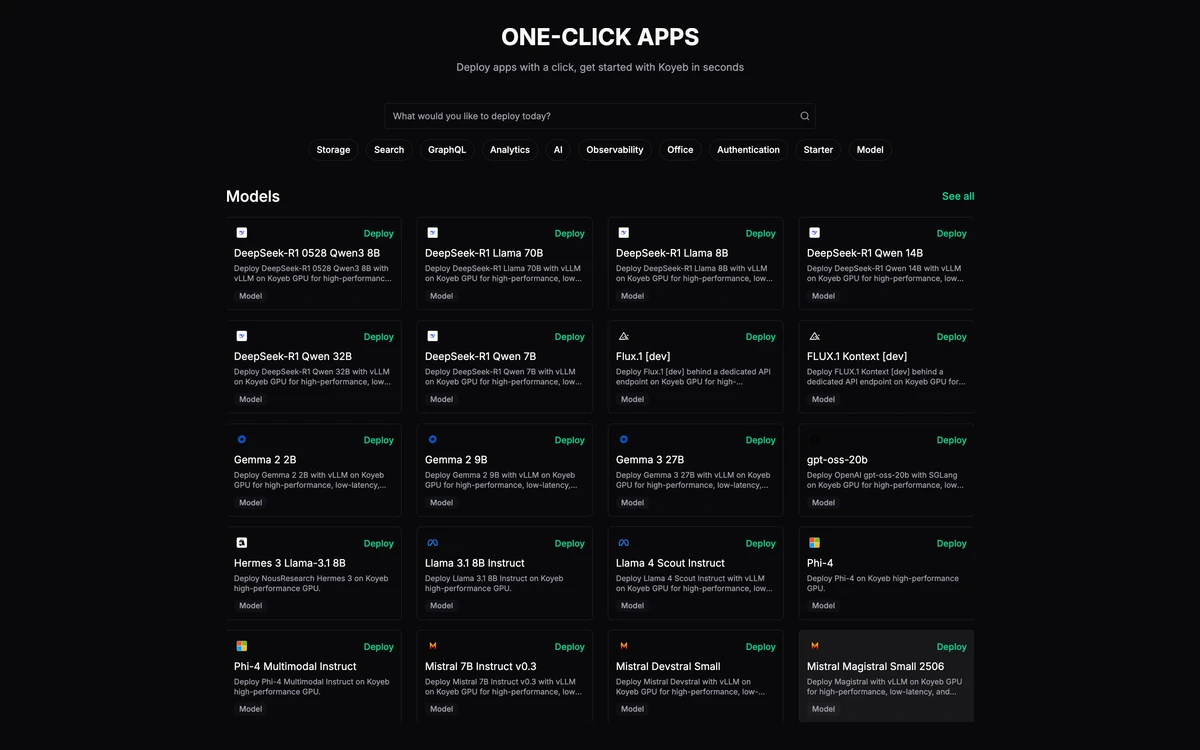
GPUs are where Koyeb is most competitive. In November 2025 it cut prices by up to 24%: L40S from $1.55 to $1.20/hr, A100 from $2.00 to $1.60/hr, and H100 from $3.30 to $2.50/hr. RTX Pro 6000, H200 and B200 arrived in January 2026. All GPU instances are billed by the second.
- RTX 4000 SFF Ada (20GB): $0.50/hr
- L4 (24GB): $0.70/hr
- RTX A6000 (48GB): $0.75/hr
- L40S (48GB): $1.20/hr
- A100 (80GB): $1.60/hr
- A100 SXM (80GB): $2.15/hr
- RTX Pro 6000 (96GB): $2.20/hr
- H100 (80GB): $2.50/hr
- H200 (141GB): $3.00/hr
- B200 (180GB): $5.50/hr
Multi-GPU configurations scale linearly: 2x, 4x and 8x A100 at $3.20, $6.40 and $12.80/hr; 2x, 4x and 8x H100 at $5.00, $10.00 and $20.00/hr; 2x, 4x and 8x H200 at $6.00, $12.00 and $24.00/hr. Tenstorrent N300s cards are listed as request access.
Listed is not the same as available
In the pricing page catalog, L4, B200, 4x H200 and every 8x configuration are marked restricted with no self-serve region. Expect to contact sales before you can deploy them. The status page also logged "RTXA6000 currently unavailable" on September 15, 2026, so capacity on popular cards can run out.
Scale-to-zero and Light Sleep
Scale-to-zero is the feature that makes per-second GPU billing practical. Koyeb stops your instances after an idle period and wakes them on the next request. It is still labelled public preview.
- Default idle period is 5 minutes, adjustable up to 6 hours on Pro and up to 12 hours on Scale and Enterprise.
- Deep Sleep shuts the instance down fully, with a cold start of 1-5 seconds.
- Light Sleep, launched September 19, 2025 and also in public preview at no extra cost, keeps the instance warm enough for a roughly 200 ms start.
Autoscaling works on CPU, memory, requests per second, concurrent connections and P95 response time, so you can scale a GPU service out under load and let it drop to zero overnight.
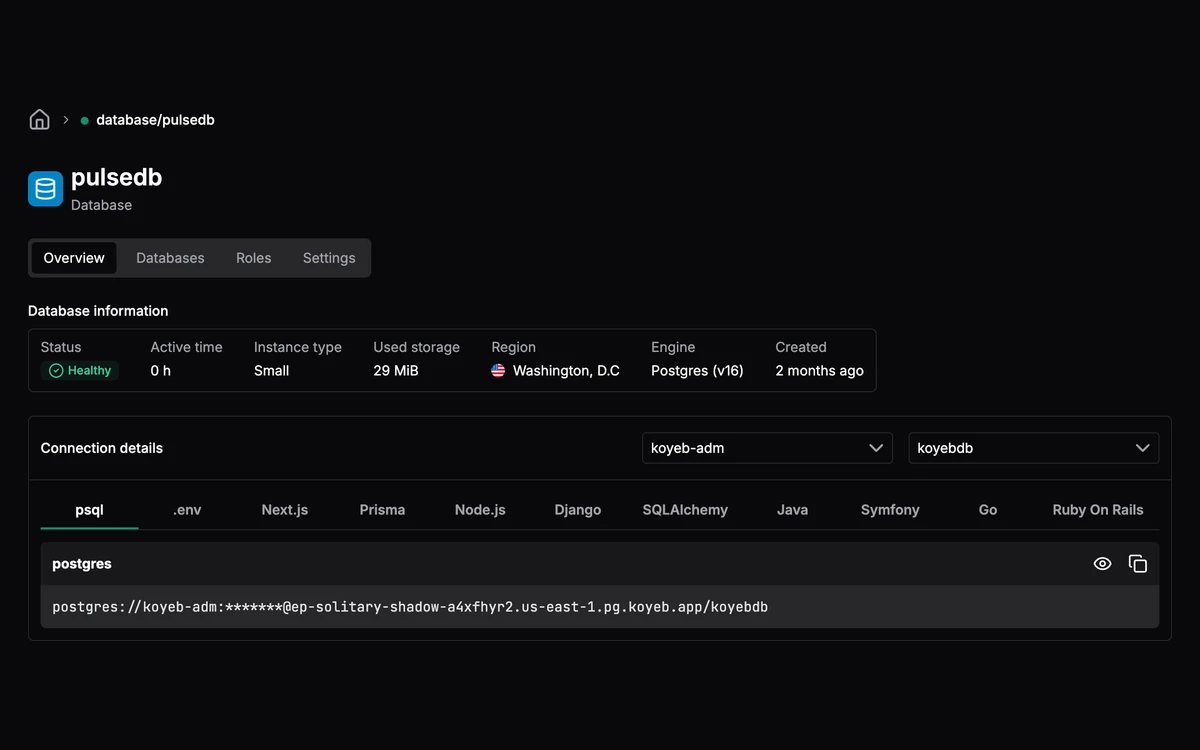
Managed Postgres
Koyeb's serverless Postgres went GA in May 2025 and added PostgreSQL 18 support in October 2025. Compute sleeps automatically after 5 minutes of inactivity, which keeps idle dev databases cheap. It runs in Frankfurt, Washington D.C. and Singapore only.
- Small - 0.25 vCPU, 1GB: $0.04/hr, $29.76/mo
- Medium - 0.5 vCPU, 2GB: $0.08/hr, $59.52/mo
- Large - 1 vCPU, 4GB: $0.16/hr, $119.04/mo
- XLarge - 2 vCPU, 8GB: $0.32/hr, $238.08/mo
- 2XLarge - 4 vCPU, 16GB: $0.64/hr, $476.16/mo
- 3XLarge - 8 vCPU, 32GB: $1.28/hr, $952.32/mo
- Storage: $0.50 per GB per month ($0.000672 per GB-hour)
The pricing page still lists a free database row (0.25 vCPU, 1GB, 5 active hours, 1GB storage). That allowance came from the old Starter plan, and it is unclear whether a new Pro account gets it, so budget for at least the Small tier.
Deploy workflow and features
Deployment is the polished part. You connect a GitHub repo or point at a Docker image; Koyeb builds with a Dockerfile or with Buildpacks derived from the heroku/buildpacks:20 builder, so most Heroku-style apps deploy unchanged.
- Control via web panel, CLI, API, Terraform and Pulumi, plus an MCP server for AI agents.
- Private networking and service discovery between services; TCP proxy in preview since September 2025.
- Global edge network in front of every service, with a limit of 10,000 concurrent requests across all regions and 5,000 per region.
- HTTP connection timeout of 100 seconds; WebSockets and gRPC streams can last up to 12 hours.
- MFA and passkeys since December 2025.
- Volumes in public preview, 1-10GB, Washington D.C. and Frankfurt only, and "currently only suitable for testing". No published volume or snapshot price.
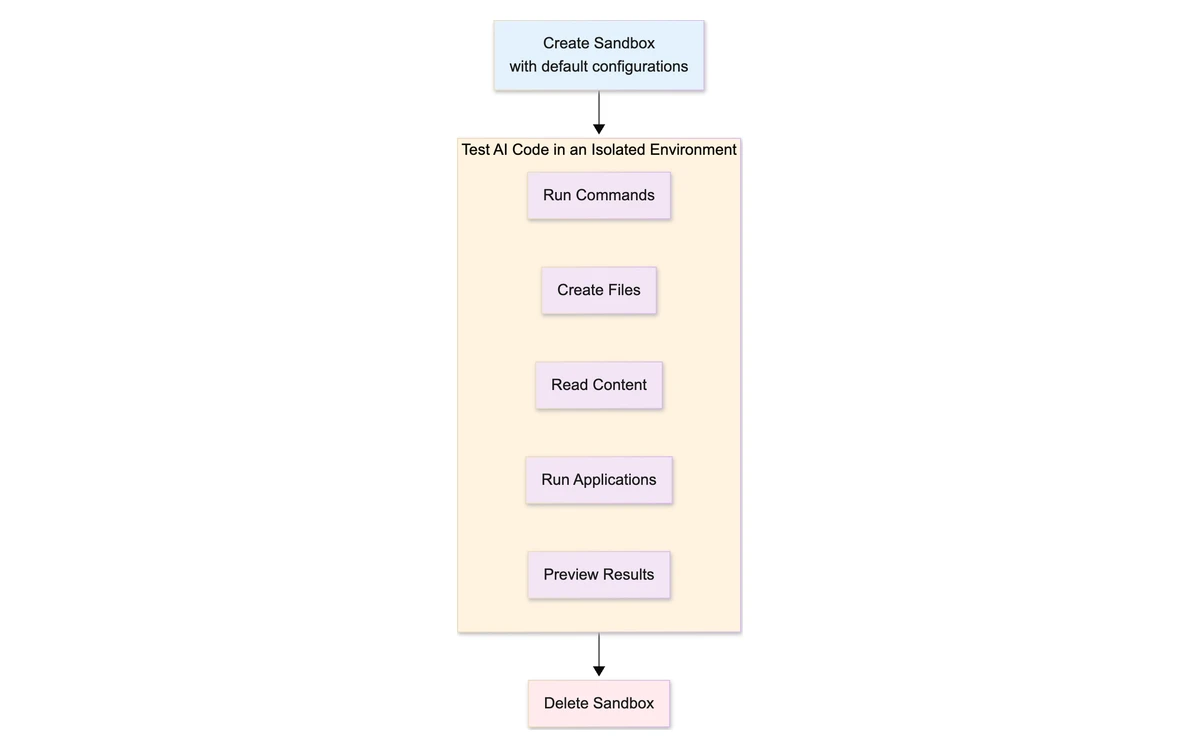
Koyeb Sandboxes
Sandboxes, in public preview since November 21, 2025, give AI agents fully isolated environments to run code in, with Python and JavaScript SDKs and auto-deletion after anywhere from 60 seconds to 24 hours. It is a natural fit for Mistral's agent plans, though as a preview it has no SLA.
Regions and reliability
Core regions are Frankfurt, Washington D.C., Singapore, Tokyo and Paris, plus aws-us-east-1 for Scale customers, and a San Francisco preview region open to every paid organization. The control plane runs on Google Cloud in Belgium; workload subprocessors include Equinix Metal, IBM Cloud, Scaleway and AWS.
Reliability in 2026 has been uneven. The public status history lists, among others: 500 errors in the API and control panel with provisioning delays (October 16), low availability in was1 (September 29), an authentication issue (September 21-22), login failures (July 16), connectivity issues in Paris (June 22), an unreachable hypervisor (May 25-26) and several provisioning delays between May and July. We found no security incident.
Contractually, Pro has no SLA at all. Scale promises 99.9% and Enterprise 99.99%, and under the SLA dated June 28, 2024, service credits are a pro rata discount and the customer's only recourse.
Billing fine print
- No free tier for new users. Since the Mistral announcement, new users need a valid payment method and must subscribe to Pro, Scale or Enterprise. Existing Starter organizations keep their plan.
- Card check: Koyeb places a $29 pre-authorization hold. It accepts Visa, Mastercard, American Express, Diners, Discover and China UnionPay, charges in USD and invoices on the first of the month through Stripe.
- No spending limits. Koyeb says it is "working on a spending limits feature". With per-second GPU billing, a forgotten H100 costs about $60 a day.
- Rounding: processing is accounted per second and billing is rounded up to the nearest unit.
- Failed payments: after 7 days new resource creation can be suspended, after 14 days all instances are paused, and after 21 days resources are permanently deleted.
- Refunds: the pricing FAQ says cancelling ends the subscription immediately with a prorated credit, while the Terms say sums paid are not refundable even on termination. Expect a credit, not cash back.
Privacy and compliance
Koyeb is an EU company and offers GDPR terms through a data processing agreement. ISO 27001 and SOC 2 are listed as Enterprise-plan features, so Pro and Scale customers should not assume they can obtain the reports. HIPAA is not mentioned anywhere we looked, so do not plan to host protected health data.
What it costs in practice
- Small side project: Pro ($29) + one small instance 24/7 ($10.71) - $10 credit = about $29.71/mo.
- Small production app: Pro ($29) + medium web service ($21.43) + Small Postgres ($29.76) + 10GB storage ($5) - $10 credit = about $75.19/mo, before bandwidth over 1 TB.
- Inference endpoint on one H100, busy 8 hours a day for 22 working days and scaled to zero otherwise: 176 hours x $2.50 = $440, plus $29 Pro - $10 credit = about $459/mo.
- Same H100 left running 24/7: about 744 hours x $2.50 = $1,860/mo, which is why scale-to-zero matters.
For CPU-only web apps, those numbers put Koyeb in the same range as the platforms covered in our Render, Railway, Fly.io and Heroku reviews, with the $29 floor being the main disadvantage for tiny projects. For GPU inference, the per-second billing and the H100 price are the reason to choose it.
Who should use Koyeb
Good fit
- Teams serving open models on L40S, A100 or H100 who want per-second billing and scale-to-zero without managing Kubernetes.
- Small teams that want a Heroku-like Git push workflow with autoscaling and multi-region deploys.
- EU-based companies that prefer a European provider with a DPA.
Look elsewhere
- Hobby projects that need a free tier.
- Anyone who needs an uptime SLA but cannot justify $299 per month.
- Workloads that need persistent volumes in production, since volumes are still a testing-only preview.
- Buyers who need hard spending caps or SOC 2 reports below Enterprise.
Frequently asked questions
Does Koyeb still have a free tier?
No, not for new users. After the February 2026 Mistral AI announcement, new sign-ups must add a payment method and choose Pro, Scale or Enterprise. Organizations already on the Starter plan keep their free instance.
How much does Koyeb cost per month?
At least $29 per month for Pro, plus compute beyond the $10 included credit. Scale is $299 per month with $100 included, and Enterprise starts at $1,000 per month with $500 included. Compute is billed per second on top.
How much is an H100 on Koyeb?
$2.50 per hour for a single H100 80GB, billed by the second, down from $3.30 before the November 2025 price cut. 2x, 4x and 8x H100 configurations cost $5, $10 and $20 per hour, though 8x setups are marked restricted.
Does Koyeb offer an uptime SLA?
Only on Scale and Enterprise. Scale carries a 99.9% SLA and Enterprise 99.99%; Pro has none. SLA remedies are service credits, not cash.
Can I set a spending limit on Koyeb?
Not yet. Koyeb says a spending limits feature is in the works. Until then, use scale-to-zero and billing alerts from your own monitoring, especially on GPU services.
Can I get a refund if I cancel?
Expect a prorated credit rather than a cash refund. The pricing FAQ promises a prorated credit when you cancel, while the Terms state that payments are not refundable, even on termination.
Will my data move to Mistral AI?
Not immediately, according to Koyeb. It says the platform keeps running and billing directly as before, but it has not committed to anything long term, so watch for updated terms after the deal closes.
Where are Koyeb's regions?
Frankfurt, Paris, Washington D.C., Singapore and Tokyo, plus a San Francisco preview region for paid plans and AWS us-east-1 for Scale customers. Managed Postgres and eco instances are limited to Frankfurt, Washington D.C. and Singapore.
Key takeaways
- No free tier for new users: plans start at $29/mo Pro plus compute, with $10 of compute included.
- CPU instances are billed per second, from $1.61/mo (eco-nano) and $2.68/mo (nano) running 24/7.
- GPU pricing is the highlight: L40S $1.20/hr, A100 $1.60/hr, H100 $2.50/hr, B200 $5.50/hr, with some cards restricted to sales.
- Scale-to-zero (public preview) wakes in about 200 ms with Light Sleep or 1-5 seconds with Deep Sleep.
- Pro has no SLA and there are no spending limits; the 99.9% SLA starts at the $299 Scale plan.
- Mistral AI agreed to acquire Koyeb in February 2026; service and billing continue, but public updates have slowed.
More in Cloud Computing
Browse Cloud Computing