Copy.ai Review 2026: GTM Workflows, Credits and Real Cost
Copy.ai stopped being a copywriting tool. Chat costs 29 dollars a month, workflow automation starts at 1,000, and Fullcast has owned the platform since October 2025.
Most people who search for Copy.ai are still looking for the cheap AI copywriter from a few years ago, the one that spat out product descriptions and Instagram captions for a few dollars a month. That product is gone. Copy.ai now sells itself as a go-to-market platform, and the price list has moved with it.
This review covers what each tier actually costs in August 2026, how workflow credits are consumed, which parts of the platform you will use at which team size, and what changed when Fullcast bought the company. The numbers come from the Copy.ai pricing page and its own help centre, read on 16 August 2026.
From copywriting tool to GTM platform
Copy.ai describes itself as the first AI-native GTM platform, and it argues against buying a dozen disconnected copilots and point tools. The pitch is one workspace where sales, marketing and operations run the same automations against the same company data. The company says it has 17 million users, offers more than 2,000 integrations, and stays model agnostic rather than betting on a single provider.
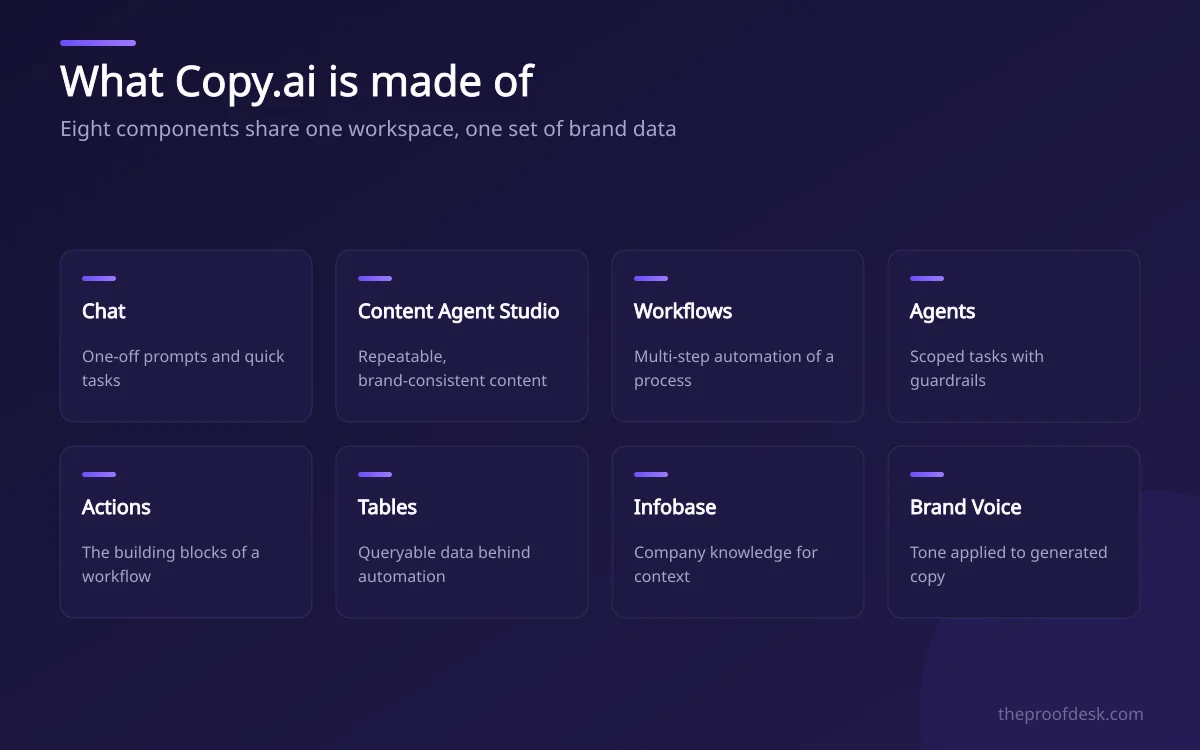
The platform breaks into components rather than a single editor. Chat handles one-off prompts. Workflows chain steps into a repeatable process. Agents run scoped tasks with guardrails. Actions are the individual building blocks, Tables hold the data those blocks query, Infobase stores company knowledge, and Brand Voice governs how the output sounds. Content Agent Studio sits between chat and full workflows for content you produce again and again.
The marketing leans on large customer numbers, including a Lenovo executive quoted as saving 16 million dollars a year through automated workflows. Treat those as vendor-published claims. They describe what a large team with dedicated operations staff achieved, not what a five person marketing team should expect in its first quarter.
Copy.ai is now owned by Fullcast
Fullcast announced the acquisition of Copy.ai on 15 October 2025 and folded it into a revenue operations suite that already included Ebsta, Atrium and Commissionly. The product is still sold as Copy.ai at the same domain, but the help centre now lives on the Fullcast support site. Neither company has published pricing or migration changes for existing customers.
What Copy.ai costs in 2026
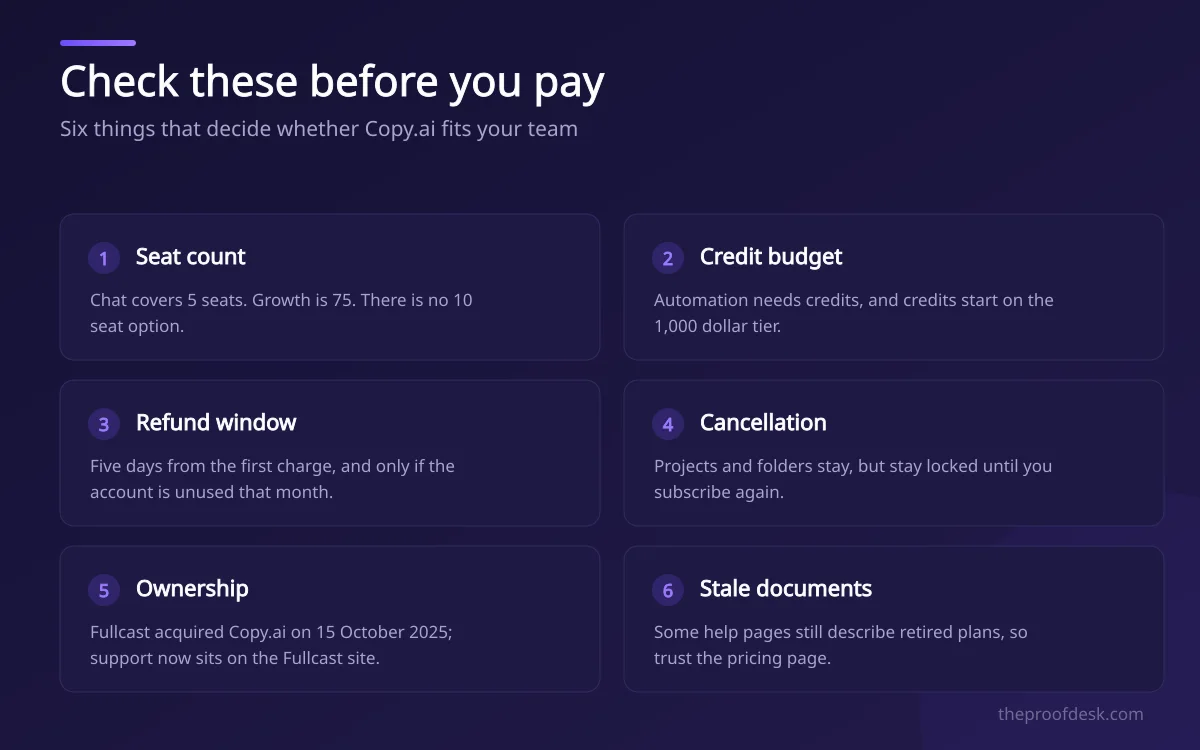
The cheapest way in is the Chat plan at 29 dollars a month, or 24 dollars a month if you pay 288 dollars for the year. That covers five seats, unlimited words in chat, unlimited chat projects, and access to models from OpenAI, Anthropic and Gemini. It is a reasonable price for a small team that wants a shared, brand-aware chat tool and nothing else.
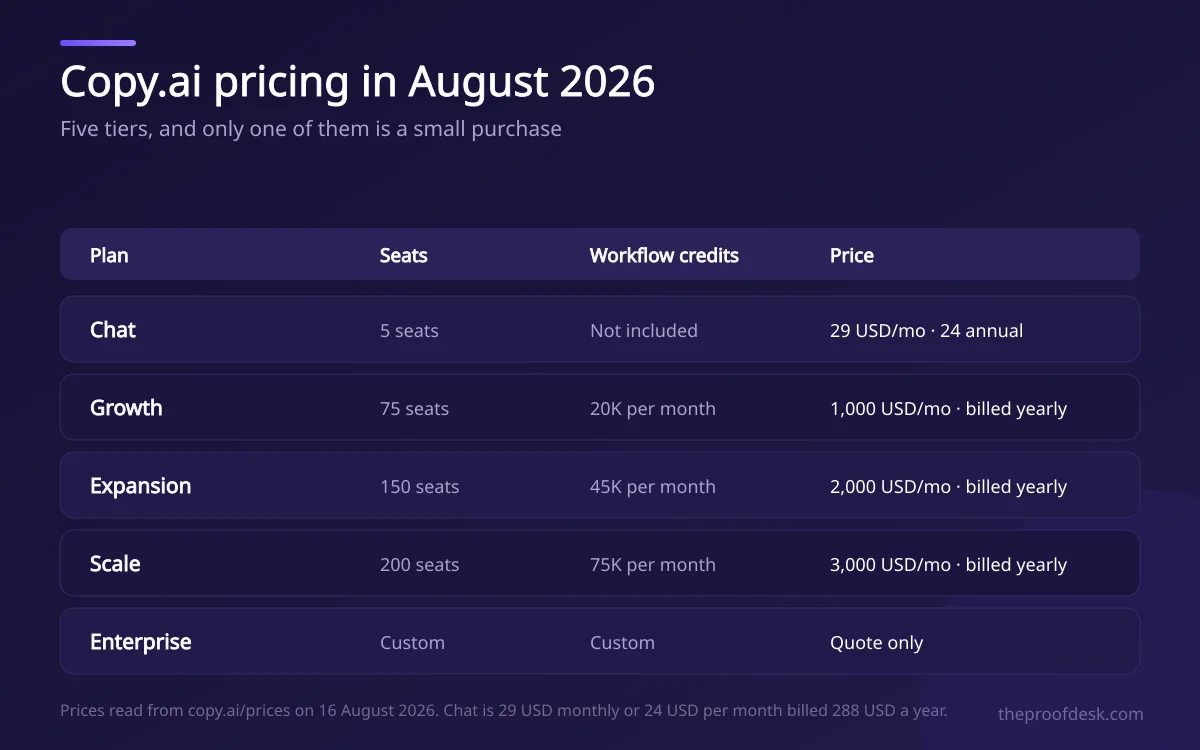
Automation is priced separately and starts much higher. Growth is 1,000 dollars a month billed at 12,000 a year, for 75 seats and 20,000 workflow credits a month. Expansion doubles that to 2,000 a month for 150 seats and 45,000 credits. Scale is 3,000 a month for 200 seats and 75,000 credits. Enterprise is quote-only and adds guided implementation, API access and bulk workflow runs, more than 20 tech integrations, unlimited customisable workflows, a named account team and enterprise security controls.
The missing middle
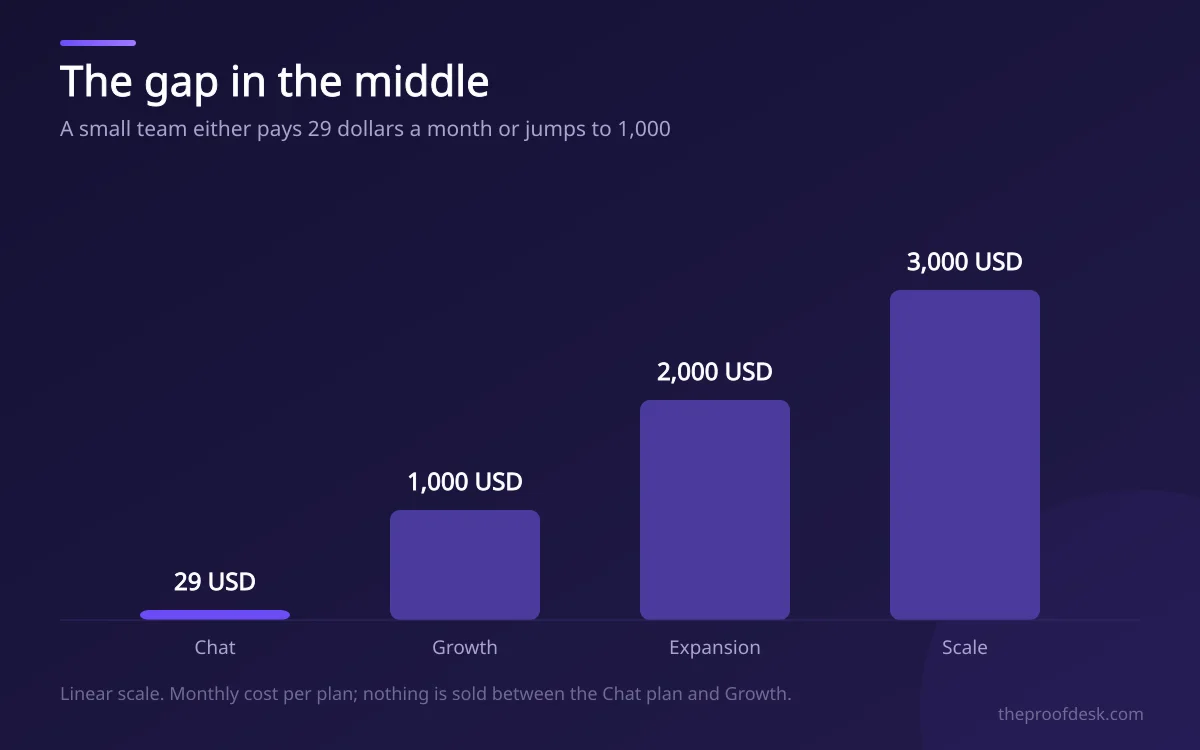
There is no tier between 29 dollars and 1,000 dollars a month. A team of twelve that wants one useful automation cannot buy a little of it. The plan jump is a 12,000 dollar annual commitment, and the seat count leaps from 5 to 75 at the same time. That single gap decides most purchase outcomes for small companies.
The pricing page lists no free tier. New accounts do start with a small bonus credit balance, and the site pushes a free signup, but the published plans all carry a charge. If you are comparing against a per-seat writing tool, compare the annual figure rather than the monthly sticker, because the automation tiers are quoted as annual commitments.
How workflow credits work
A credit is a unit of compute, not a word count. Generating text, searching the web, scanning a site and calling an integration all draw on the same balance, so two workflows on the same plan can cost wildly different amounts. Copy.ai shows the cost of each run in the side panel under credits used, which is the only reliable way to forecast a month.
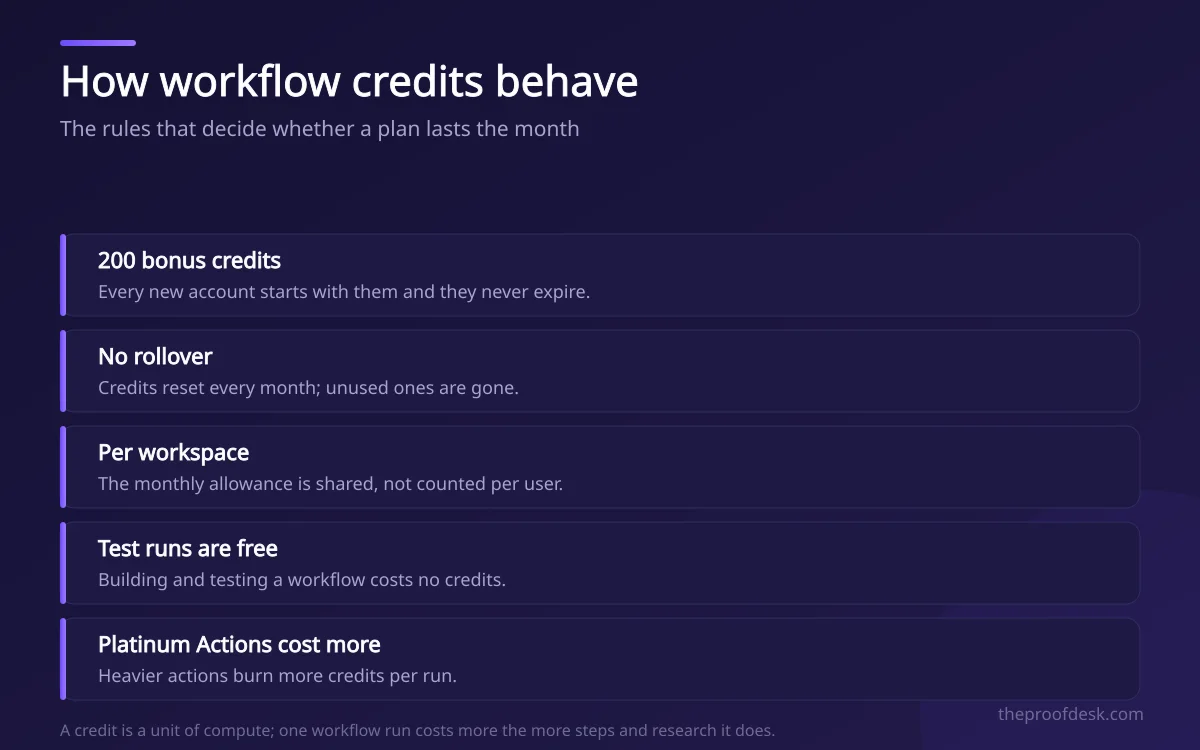
- The help centre states that every new account starts with 200 bonus credits, and that those never expire.
- Monthly credits reset and do not roll over, so an unused allowance is lost at the end of the cycle.
- The allowance belongs to the workspace, not to each user, so one heavy automation can consume the team budget.
- Test runs while you are building a workflow do not spend credits, which makes iteration cheap.
- Platinum Actions do more work in the background and cost more credits per run than standard actions.
Build the workflow you actually intend to run before you size a plan, then multiply its measured cost by your real monthly volume. Estimating from a simple demo workflow will understate the bill, because research steps and premium actions carry most of the cost. Credits can be topped up mid-term, so the risk is under-buying rather than being locked out.
Chat, Content Agent Studio and workflows
Copy.ai splits its own platform into three tiers of effort, which it calls crawl, walk and run. The distinction matters because building a workflow for a task you will do once is the most common way to waste a month of setup time.
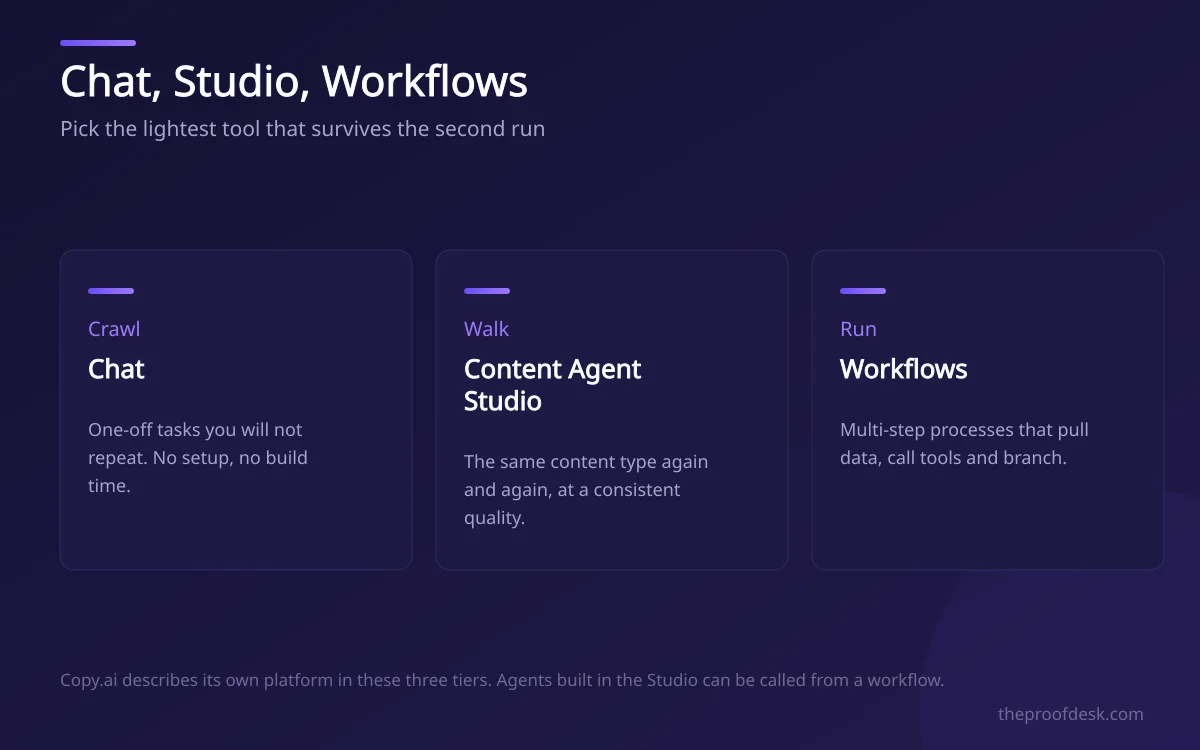
- Chat suits one-off work: a launch email, a quick rewrite, a brainstorm against your brand data.
- Content Agent Studio suits repeated output of the same shape, such as weekly posts or recap summaries, without building a full automation.
- Workflows suit multi-step processes that pull records, call external tools and branch on conditions.
Quality depends on the setup work rather than the model. Infobase holds the company knowledge that gets pulled into generations, and Brand Voice defines the tone applied on top. Skip both and the output reads like any generic assistant. Budget a week to load real material before you judge whether the platform is working, and give one person ownership of that library or it will rot.
Who it fits, and who should skip it
Copy.ai now fits revenue teams with an operations function: a group that already runs Salesforce or HubSpot, has somebody who can design a process, and has budget measured in tens of thousands a year. For that buyer the pitch is coherent, because the alternative is stitching the same automation together from several point tools.
- Good fit: a sales or marketing team that wants one automation layer over its existing GTM systems.
- Good fit: a small team that only needs shared, brand-aware chat for five people at 29 dollars a month.
- Poor fit: a freelancer or solo marketer who wants a cheap long-form writing assistant.
- Poor fit: a ten to twenty person team that needs automation but cannot justify a 12,000 dollar annual commitment.
Verify before you commit
Parts of the help centre still describe retired plans, including a credit page that refers to an Advanced tier with 2,000 credits a month that no longer appears on the pricing page. Treat the pricing page as the current source, and get any credit allowance or seat count written into the order form rather than inferred from a support article.
Frequently asked questions
Does Copy.ai have a free plan?
No. The pricing page lists no free tier in August 2026, and the cheapest paid plan is Chat at 29 dollars a month for five seats. The site still offers a free signup, and the help centre says new accounts receive 200 bonus workflow credits that never expire, so you can test a small amount of automation before paying.
How much does Copy.ai cost per month?
Chat is 29 dollars a month, or 24 dollars a month when billed at 288 dollars a year. Growth is 1,000 dollars a month billed annually, Expansion is 2,000, and Scale is 3,000. Enterprise is quote-only. The three automation tiers are published as annual commitments rather than monthly rolling plans.
Does the Chat plan include workflows?
No. The Chat plan lists unlimited words in chat, unlimited chat projects and five seats, but no workflow credits. Workflow automation appears from the Growth plan upward, where the allowance starts at 20,000 credits a month. If automation is the reason you are buying, Chat is not the plan to start on.
Do unused workflow credits roll over to the next month?
No. Credits reset every month and unused ones are lost, which Copy.ai explains as a way to keep capacity predictable. The allowance is shared across the whole workspace rather than allocated per user, and testing a workflow while you build it does not consume any credits.
What is the refund policy?
Copy.ai publishes a five-day money-back guarantee running from the date of the initial charge, and you have to request it. Cancelling on its own does not trigger a refund, cancellation takes effect at the end of the billing cycle, and no refund is issued if you used the account during the same calendar month as the request.
What happens to my projects if I cancel?
They stay, but you lose access to them until you subscribe again. Projects and folders are retained rather than deleted when a subscription ends. The same lockout applies when a payment fails: the payment processor retries for up to seven days, and the subscription is cancelled if the card still will not charge.
Who owns Copy.ai now?
Fullcast, which announced the acquisition on 15 October 2025. Copy.ai is still sold under its own name and domain, and it now sits alongside Ebsta, Atrium and Commissionly in a revenue operations suite. The most visible change so far is the help centre, which now lives on the Fullcast support site.
Key takeaways
- Copy.ai is a go-to-market platform now, not the cheap copywriting tool people remember.
- Chat costs 29 dollars a month for five seats and includes no workflow credits at all.
- Automation starts at the Growth plan, which is 1,000 dollars a month billed as 12,000 a year.
- Credits are compute, not words: they reset monthly, do not roll over, and are shared across the workspace.
- Fullcast has owned Copy.ai since October 2025, and some help pages still describe plans that no longer exist.
More in Artificial Intelligence
Browse Artificial Intelligence