ElevenLabs Review 2026: Credits, Voice Cloning and Real Costs
A close look at ElevenLabs in 2026: what the shared credit pool actually buys, which tier unlocks professional voice cloning, how Agents minutes are billed, and where the platform frustrates paying users.
ElevenLabs is the default answer when someone asks which AI voice generator sounds most like a person. That reputation is earned. What is less obvious from the marketing pages is how the platform charges you: not per word, not per minute, but out of a single monthly pool of credits that every product on the site draws from at wildly different rates.
That one design decision shapes everything else. It decides whether the $22 plan is generous or gone by the second week, whether a failed take costs you anything, and whether it makes sense to run dubbing and music generation on the same account you use for narration.
This review works through the 2026 pricing as ElevenLabs publishes it, what each tier actually unlocks, how voice cloning and the Voice Library work, how Agents are billed separately from everything else, and the places where paying customers say it falls short. All figures come from ElevenLabs' own pricing page, docs and help centre, checked in August 2026.
What ElevenLabs actually sells
ElevenLabs started as a text-to-speech company and is now closer to an audio suite. Under one login you get text to speech, speech to text, a voice changer, sound effects, music generation, video dubbing, a long-form editor called Studio, a marketplace of community voices, and a conversational agents platform.
The important structural fact is that all of these except Agents share one balance. ElevenLabs puts it plainly on its pricing page: "All products draw from one shared monthly credit pool, so the same credits can be spent on any of them and using one leaves fewer for the others."
So the plan you pick is not really a feature choice. It is a budget, and the products spend it at very different speeds.
The short version
Text to speech is cheap per credit and everything else is not. If narration is your use case, a mid-tier plan goes a long way. If you plan to dub video or generate music, expect the same plan to disappear quickly.
The 2026 tiers and what they cost
Six self-serve tiers, plus a custom Enterprise plan. Monthly prices and the included credit allowance, verbatim from the pricing page:
- Free — $0, 10,000 credits a month, 3 Studio projects, no commercial licence.
- Starter — $6, 30,000 credits. Adds the commercial licence, instant voice cloning and 20 Studio projects.
- Creator — $22, 121,000 credits, and $11 for the first month. Adds professional voice cloning.
- Pro — $99, 600,000 credits. Adds 44.1kHz PCM output via the API and 192kbps audio.
- Scale — $299, 1,800,000 credits, 3 workspace seats, team collaboration and 3 professional voice clones.
- Business — $990, 6,000,000 credits, 10 seats and 10 professional voice clones.
Annual billing is a straightforward two-months-free discount. ElevenLabs describes it as "annual price = monthly price × 10", which works out to an effective $5 a month on Starter, $18.33 on Creator, $82.50 on Pro, $249.17 on Scale and $825 on Business.
Two thresholds matter more than the rest. The commercial licence arrives at Starter, so anything you generate on the free plan is not yours to publish commercially. Professional voice cloning arrives at Creator, which is the real dividing line between hobby use and production use.
Audio quality is also tiered. ElevenLabs frames it as "Standard audio at 128kbps suits most needs; higher quality at 192kbps, 44.1kHz, meets audiobook standards" — and that higher tier sits on Pro and above. If you are delivering audiobooks to a distributor with bitrate requirements, that is a $99 floor, not a $22 one.
How credits are actually spent
A credit is not a unit of time or a unit of text. It is a unit of account whose exchange rate depends entirely on which product you point it at. These are the published rates:
- Text to speech — 1 credit per character on the Multilingual v2 models.
- Flash and Turbo models via the API — "between 0.5 and 1 credit per character", a discount for the low-latency models.
- Speech to text — 330 credits per minute.
- Sound effects — 200 credits per generation if you let the model choose the length, or 40 credits per second if you set the duration yourself, up to 22 seconds.
- Eleven Music — 900 credits per minute.
- Voice Changer and Voice Isolator — 1,000 credits per minute.
- Speech to speech — 1,000 credits per minute of converted audio.
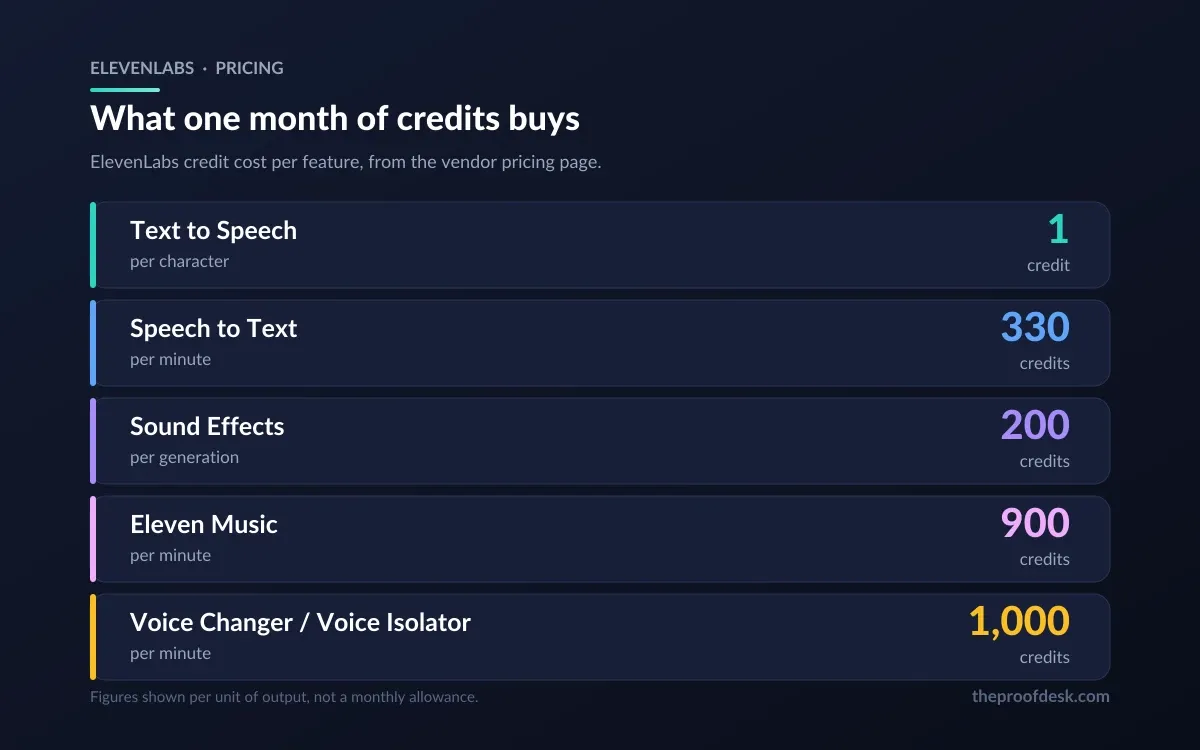
Put that against a plan. Creator's 121,000 credits is roughly 121,000 characters of narration — call it two hours of finished speech, comfortably a season of a podcast intro or a mid-length audiobook chapter set. The same 121,000 credits is about 134 minutes of transcription, or roughly 134 minutes of voice changing, or a little over two hours of generated music. Same balance, very different mileage.
Rollover exists but is capped. ElevenLabs states that "unused credits roll over for up to two months — up to 2× your monthly quota — so your balance can reach at most 3× your monthly quota", and only while you keep an active paid subscription. Rollover does not apply to the free plan.
The flip side is harsher. If you cancel or downgrade, "any unused paid credits will expire" once the cycle ends. Credits you paid for and did not use do not survive leaving.
For overage, new self-serve accounts use pay-as-you-go top-ups, which ElevenLabs says "last for 12 months, and will be used if you run out of credits from your monthly quota". The older usage-based billing, priced per additional 1,000 credits, is now described as "a legacy feature, and is not available on new self-serve subscriptions". Neither the PAYG rate nor the usage-based rate is published — it is shown to you in-product before you confirm.
The Voice Library
The Voice Library is the marketplace of voices other users have shared, browsable by language, accent, age and use case. It is the fastest way to get a usable voice without recording anything yourself, and it is the part of the product that most clearly benefits from ElevenLabs' scale.
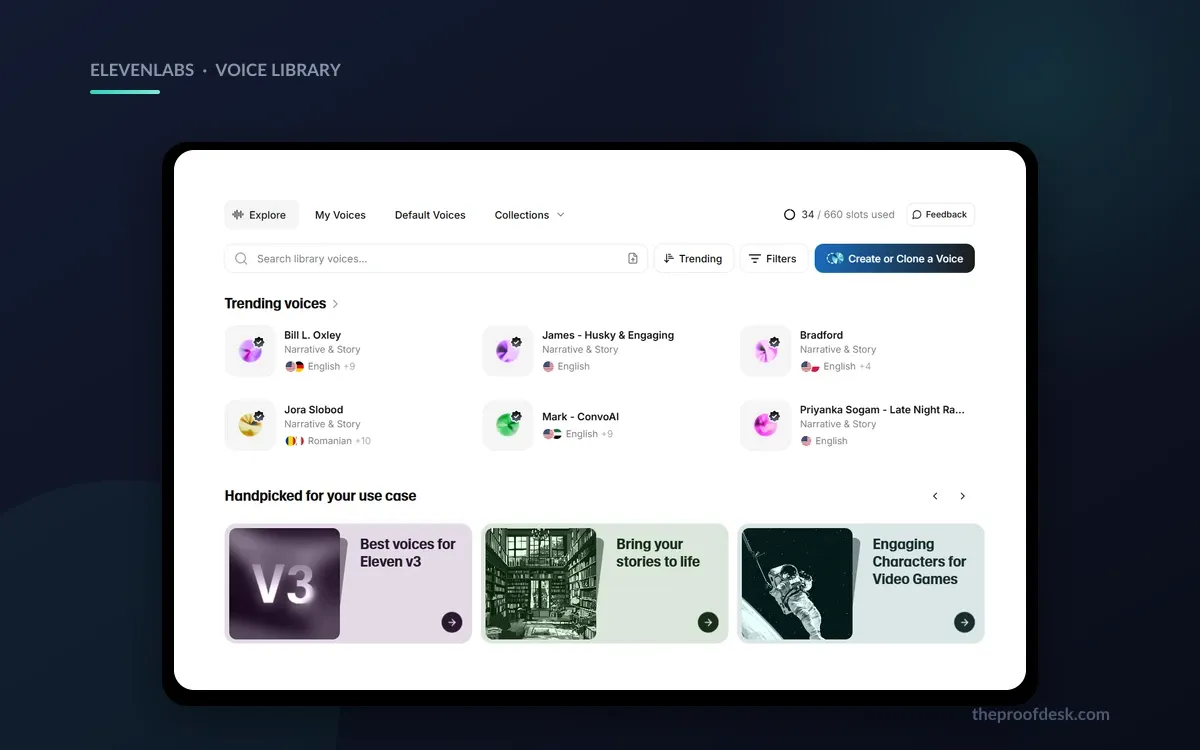
Only one kind of voice can be listed. ElevenLabs is explicit: "Currently, only Professional Voice Clones can be shared. Instant Voice Clones and voices created with Voice Design are not shareable." That keeps the library to human-verified voices rather than clones of arbitrary uploaded audio.
If you share a voice, there is a payout scheme. Voice Actor Payouts "let you earn cash rewards when paid users generate audio with your Professional Voice Clone shared in the Voice Library", calculated on paid usage only and excluding free users. It needs the Creator plan or above, a Stripe Connect account and an active paid subscription. Payouts run "automatically every 6–8 days once your earnings exceed the minimum threshold", usually $10.
It is a real revenue stream for a small number of voice owners and a rounding error for most. Treat it as an upside, not a reason to subscribe.
Instant versus professional voice cloning
There are two cloning paths and the gap between them is significant.
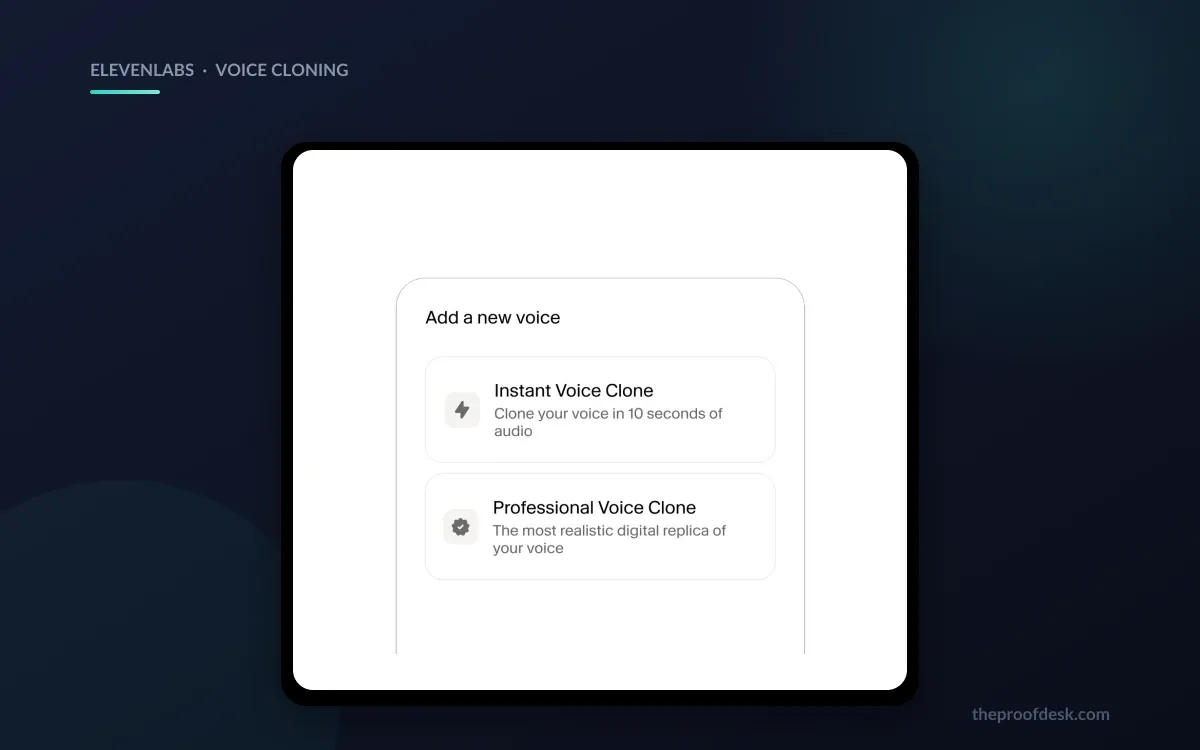
Instant Voice Cloning unlocks at Starter and works from a very short sample — ElevenLabs advertises ten seconds. It is fast and it is good enough for internal drafts, prototypes and casual work. It is not a convincing replica under scrutiny.
Professional Voice Cloning starts at Creator and is the one people mean when they say ElevenLabs clones voices well. It wants a substantial, clean recording and it puts you through verification: "After uploading your samples, you'll complete a Voice Captcha verification by reading a short text prompt within a set timeframe." That step exists to make sure you are cloning your own voice, and ElevenLabs treats getting around it as grounds for a ban, warning that "evading product guardrails including voice verification (e.g., CAPTCHA) is against our Prohibited Use Policy and might lead to a permanent ban of the user's account."
Professional clone slots are metered by tier: Scale includes 3 and Business includes 10. If you downgrade below Creator, the clone is not deleted — ElevenLabs says it "will not be removed from your account, but you will not be able to use it until you upgrade to Creator or above". Your voice is held, not destroyed, which is the right call but does mean a lapsed subscription silently locks your main asset.
Studio, for anything longer than a paragraph
Studio is the long-form editor: you bring a manuscript, split it into chapters, assign voices per speaker or per segment, and regenerate individual passages without touching the rest. It is the difference between using ElevenLabs as a toy and using it to ship an audiobook.
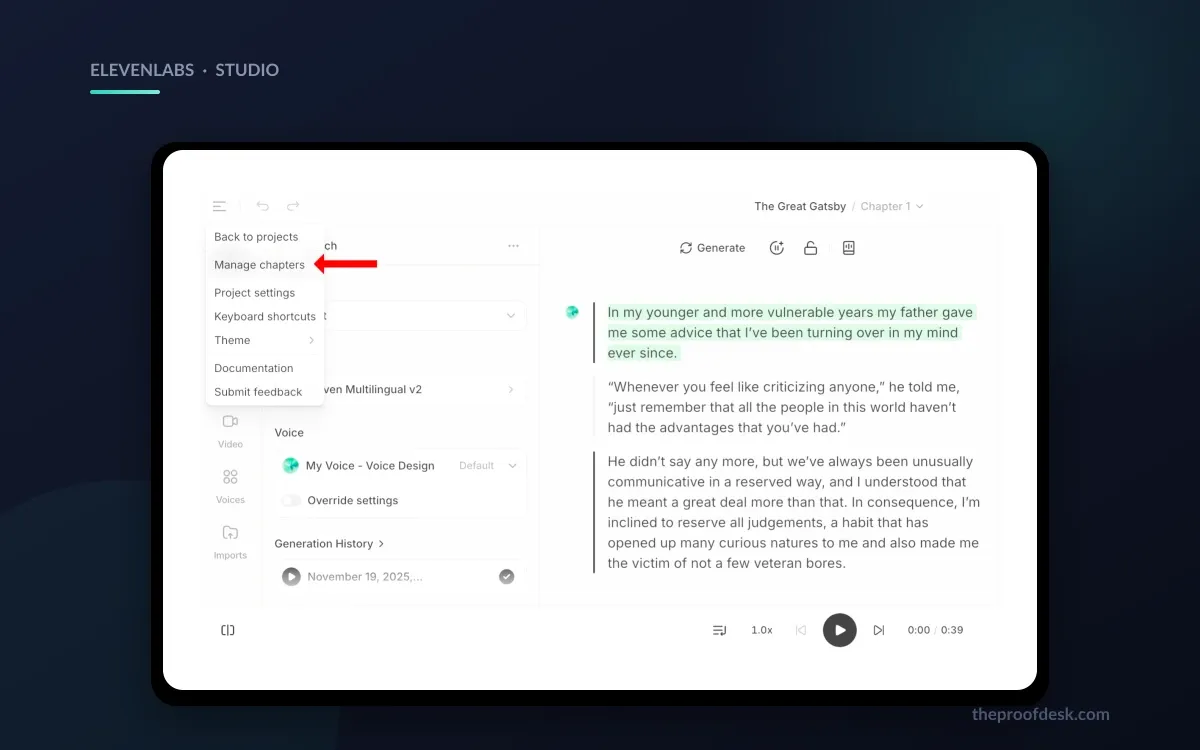
Project counts are capped by plan: 3 on Free, 20 from Starter. The generation history per segment is the feature that matters day to day, because it lets you compare takes rather than regenerate blindly — which, given that every take costs credits, is more than a convenience.
Which model to use, and the latency trade
ElevenLabs ships several models with genuinely different characters, and picking wrong is the most common way to be disappointed by the output.
- Eleven v3 — the flagship. "Our latest and most advanced speech synthesis model", with high emotional range and support for 74 languages, capped at 5,000 characters per generation. The docs warn that "its more variable consistency and higher latency mean it's not suitable for real-time or conversational use cases".
- Eleven v3 Conversational — the realtime sibling, described as "our most expressive model for realtime speech synthesis (~280ms latency)".
- Multilingual v2 — the workhorse for narration. "Most life-like, emotionally rich model… best for voiceovers, audiobooks, and content creation", 29 languages, 10,000 characters per generation.
- Flash v2.5 — the low-latency option, "generating speech in under 75ms" across 32 languages, with a 40,000 character limit. Flash v2 is the English-only version.
- Turbo v2 and v2.5 — legacy, and the docs say they are "outclassed by Flash models".
- Scribe v2 — speech recognition across "90+ languages" with word-level timestamps and speaker diarization. Scribe v2 Realtime returns partial transcriptions in roughly 150ms.
The practical rule: v3 or Multilingual v2 for anything you will publish, Flash for anything a human is waiting on. Do not use the flagship model for a phone agent and then complain about the pause.
One caveat on those latency numbers — the docs footnote them as "excluding application & network latency". They describe the model, not your user's experience.
Agents are billed separately
The conversational Agents platform does not spend credits. It runs on call minutes, and each plan includes an allowance: 15 minutes on Free, 75 on Starter, 275 on Creator, 1,238 on Pro, 3,738 on Scale and 12,375 on Business.
Beyond the allowance it is $0.080 per additional minute, $0.003 per text message, and $0.160 per minute under burst pricing. Burst "allows your agents to handle up to 3 times your normal concurrency limit, with a maximum of 300 calls for non-enterprise customers".
Two details are easy to miss. Silence is discounted — ElevenLabs charges on connection duration but applies "a 95% discount for periods of silence longer than 10 seconds" — and the language model behind the agent is not included: "LLM costs are passed through separately." A quoted per-minute agent rate is therefore a floor, not a total.
Concurrent calls scale with the plan too: 4 on Free, 6 on Starter, 10 on Creator, 20 on Pro, 30 on Scale and 40 on Business.
API concurrency and queueing
If you are building on the API rather than clicking through the site, concurrency is the constraint that will bite first. ElevenLabs publishes limits per plan, and they differ by model family — the Flash and Turbo models get roughly double the slots of everything else.
- Free — 2 concurrent requests on standard models, 4 on Flash and Turbo.
- Starter — 3 and 6.
- Creator — 5 and 10.
- Pro — 10 and 20.
- Scale and Business — 15 and 30.
- Enterprise — described only as "elevated", with the highest queue priority.
Speech to text gets its own, higher allowance. Hitting the ceiling is not a hard failure: "once the concurrency limit is met, subsequent requests are processed in a queue alongside lower-priority requests. In practice this typically only adds ~50ms of latency." Higher plans also carry a higher priority level in that queue, which is the part of a subscription you cannot see on an invoice.
Ownership, training data and the opt-out
On ownership, ElevenLabs is unambiguous about your uploads: "We claim no rights over the files you upload to the platform, except the rights outlined in the Terms of Service, Privacy Policy and Data Processing Addendum."
On training, the default is less comfortable and worth setting deliberately. ElevenLabs states that it "uses certain data you provide to us to improve the quality of our audio models for everyone", while promising that "we don't use your data to clone your voice without your consent or create advertising profiles of you". Enterprise is carved out by default: "By default, we don't train on any data from our Enterprise customers."
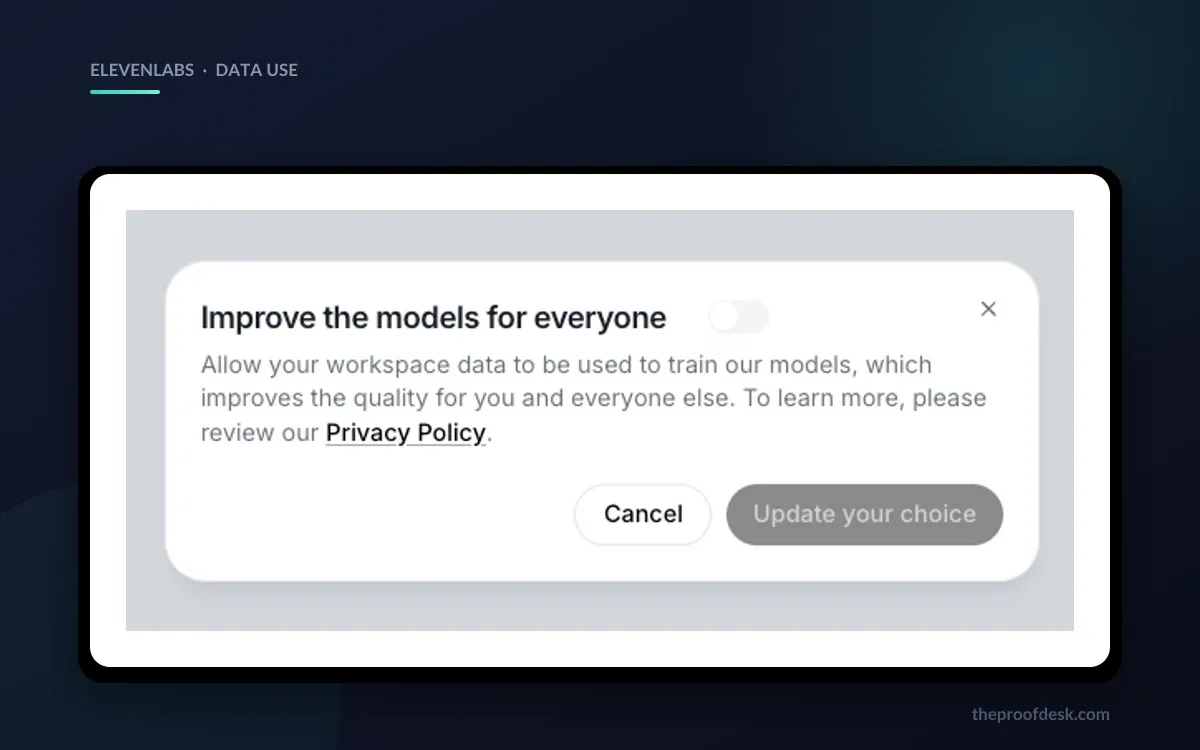
Everyone else can leave: "Anyone can opt out of data use at any time… In the Data use menu, you'll see a toggle called Improve the models for everyone. To stop sharing your data with us, disable the toggle." If you are running client scripts or unreleased material through the platform, that is a first-day setting, not a later one.
One gap worth naming: ElevenLabs does not publish a named zero-retention mode on its self-serve help pages. Enterprise contracts reference custom terms and BAAs for HIPAA customers, but if you need a contractual no-retention guarantee, that is a sales conversation rather than a toggle.
Where it frustrates people
The output quality is not seriously in dispute. The billing model is where the complaints cluster, and they are consistent enough to be worth planning around.
Failed takes cost money. Credits are spent on generation, not on satisfaction, and reviewers on Trustpilot make the point bluntly — "every failed attempt consumes paid credits" — with another describing a mistake that cost them roughly 150,000 credits in one sitting. On a 30,000-credit Starter plan, a bad afternoon of retries is the whole month.
Consistency across a long piece is the second theme, with users reporting that "generated speech randomly changes speed within the same piece of text" and that dubbed output can skip words. Studio's per-segment regeneration exists precisely because this happens; budget review time accordingly.
Support response times draw complaints too, including from otherwise positive reviewers waiting days for a reply.
Read the aggregate ratings with care, because they disagree sharply. Trustpilot sat around 3.0 out of 5 across roughly 1,100 reviews when we checked, while G2's listing runs closer to 4.5. That spread is typical of a product people love using and dislike being billed by.
Finally, the refund window is narrow and conditional: "You are eligible for a refund if a request is filed within 14 days of payment and no credit quota was used in the period for which you are seeking the refund." In other words, trying the product disqualifies the refund. Test on Free first.
Who each plan actually fits
- Free — evaluation only. No commercial licence, no rollover, 2,500 characters per generation. Use it to decide whether the voices work for you, then leave.
- Starter at $6 — the cheapest legal option for published work, and enough for short-form social video or a weekly intro. 30,000 credits goes fast if you touch anything other than text to speech.
- Creator at $22 — the plan most individual creators should be on. It is the entry point for professional voice cloning and for Voice Library payouts, and 121,000 credits is a workable monthly budget for narration.
- Pro at $99 — justified by 44.1kHz PCM and 192kbps output, not by the credits alone. If you are delivering audiobooks or licensed audio, this is the floor.
- Scale at $299 and Business at $990 — team plans. You are buying seats, multiple professional clones and API concurrency, not just a larger balance.
A useful sanity check before subscribing: estimate your monthly output in characters or minutes, convert it at the rates above, then compare against the tier allowance. Most people who feel cheated by ElevenLabs skipped that arithmetic.
Frequently asked questions
How much does ElevenLabs cost in 2026?
Six self-serve tiers: Free at $0 with 10,000 credits, Starter at $6 with 30,000, Creator at $22 with 121,000 (and $11 for the first month), Pro at $99 with 600,000, Scale at $299 with 1,800,000, and Business at $990 with 6,000,000. Annual billing is priced at ten months for twelve, so Creator works out to an effective $18.33 a month.
What does one credit actually buy?
It depends entirely on the product. Text to speech costs 1 credit per character on Multilingual v2, and 0.5 to 1 credit per character on the Flash and Turbo models via the API. Speech to text is 330 credits per minute, sound effects are 200 credits per generation, music is 900 credits per minute, and the voice changer is 1,000 credits per minute. All of it comes from one shared monthly pool.
Which plan do I need to clone my own voice properly?
Creator, at $22 a month. Instant Voice Cloning is available from Starter and works from about ten seconds of audio, but Professional Voice Cloning — the one that produces a convincing replica — starts at Creator and requires a Voice Captcha verification where you read a prompt aloud within a time limit. Scale includes 3 professional clone slots and Business includes 10.
Do unused credits roll over?
On paid plans, yes, for up to two months. Your balance can reach at most three times your monthly quota — the current month plus two months of rollover — and only while the subscription stays active. Rollover does not apply to the free plan, and if you cancel or downgrade, any unused paid credits expire at the end of the cycle. Pay-as-you-go top-up credits are separate and last 12 months.
Can I get a refund from ElevenLabs?
Only if you have not used the product. ElevenLabs grants a refund when the request is filed within 14 days of payment and no credit quota was used in the period being refunded. Cancelling is separate: it takes effect at the end of the current billing cycle, after which the account drops to the free plan and unused credits are lost. Upgrading mid-cycle is not prorated — you pay the new plan's fee and a new billing cycle begins.
Is my audio used to train their models?
By default, yes, below Enterprise. ElevenLabs says it uses certain data you provide to improve its audio models, while stating it will not clone your voice without consent or build advertising profiles. Enterprise customers' data is excluded by default, and anyone else can opt out at any time by disabling the "Improve the models for everyone" toggle in the Data use menu. There is no publicly documented zero-retention mode outside an Enterprise contract.
Key takeaways
- One credit pool feeds every product, and the exchange rates differ by three orders of magnitude — 1 credit per character for speech, 1,000 credits per minute for the voice changer.
- Starter at $6 buys the commercial licence; Creator at $22 buys professional voice cloning. Those two thresholds matter more than the credit counts.
- Pro at $99 is where 44.1kHz PCM and 192kbps output arrive, which is the real requirement for audiobook delivery.
- Credits roll over for two months on paid plans, capped at 3× your quota, and expire entirely if you cancel or downgrade.
- Agents are billed in call minutes, not credits, and the language model behind them is charged separately on top.
- Refunds require that you filed within 14 days and used no credits — so evaluate on the free plan before paying.
- Model training is on by default below Enterprise; the opt-out is a single toggle and worth setting on day one.
More in Artificial Intelligence
Browse Artificial Intelligence