Firebase Review 2026: What Google's App Backend Really Costs Now
Firebase in late 2026: what is still free on Spark, what needs Blaze, Firestore and Auth prices, the Remote Config billing change and the new spend caps.
Firebase is still the fastest way to give a mobile or web app a login screen, a realtime database and push notifications without running a server. What changed in 2026 is the meaning of the word free. Cloud Storage left the Spark plan on February 3, 2026, Remote Config became usage-billed from September 1, 2026, Data Connect was renamed SQL Connect and given a per-operation price, and Firebase Studio is being shut down.
This review works from Firebase's own pricing pages, docs and blog as of late October 2026. It covers what each product costs, which limits bite first, where surprise bills come from, what the new spend caps do and do not protect, and who should pick Firebase over a Postgres-first backend like Supabase.
What Firebase is in 2026
Firebase is Google's app-development platform: a set of managed backend services with client SDKs for Android, Apple platforms, the web, Flutter and more. Every Firebase project is also a Google Cloud project, so anything you outgrow in Firebase can be extended with Cloud Run, BigQuery or Pub/Sub, and billing runs through a Google Cloud Billing account.
The lineup splits into two groups. Some products cost nothing on any plan, and some have a free quota followed by metered prices.
- No-cost on every plan: A/B Testing, App Check, App Distribution, Authentication (most sign-in methods), Cloud Messaging (FCM), Crashlytics, Firebase ML model deployment, In-App Messaging, Performance Monitoring, plus Google Analytics and Gemini in Firebase.
- Free quota, then paid: Cloud Firestore, Realtime Database, SQL Connect, Cloud Storage, Cloud Functions, Hosting and App Hosting, phone Authentication, Phone Number Verification, Extensions, Test Lab, Firebase AI Logic and, since September 2026, Remote Config.
That free group is the real reason teams stay. Crashlytics, FCM push, Analytics and email or social sign-in for up to 50,000 monthly active users cost nothing, and they would each be a separate paid vendor in most other stacks.
Spark vs Blaze: what free really means now
Firebase has two plans. Spark needs no payment method. Blaze is pay-as-you-go and requires a Cloud Billing account with a card on file, but it keeps the same no-cost quotas as Spark, so a small Blaze project often pays nothing.
The difference is what happens at the limit. On Spark, if you exceed the free quota of a product in a calendar month, that product is shut off for the rest of the month. On Blaze, usage keeps going and you are billed for it. Spark also cannot use paid Google Cloud products such as Cloud Run, Pub/Sub or BigQuery streaming for Analytics.
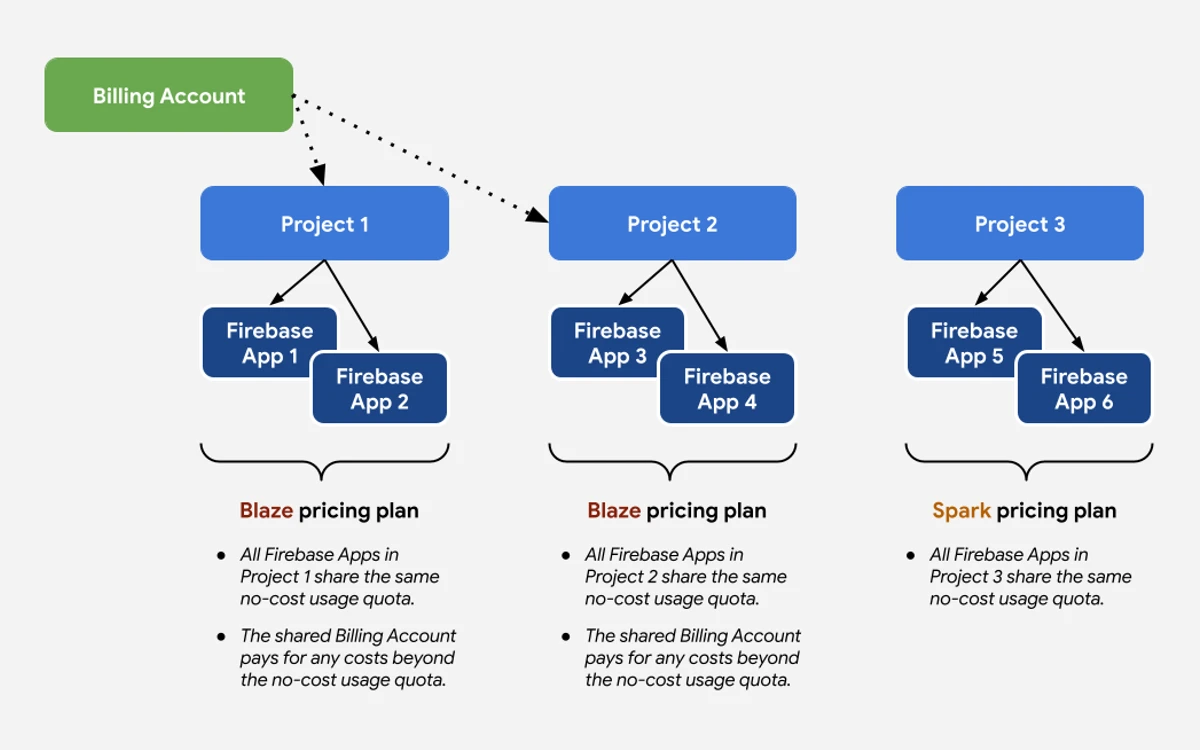
In 2026 the list of things Spark can do got shorter:
- Cloud Storage requires Blaze since February 3, 2026, even for the default bucket. Spark projects lose access to every bucket and API calls return 402 or 403 errors.
- Cloud Functions and App Hosting have always been Blaze-only.
- Remote Config now has a daily free limit, and Spark projects that go over it are throttled after 30 days.
- SQL Connect gives Spark a 90-day database trial, after which the instance is archived unless you upgrade.
In practice, any app that lets users upload a photo now needs a billing account. New Google Cloud customers may get a 90-day trial with $300 in credits, and Firebase says a project on that Free Trial billing account cannot be charged beyond the credits; when the trial ends without an upgrade, the project drops back to Spark.
Downgrading is not a clean undo
Moving a project from Blaze back to Spark keeps your data, but you lose access to non-default Realtime Database instances and non-default Storage buckets, and you can no longer deploy new or existing Cloud Functions.
Firestore, Realtime Database and SQL Connect
Firebase now offers three databases, and they bill in very different ways.
Cloud Firestore
Firestore is the default choice: a document database with offline sync and realtime listeners. The Standard edition free quota is 1 GiB stored, 50,000 reads, 20,000 writes and 20,000 deletes per day, and 10 GiB of network egress per month. On Blaze, Google Cloud lists prices from $0.03 per 100,000 reads, $0.09 per 100,000 writes and $0.01 per 100,000 deletes, with multi-region locations costing more.
Two fine-print rules matter. Only one Firestore database per project gets the free quota, and named extra databases have none. The location of a database cannot be changed after you create it, so pick the region before you write a line of code.
Firestore also closed some long-standing gaps this year. Pipeline queries with search and JOINs went GA in April 2026, and a data modification language with insert and upsert support reached GA on October 22, 2026.
Realtime Database
The original Firebase database still suits presence indicators, chat and live cursors. It is billed by storage and download, not by operation: 1 GB stored free then $5 per GB, and about 10 GB per month downloaded free then $1 per GB. Spark caps it at 100 simultaneous connections; Blaze allows 200,000 per database.
SQL Connect (formerly Data Connect)
Firebase Data Connect became Firebase SQL Connect on April 29, 2026. It is a managed PostgreSQL database powered by Cloud SQL, with generated, typed SDKs. Since May 1, 2026 it costs $0.90 per million operations after 250,000 free operations per month, plus 10 GiB of free egress.
The database underneath is billed separately. Spark projects get one PostgreSQL instance, equivalent to a db-f1-micro with 1 vCPU and 10 GB SSD, free for 90 days with no card. If the project is not on Blaze by the end of that trial, the instance is archived, and 90 days later it is deleted. After the trial, Cloud SQL starts at about $9.37 per month.
Auth, Storage, Functions and Hosting costs
Authentication
Email, password, anonymous and social sign-in are free for the first 50,000 monthly active users. Beyond that, Firebase uses Identity Platform pricing:
- 50,000 to 100,000 MAUs: $0.0055 per MAU
- 100,000 to 1,000,000 MAUs: $0.0046 per MAU
- 1,000,000 to 10,000,000 MAUs: $0.0032 per MAU
- Above 10,000,000 MAUs: $0.0025 per MAU
- SAML and OIDC enterprise sign-in: 50 MAUs free, then $0.015 per MAU
Phone sign-in is billed per SMS, and the rate depends on the country: about $0.01 in the US, $0.04 in the UK, $0.07 in India and $0.10 in Germany. SMS is the Auth line item most likely to surprise you, because bots can trigger it.
Cloud Storage
New default buckets are named PROJECT_ID.firebasestorage.app and follow Google Cloud Storage pricing. The always-free tier covers 5 GB-months of storage, 100 GB of download, 5,000 uploads and 50,000 downloads per month, but only in us-central1, us-east1 and us-west1. Pick any other region and you pay from the first byte. Older appspot.com buckets on Blaze keep the legacy daily quota, then $0.026 per GB stored and $0.12 per GB downloaded.
Cloud Functions
Functions need Blaze. Each month includes 2 million invocations, 400,000 GB-seconds, 200,000 CPU-seconds and 5 GB of outbound data free, then $0.40 per million invocations and $0.12 per GB out. The free allowance is counted per Cloud Billing account, not per project, so an agency running ten client projects on one card shares one allowance. Dart joined the supported languages in May 2026.
Hosting and App Hosting
Classic Hosting for static sites includes 10 GB of storage and 360 MB per day of transfer, then $0.026 per GB stored and $0.15 per GB transferred, with custom domains and SSL included. App Hosting, built for server-rendered frameworks such as Next.js and Angular, requires Blaze. It includes 10 GiB of outbound transfer per month, then $0.20 per GiB uncached or $0.15 per GiB cached, and runs on Cloud Run, whose own free tier covers 180,000 vCPU-seconds, 360,000 GiB-seconds and 2 million requests.
The Remote Config billing change
Remote Config used to be free without limits. Since September 1, 2026, the first 100,000 fetch requests per day stay free on both plans. On Blaze, requests between 100,001 and 10 million per day cost $0.06 per 10,000, and requests above 10 million per day cost $0.01 per 10,000.
Existing projects get a grace period, and the dates are close:
- Existing Spark projects: standard billing starts December 1, 2026.
- Upgrade a Spark project to Blaze before November 15, 2026, and the grace period stretches to five months.
- Existing Blaze projects: standard pricing from February 1, 2027.
Spark projects that exceed the daily limit keep working for 30 days after the first time it happens, then get throttled from day 31, and that countdown does not reset. Blaze projects are never throttled; they are billed.
Only fetches made directly by the Remote Config service count. Fetches made internally by other Firebase products, opening a realtime connection and reading cached values on the device are free, but the download triggered by a realtime server push does count. An app with a few hundred thousand daily users that fetches on every launch can cross 100,000 requests a day, so check the minimum fetch interval before December.
Surprise bills and the new spend caps
For years the standard Firebase horror story was a runaway loop of Firestore reads or Function calls on Blaze, because budgets only send alerts. Firebase's own docs still say budget alerts do not cap your usage or charges, and suggest using budget notifications to switch off billing on a project programmatically.
On September 14, 2026, Firebase added spend caps, in Preview. You set a monthly amount per service, get alerts at 50%, 80% and 100%, and at 100% that service is paused for the rest of the billing month. The cap resets at the start of the next month, and services can take up to an hour to resume after you lift it.
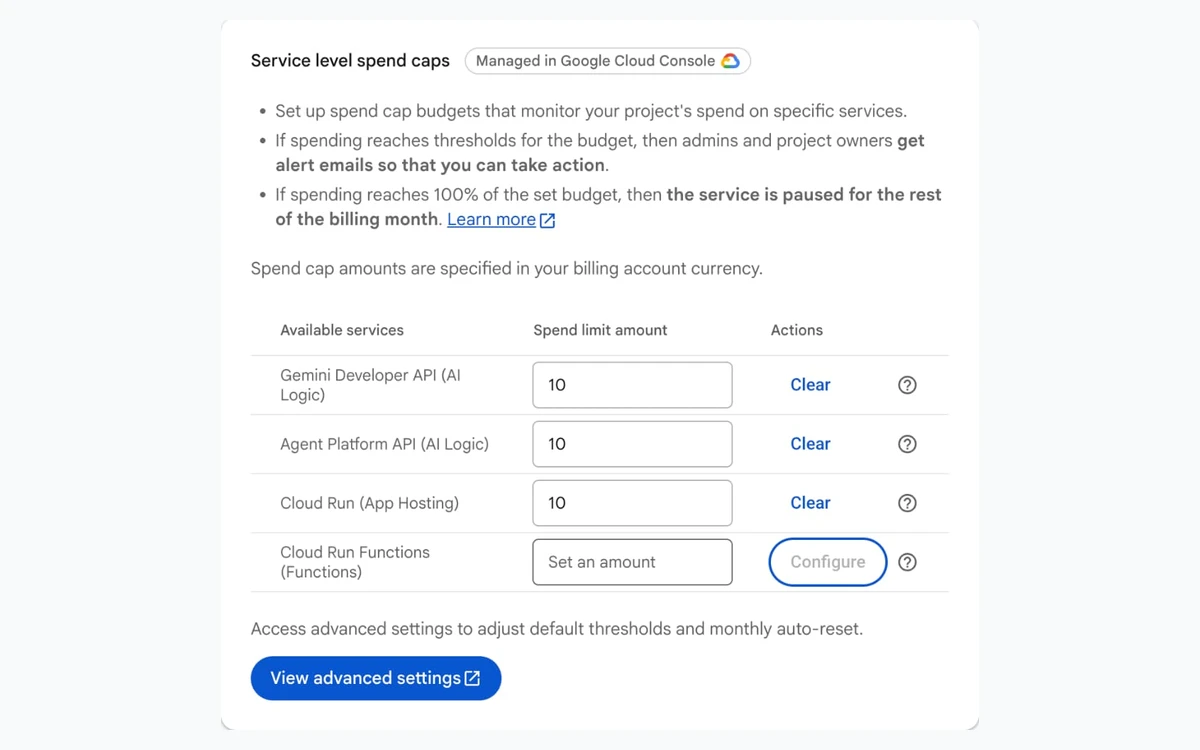
Read the limits before you rely on them:
- They cover only four services: Firebase AI Logic, App Hosting, Cloud Functions and Extensions.
- Firestore, Realtime Database, Cloud Storage and Hosting have no spend cap at all.
- Firebase says they are not hard caps: enforcement can lag by several minutes, and overages during that delay are billed.
- Caps are calculated on gross cost, before free tiers, credits or discounts, so a cap can trip while your actual bill is still near zero.
- Preview means no SLA and the feature may change.
Practical protection
Set a budget alert on the billing account, add spend caps for Functions and AI Logic, turn on App Check for every client, and lock down Firestore and Storage Security Rules before launch. Most runaway database bills come from an open rule or a listener stuck in a loop, and no cap catches those.
AI Logic, I/O 2026 and what is being retired
Firebase AI Logic lets client apps call Gemini models without running your own server, with App Check guarding the API key. AI Logic itself is free; you pay for the Gemini API behind it. The Gemini Developer API free tier works on Spark, paid tiers need Blaze, and the $300 Google Cloud credit cannot be used for the Gemini Developer API, only for the Agent Platform Gemini API (formerly Vertex AI).
At Google I/O on May 19, 2026, Firebase announced support for the latest Gemini 3.x models in AI Logic, Grounding with Google Maps, a template-only mode, App Check replay protection, one-click Firebase setup in Google Antigravity and Agent Skills for Firebase in Android Studio.
Some things are going away, and you should not build on them:
- Firebase Studio: new workspaces and sign-ups stopped on June 22, 2026, and the service shuts down on March 22, 2027, when remaining data is permanently deleted. Google points users to Google AI Studio and Antigravity. The pricing page still lists Studio workspaces, which is out of date.
- Dynamic Links: shut down on August 25, 2025; old links return HTTP 404.
- CocoaPods: Firebase 12 is the last major version published there. The Apple SDK 13.0.0, released October 7, 2026, means moving to Swift Package Manager.
Lock-in, reliability and compliance
Lock-in is the strongest argument against Firebase. Firestore's data model, query rules and Security Rules do not map onto any other database, and the client SDKs are woven through your app code. Leaving is possible but takes work:
- Auth users can be exported to JSON or CSV with the firebase auth:export command, including password hash parameters for import elsewhere.
- Firestore managed export and import only work on projects with billing enabled, so a Spark project cannot use them.
- Realtime Database automatic daily backups to a Storage bucket are a Blaze feature.
- SQL Connect stores data in standard PostgreSQL, which is the most portable option Firebase now offers.
On reliability, the Firebase SLA promises at least 99.95% monthly uptime with service credits below that. Firestore has its own SLA: 99.999% for multi-region and 99.99% for regional databases.
On compliance, Firebase says all of its services have completed ISO 27001 and SOC 1, SOC 2 and SOC 3 evaluations, with some also certified for ISO 27017 and ISO 27018. Under GDPR, Google acts generally as a data processor, and data processing terms apply.
Who should pick Firebase, and who should not
Pick Firebase if you are building a mobile-first app and want Crashlytics, push notifications, Analytics, Remote Config and A/B testing under one console, mostly free. Its offline sync on Android and iOS is still better than most alternatives, and nothing else bundles that much at no cost.
Look elsewhere if your data is relational, you need reporting queries, or you want to be able to leave without a rewrite. A Postgres-first backend like Supabase fits that better; we cover it in our Supabase review. SQL Connect narrows the gap, but it adds Cloud SQL's monthly cost after the trial.
Be careful if your app reads heavily from Firestore. Per-document billing rewards careful data modeling and punishes listeners that re-read large collections, and those costs still have no cap.
Verdict
Firebase in late 2026 is a strong platform with a smaller free tier than its reputation suggests. The no-cost tools are still excellent, Firestore keeps improving, and spend caps finally exist. But Storage now needs a card, Remote Config has a meter, the caps leave out the databases, and Studio is on its way out.
Our advice: put production apps on Blaze from day one, upgrade any Spark project that uses Remote Config before November 15, 2026, keep Storage in a free-tier US region if cost matters, and treat budget alerts and spend caps as smoke alarms rather than a fire door.
Frequently asked questions
Is Firebase still free in 2026?
Partly. The Spark plan needs no card and covers Auth, Firestore, Realtime Database, Hosting, FCM, Crashlytics and Analytics within free quotas. Cloud Storage, Cloud Functions and App Hosting now require the paid Blaze plan, which keeps the same free quotas.
Will Firebase charge me if I go over the free tier?
Only on Blaze. On Spark, a product that exceeds its monthly quota is switched off until the next month. On Blaze, usage beyond the free quota is billed, and budget alerts do not stop it.
Do Firebase spend caps stop all charges?
No. Spend caps are in Preview, cover only AI Logic, App Hosting, Cloud Functions and Extensions, and Firebase says they are not hard caps because enforcement can lag by several minutes. Firestore, Realtime Database, Storage and Hosting have no cap.
When does Remote Config start costing money?
New projects have been billed since September 1, 2026, existing Spark projects from December 1, 2026, and existing Blaze projects from February 1, 2027. The first 100,000 fetches per day are free, and upgrading a Spark project before November 15, 2026 extends its grace period to five months.
How much does Firestore cost after the free tier?
From $0.03 per 100,000 reads, $0.09 per 100,000 writes and $0.01 per 100,000 deletes on Blaze, with multi-region locations costing more. The free quota is 50,000 reads and 20,000 writes per day, for one database per project.
Can I move my data out of Firebase?
Yes, with effort. Auth users export with firebase auth:export, Firestore managed export needs a billing-enabled project, and SQL Connect data sits in standard PostgreSQL. Your app code and Security Rules still need rewriting for another backend.
What happens to Firebase Studio projects?
Firebase Studio shuts down on March 22, 2027, and any data left in it is permanently deleted. New workspaces have been blocked since June 22, 2026, so move projects to Google AI Studio, Antigravity or a local setup now. Core Firebase services are not affected.
Key takeaways
- Spark still needs no card, but Cloud Storage has required Blaze since February 3, 2026.
- Blaze keeps the Spark free quotas, so small production apps often pay little or nothing.
- Remote Config is billed above 100,000 fetches per day; existing Spark projects start December 1, 2026.
- Spend caps cover only AI Logic, App Hosting, Functions and Extensions, and are not hard caps.
- Firestore starts at $0.03 per 100,000 reads; only one database per project gets the free quota.
- Data Connect is now SQL Connect at $0.90 per million operations, plus Cloud SQL after a 90-day trial.
- Firebase Studio shuts down March 22, 2027; do not start new work there.
More in Cloud Computing
Browse Cloud Computing