Technology reviews & practical guides
Fly.io review for late 2026: real Machine prices after the 1 October RAM increase, the 2-hour trial, Managed Postgres from $38, no spending caps, recent outages and what the Sprites refocus means for buyers.
Fly.io runs your app as Firecracker microVMs - it calls them Machines - in 17 regions, billed by the second with no platform fee. For years it was the default answer to "where do I host a small app close to my users for almost nothing". That answer has aged. As of late October 2026 there is no free tier, Machine RAM got 20% more expensive on 1 October, volume snapshots are billable, GPUs are gone, and the company has said its focus is now Sprites, its sandboxes for AI agents.
None of that makes Fly.io a bad platform. The smallest always-on Machine still costs $2.19 per 30 days, the private WireGuard network between regions is genuinely good, and scale-to-zero is on by default. But the fine print matters more than it used to, and most third-party pricing pages still quote numbers that stopped being true this month. This review works from Fly.io's own docs, pricing page, terms and status history, checked on 26 October 2026.
Affiliate offer
Pay-as-you-go microVMs in 17 regions. No free tier, so start with the 2-hour trial and check the usage page early.
Fly.io is a strong fit for developers who are comfortable with a CLI, want their app running in several regions, and will actually read a usage-based bill. It is a weak fit for anyone who needs a hard spending limit, a free hobby tier, phone-speed support without paying for it, or GPUs.
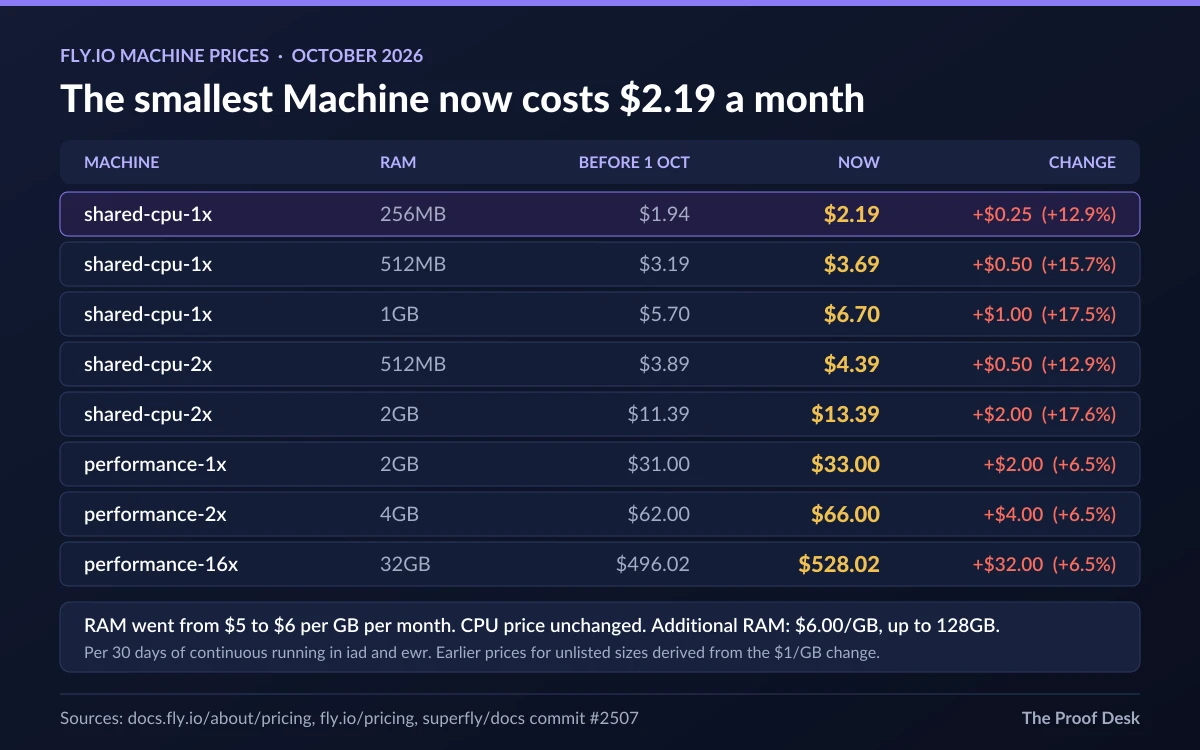
All Machine prices are the post-1 October 2026 rates for iad (Ashburn) and ewr, per 30 days of continuous running. Older articles quoting $1.94 for the smallest Machine or $5/GB for RAM are describing the price list before that date.
You package an app as a container image, and Fly.io boots it as a hardware-isolated microVM on its own servers. A Machine can be a shared-CPU instance with as little as 256MB of RAM or a performance instance up to 16 vCPUs and 128GB. Each shared vCPU comes with 256MB, each performance vCPU with 2GB, and you pay extra per GB on top.
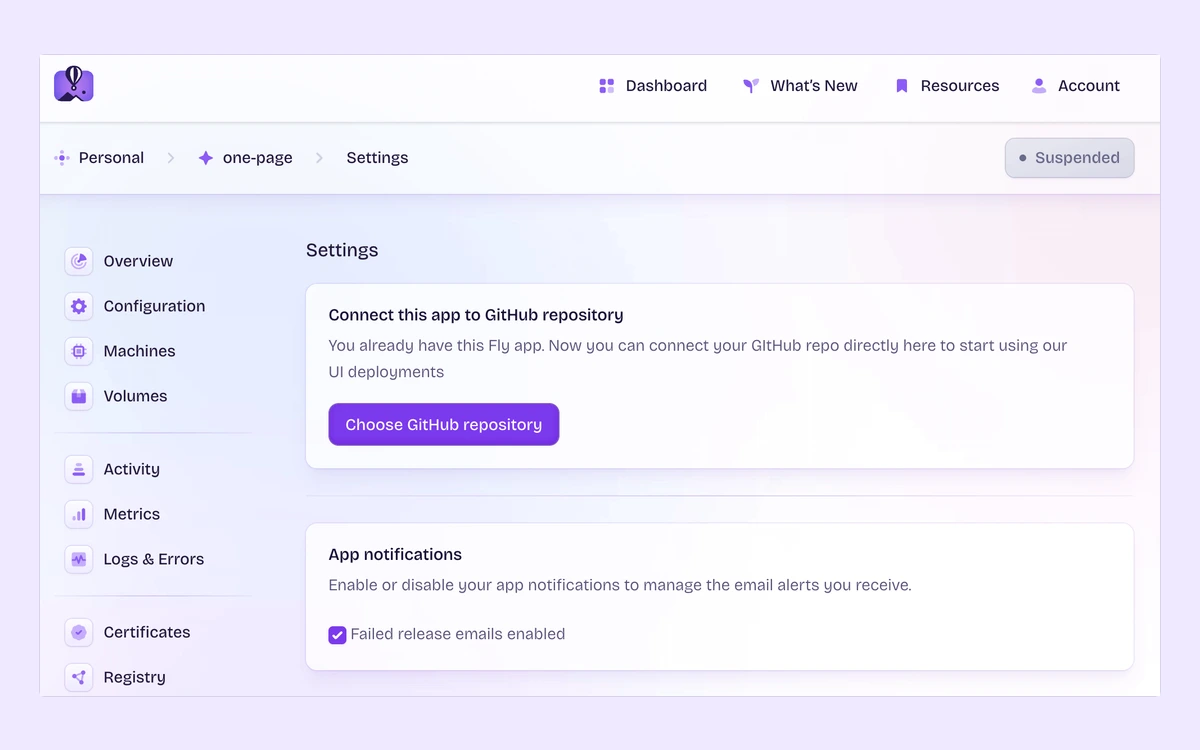
Deploys usually go through flyctl: fly launch scans your project and writes a fly.toml config, and fly deploy builds and ships it. There is also a dashboard flow that connects an app to a GitHub repository for UI deployments. The 17 regions are Amsterdam, Stockholm, Paris, Dallas, Secaucus (ewr), Frankfurt, Sao Paulo, Ashburn (iad), Johannesburg, Los Angeles, London, Tokyo, Chicago, Singapore, San Jose, Sydney and Toronto. Mumbai was removed in September 2026.
Fly.io's docs say autostop/autostart is "what fly launch writes by default": when traffic stops, Machines stop, and the proxy starts them again on the next request. The docs put a cold start at "about 2 seconds or more", while resuming a suspended Machine "takes a few hundred milliseconds". A stopped Machine is not free - you pay $0.15/GB/month for its root filesystem - but that is pennies next to running it.
Every app in an organization joins a mesh of WireGuard tunnels over IPv6 that Fly.io calls 6PN, so a web app in Frankfurt can talk to a database in Ashburn without a public endpoint. flyctl can generate WireGuard configs for your laptop or an outside service. Two regions, Johannesburg and Sao Paulo, have no WireGuard gateway of their own.

Fly.io bills Machines by the second while they run. There is no monthly platform fee, and every organization needs a card on file. These are the 30-day prices in iad and ewr:
On 1 October 2026 RAM went from $5 to $6 per GB per month. CPU pricing did not change; the bundled RAM simply costs more, so the smallest Machine went from $1.94 to $2.19, a 1GB shared Machine from $5.70 to $6.70, and performance-1x from $31.00 to $33.00. Fly.io changed its pricing docs rather than publishing an announcement we could find; third-party write-ups tie the rise to RAM costs driven by AI demand. Memory-heavy apps feel this most: a Machine that is mostly RAM got close to 20% more expensive overnight.

If your usage is steady, Fly.io sells compute blocks a year in advance at a 40% discount: $36/year buys $5/month of shared compute, $360/year buys $50/month, and $3,600/year buys $500/month. Performance blocks start at $144/year for $20/month. The credit does not roll over, applies only to CPU and additional RAM charges, and is tied to a region.
The $2.19 figure is real, but a production app almost always pays for more than a Machine. These are the line items to budget for:
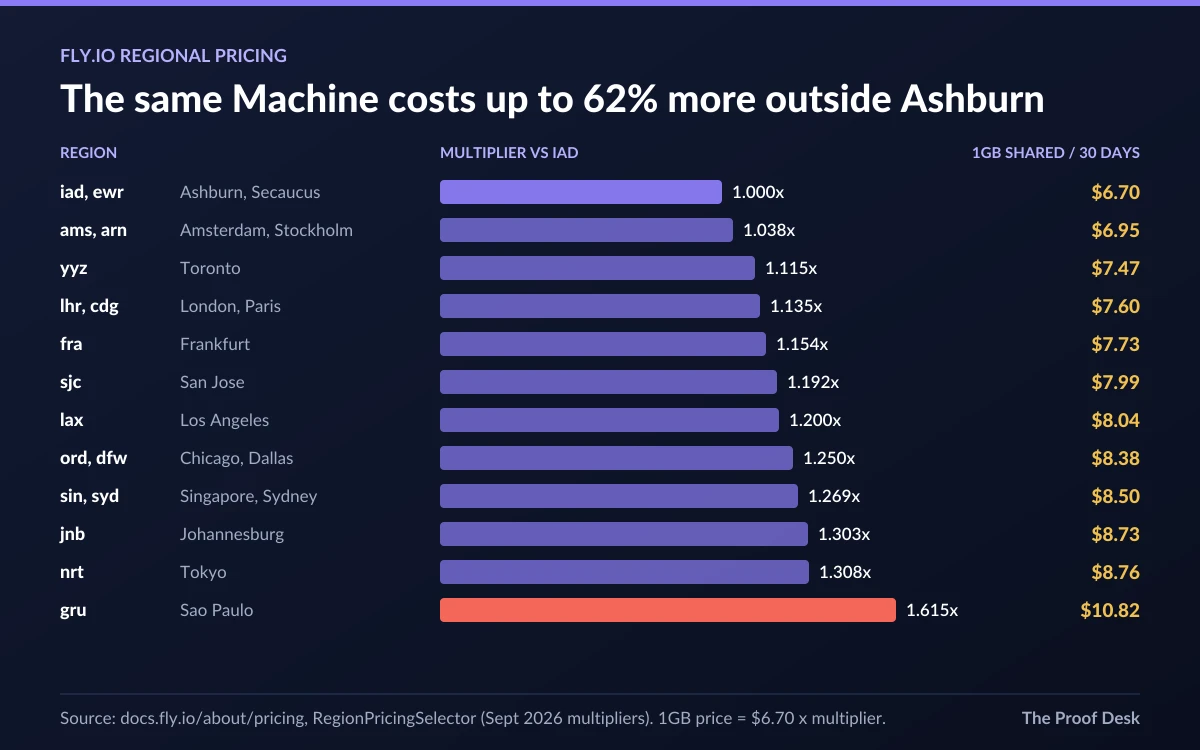
The iad price is the cheapest. Other regions apply a multiplier: Amsterdam and Stockholm 1.038x, Toronto 1.115x, London and Paris 1.135x, Frankfurt 1.154x, San Jose 1.192x, Los Angeles 1.2x, Chicago and Dallas 1.25x, Singapore and Sydney 1.269x, Johannesburg 1.303x, Tokyo 1.308x and Sao Paulo 1.615x. Fly.io's own examples put a 1GB shared Machine at $7.73 in Frankfurt and $8.50 in Singapore. Fly.io corrected wrong multipliers in its docs in late September 2026 (Tokyo had been listed at 2.0x), so recheck any calculator you built before then.

Fly.io's marketing says "Start for free, pay as you grow", but its pricing docs are blunt: "New organizations don't have a free tier or a monthly free usage allowance." What you get instead is a trial: 2 hours of Machine runtime or 7 days, whichever comes first.
Two hours is enough to see a deploy work, not enough to evaluate a real app. Some things stay free after the trial: inbound transfer, shared IPv4 and IPv6 addresses, the first 10 certificates and the first 10GB of snapshot storage each month.
Fly.io stopped selling its Hobby ($5/month), Launch and Scale ($29/month) plans on 7 October 2024. Organizations that bought Launch or Scale before then keep their allowances - up to three 256MB shared Machines, 3GB of volumes and 100GB of North America and Europe egress - unless they switch to Pay As You Go or remove their card. Separately, a Fly.io staff member said on the community forum in November 2025 that bills under $5 are waived for your personal organization only. That is a forum statement, not something in the docs or terms, so do not plan a budget around it.
Two examples at current iad prices, rounded to the cent:
One shared-cpu-1x 256MB Machine running all month is $2.19. With the free shared IPv4, a free certificate and a few GB of egress, the bill stays around $2.20 to $2.50. Let it scale to zero and it can be lower still, at the cost of a cold start of a couple of seconds on the first request.
Run the same two Machines in Frankfurt and they cost $15.46 instead of $13.40. Before 1 October they would have been $11.40 in iad. The database is two-thirds of this bill - which is the honest shape of most small production setups on Fly.io now that unmanaged Postgres is unsupported.
We review Railway and Render on the same terms in our Railway review (/railway-review) and Render review (/render-review). Both offer flatter plan pricing; Fly.io wins on regions and per-second granularity, loses on predictability.
Managed Postgres (MPG) is the supported database. Fly.io's docs list five plans per month:
Storage is billed on usage at $0.28/GB per 30 days, up to 1TB, with up to 500GB at creation. Every plan includes high availability, backups and connection pooling. Since February 2026, inter-region private traffic from MPG is charged at the same rate as Machines. MPG runs in 12 regions; Stockholm, Paris, Secaucus and Johannesburg are not among them.
The old fly postgres route still exists, now labelled "Unmanaged Fly Postgres (Unsupported)". Fly.io estimates about $2/month for a single node or $82 to $164/month for a three-node cluster, but support will not help you with it, and LiteFS is on the same unsupported list. Treat both as do-it-yourself.

This is the part of Fly.io that deserves the most attention. Its cost-management docs say: "there's no soft ceiling. If you go over, we'll bill you. We don't support billing alerts (yet), so budget accordingly." A traffic spike, a runaway autoscale or a forgotten performance Machine is billed in full.
Keep autostop on for anything that does not need to be always-on, set a maximum Machine count in your config, and check the usage page weekly until you trust your pattern. There is nothing on Fly.io that will stop the bill for you.
Fly.io runs its own hardware and network, and its status page is busy. The RSS feed lists 59 items between roughly August and October 2026. Recent incidents by title:
Many of these are regional and short, and Fly.io is unusually open about them - its infra log in March 2026 described a certificate vault failure that took proxies down, a BGP route leak that sent North American traffic to Singapore, and app-scoped IPs deleted by mistake. Openness is good; the frequency is a reason to run at least two Machines, preferably in two regions, for anything that matters.
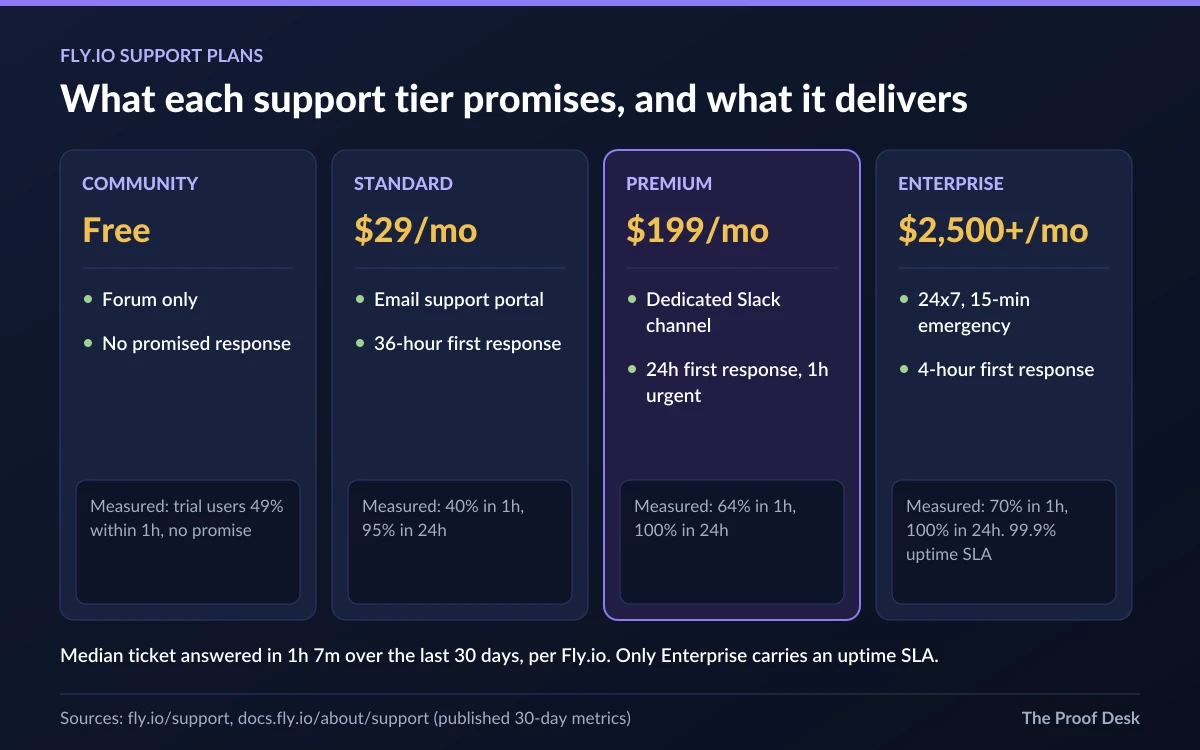
Community forum support is free. Email support through the Support Portal is for paid support plans, legacy Launch and Scale orgs, and MPG customers on database issues.
Fly.io publishes its real numbers, which beat the targets: over the last 30 days it answered the median ticket in 1 hour 7 minutes, with Standard at 40% within an hour and 95% within 24 hours, and Premium and Enterprise at 100% within 24 hours. Note that only Enterprise carries an uptime SLA.

In July 2026 Fly.io raised more money, named Scott Johnston as CEO and said "Computers for Agents are, going forward, the focus of our company." Those computers are Sprites: sandboxed machines for AI agents priced at $0.0385 per CPU-hour and $0.021875 per GB-hour of memory, with no plans or per-Sprite fees. The same post said "Fly Machines and our Platform As A Service features aren't going anywhere", and staff repeated "machines are staying!" on the forum.
We take that at face value, but the pattern this year is a company trimming what it no longer prioritises: GPUs were fully deprecated on 31 July 2026, the Mumbai region closed in September, LiteFS and unmanaged Postgres are unsupported, and RAM prices rose. On the positive side, Fly.io keeps shipping for builders - Litestream VFS with write support in January, and on 23 October a beta MCP server at mcp.fly.io that lets AI tools manage your apps, Machines, volumes and Sprites.
For a buyer this is a medium-term risk, not a reason to panic: keep your app portable (it is a container already), keep backups outside Fly.io, and avoid features the company has marked unsupported.
Fly.io says it is SOC 2 Type 2 audited, runs hardware in ISO 27001 datacenters and will sign a BAA for HIPAA workloads. The BAA is pre-signed by Fly.io and becomes active when you sign it; a DPA is also available. Fly.io does not publish a price for the BAA, so ask before you commit a regulated workload. Microvm isolation per Machine is a real security advantage over container-sharing platforms.
No. New organizations get a trial of 2 Machine hours or 7 days, whichever ends first. After that every running Machine is billed, though inbound traffic, shared IPv4, IPv6, the first 10 certificates and 10GB of snapshots stay free.
A shared-cpu-1x Machine with 256MB of RAM costs $2.19 per 30 days in iad and ewr. Other regions cost up to 1.615x more, and a dedicated IPv4, volumes or egress add to it.
No. Fly.io has no spending caps and no billing alerts. You control cost through autostop, Machine counts and Machine sizes, and by watching usage yourself.
Possibly, at its discretion. Fly.io says it will discuss refunds for resources created by mistake or traffic from an attack if you email [email protected], but there is no automatic refund policy.
From $38/month for the Basic plan with 1GB of RAM, plus storage at $0.28/GB per 30 days. Plans go up to $1,922/month, and all include high availability, backups and connection pooling.
No. Fly.io says Machines and its platform features are not going anywhere, even though its stated focus since July 2026 is Sprites for AI agents. GPUs, however, were retired on 31 July 2026.
Community forum support only. Email support starts with the $29/month Standard plan, except for MPG issues and legacy Launch or Scale organizations.
That was the price before 1 October 2026, when RAM went from $5 to $6 per GB per month. The current smallest Machine costs $2.19.
More in Cloud Computing
Browse Cloud Computing