Heroku Review 2026: Pricing, Limits and the Sustaining Engineering Shift
Is Heroku still worth it in 2026? Dyno and Postgres pricing, what a small app really costs, key limits, and what Salesforce's sustaining engineering model means for you.
Heroku invented the git-push way of shipping web apps, and for more than a decade it was the default answer to "where do I host this?". In 2026 it is a different bet. On February 6, 2026 Salesforce moved Heroku to what it calls a sustaining engineering model, focused on stability, security, reliability and support rather than new features, and stopped offering Enterprise contracts to new customers.
That is not a shutdown. Heroku itself describes the platform as actively supported and production-ready, credit-card customers kept the same prices, and features have kept arriving all year, from 1 GB slugs in March to Postgres 18 by default in October. But there is still no free tier, the cheapest real setup is a few dollars a month, and the long-term roadmap is narrower than it used to be.
This review covers what Heroku costs in 2026, which limits and policies actually bite, what the February change means in practice, and who should still start a new project on it.
What Heroku is in 2026
Heroku is a platform-as-a-service owned by Salesforce. You push code from Git (or connect a GitHub repo), a buildpack detects the language and builds a slug, and the platform runs it on containers called dynos. Databases, caches and hundreds of third-party services attach as add-ons, and configuration lives in environment variables.
There are now two generations of the platform. Cedar is the classic runtime most apps still use. Fir is the Kubernetes-based next generation, generally available since April 14, 2025 through Fir Private Spaces. In October 2026 Cloud Native Buildpacks also came to Cedar-generation apps, so the build tooling is converging.
Heroku has also leaned into the Salesforce ecosystem. Heroku AppLink, generally available since July 14, 2025, exposes Heroku apps as API services inside Salesforce for Flow, Apex, Data Cloud and Agentforce, and Heroku AI offers managed model inference billed per token.
The February 2026 change: sustaining engineering
In a post titled "An Update on Heroku", Heroku's chief product officer Nitin T Bhat wrote that Heroku "is transitioning to a sustaining engineering model focused on stability, security, reliability, and support", with "an emphasis on maintaining quality and operational excellence rather than introducing new features."
What changed and what did not:
- Credit-card customers, existing and new, continue "with no changes to pricing, billing, service, or day-to-day usage."
- Apps, pipelines, teams and add-ons are unaffected.
- Enterprise Account contracts are no longer offered to new customers. Existing Enterprise subscriptions and support contracts are honored and may renew as usual.
- Salesforce said it is focusing investment on areas such as helping organizations build and deploy enterprise-grade AI.
Sustaining engineering has not meant zero product work. After the announcement Heroku shipped a larger 1 GB default slug size, longer build timeouts and CLI v11 (March), fine-grained access controls for all customers (August), Team Authorizations for team-owned API tokens (September), and Heroku Postgres Advanced, Postgres 18 as the default and a front-end buildpack for static sites (October).
How to read it
No sunset date has been announced and no migration is being forced. The practical risk is slower innovation over the life of your project, not a sudden shutdown. Many articles on the change are written by competing hosts or migration vendors, so weigh their framing accordingly.
Dyno pricing
Heroku has had no free dynos since November 28, 2022, when free dynos, free Postgres and free Key-Value Store plans were removed. A payment method on file is required to verify an account. Prices below are the maximum per month for a dyno running 24/7 on the Cedar Common Runtime.
- Eco - $5/month flat for a pool of 1,000 dyno hours, 0.5 GB RAM, sleeps after 30 minutes without web traffic, personal accounts only, 2 process types.
- Basic - $7/month, 0.5 GB RAM, always on, up to 10 process types, free SSL.
- Standard-1X - $25/month, 0.5 GB RAM. Standard-2X - $50/month, 1 GB RAM. Standard adds horizontal scaling, metrics and alerts, preboot zero-downtime deploys and unlimited process types.
- Performance-M - $250/month, 2.5 GB. Performance-L - $500/month, 14 GB. Performance-L-RAM - $500/month, 30 GB. Performance-XL - $750/month, 62 GB. Performance-2XL - $1,500/month, 126 GB. Performance tiers add dedicated compute and autoscaling.
Private Space dynos, which give you network isolation and more regions, start at $125/month for Private-S (1 GB) and run up to $1,500 for Private-2XL. Shield dynos for HIPAA (with a BAA) and PCI workloads range from $150 to $1,800. Fir-generation dynos require a Private Space, with Classic 1CPU-0.5GB at $25 and General Purpose 4GB at $80 among the options.
How billing works
Everything except Eco is usage-based and charged on wall-clock time, not CPU time. Any dyno scaled above zero accrues cost whether or not it serves traffic, and Heroku "prorates all costs to the second" - its own example puts a $7 Basic dyno at about $0.01 an hour. Scale a dyno to zero and its charges stop. Eco is the exception: it is a flat $5 for every subscribed month, used or not, and subscribing after the 1st still costs the full $5 for that month.
Eco is a pool, not a dyno
The 1,000 Eco hours are shared by every Eco dyno in the account. That covers one dyno awake all month (about 730 hours) but not two. Eco web dynos sleep when idle and take a short delay to wake, while Eco worker-only apps never sleep and can burn hours around the clock.
Postgres and Key-Value Store pricing
Heroku Postgres is still one of the platform's strongest parts, and the range now runs from $5 hobby databases to multi-terabyte clusters.
Essential (shared)
- Essential-0 - $5/month, 1 GB storage, 20 connections.
- Essential-1 - $9/month, 10 GB storage, 20 connections.
- Essential-2 - $20/month, 32 GB storage, 40 connections.
Essential plans allow up to 4 hours of downtime a month, have a 4,000-table limit and are encrypted at rest. They run on shared hardware, so there is no dedicated RAM figure.
Classic dedicated plans
Standard-0 costs $50/month with 4 GB RAM, 64 GB disk, 120 connections, 4-day rollback and at most 1 hour of downtime a month, scaling up to Standard-10 at $12,000. Premium adds high availability, 7-day rollback and at most 15 minutes of downtime a month, from $200 (Premium-0) to $24,000 (Premium-10). Private databases start at $300.
Postgres Advanced
The new Advanced tier, available to all teams since October 2026, decouples storage from compute. Each cluster includes the first 100 GB-month of storage and can grow to 100 TB, with zero-downtime scaling, follower pools and configurable high availability. Prices depend on where it runs:
- 4G-Performance (2 vCPU, 4 GB, 400 connections) - $150 Common Runtime, $180 Private, $210 Shield.
- 8G - $300 / $360 / $420.
- 16G - $500 / $600 / $700.
- 32G (4 vCPU, 32 GB, 3,200 connections) - $900 / $1,080 / $1,260.
Check backups before moving to Advanced
Heroku's documentation states that Heroku PGBackups isn't supported on Heroku Postgres Advanced yet. If your recovery plan depends on PGBackups, plan an alternative before migrating.
What a realistic app costs
Using list prices from Heroku's pricing page, here is what typical setups add up to per month, before third-party add-ons:
- Side project that can sleep: Eco $5 + Essential-0 Postgres $5 = $10.
- Small always-on production app: Basic $7 + Essential-0 $5 = $12, or $15 with a Mini Key-Value Store for caching or job queues.
- Small team app with zero-downtime deploys and a dedicated database: Standard-1X $25 + Standard-0 Postgres $50 = $75.
- Anything that needs an Asia-Pacific region: a Private Space, with Private-S dynos from $125 each.
Background workers are billed as separate dynos, so a web plus worker app on Basic is $14 in dynos rather than $7. Add-ons from the Elements Marketplace are priced individually and appear on the same bill.
Students
The only no-cost route is the GitHub Student Developer Pack offer for members aged 18+: $312 of platform credit, applied at $13 a month over 24 months. A card is still required, usage above $13 a month is charged, and credits start on the 1st of the month you are approved, so apply early in a month.
Developer experience
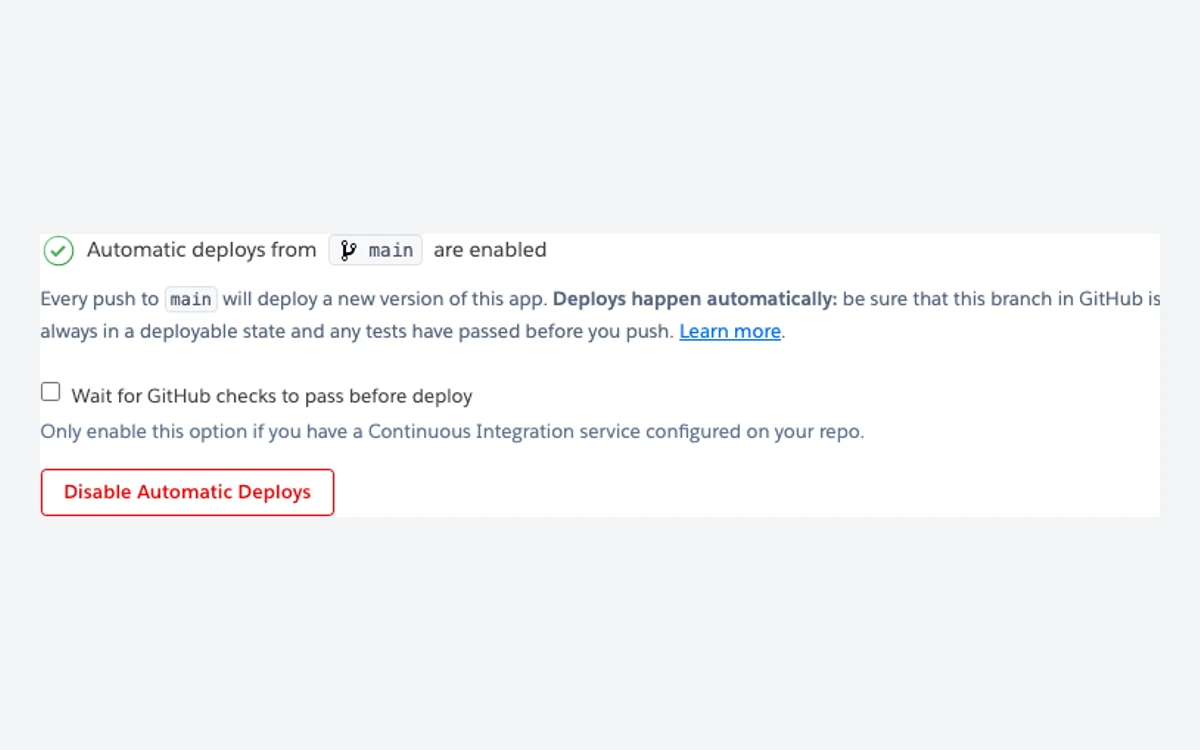
The workflow is why people still choose Heroku. Connect a GitHub repository in the Deploy tab, turn on automatic deploys for a branch, and every push builds and releases without a CI script. Rollbacks are one click, and config vars, logs and scaling all live in one dashboard or the CLI.
Pipelines group apps into stages such as staging and production and let you promote the exact same build forward instead of rebuilding it. Review apps spin up a disposable copy of the app for each pull request, which is still one of the cleanest preview-environment setups available.
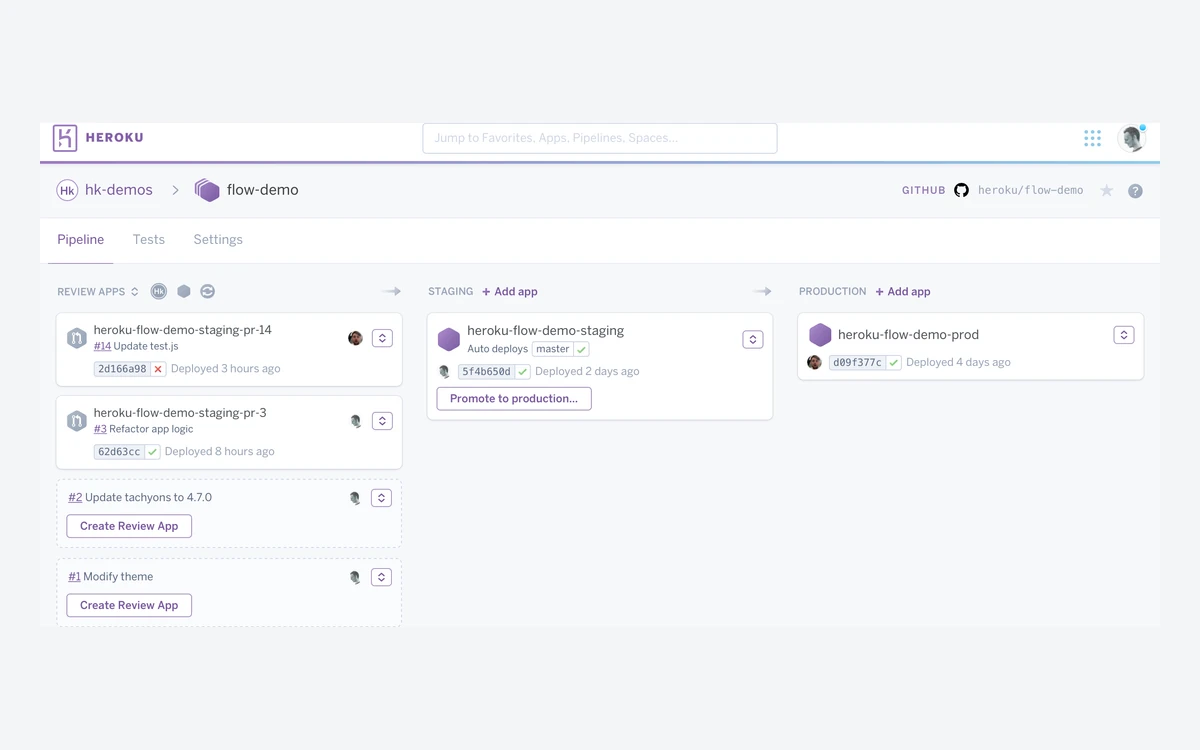
Team features improved in 2026. Fine-grained access controls let you grant view, deploy, operate or manage roles per app, and Team Authorizations make API tokens and OAuth grants belong to the team, so integrations keep working when the person who set them up leaves. Heroku CLI v11 moved to ESM and oclif v4 and introduced breaking changes in legacy namespaces, so check scripts that call older commands.
Limits and platform behavior that matter
Most limits are generous for small apps, but a few shape how you build:
- Daily restarts: dynos restart at least once every 24 hours, plus up to 216 random minutes, including one-off dynos. Deploys and config changes reset the clock. Fir apps can opt out through a Labs flag.
- 30-second router timeout: a web request must start returning data within 30 seconds or it fails with an H12 error, after which a rolling 55-second idle window applies. Long work belongs in a worker dyno.
- Logs: only the latest 1,500 log lines are kept, so add a logging add-on for anything you need to search later.
- Builds: max compressed slug 1,000 MB (raisable via support), 25-minute slug compilation, about 12 GB of build memory, repository checkout up to 1 GB uncompressed.
- Accounts: 100 apps per account (200 for Enterprise teams), 4,500 Platform API calls per hour, and an add-on can attach to at most 100 apps.
- Regions: Common Runtime apps run only in the US or Europe. Dublin, Frankfurt, London, Montreal, Mumbai, Oregon, Singapore, Sydney, Tokyo and Virginia are available through Private Spaces.
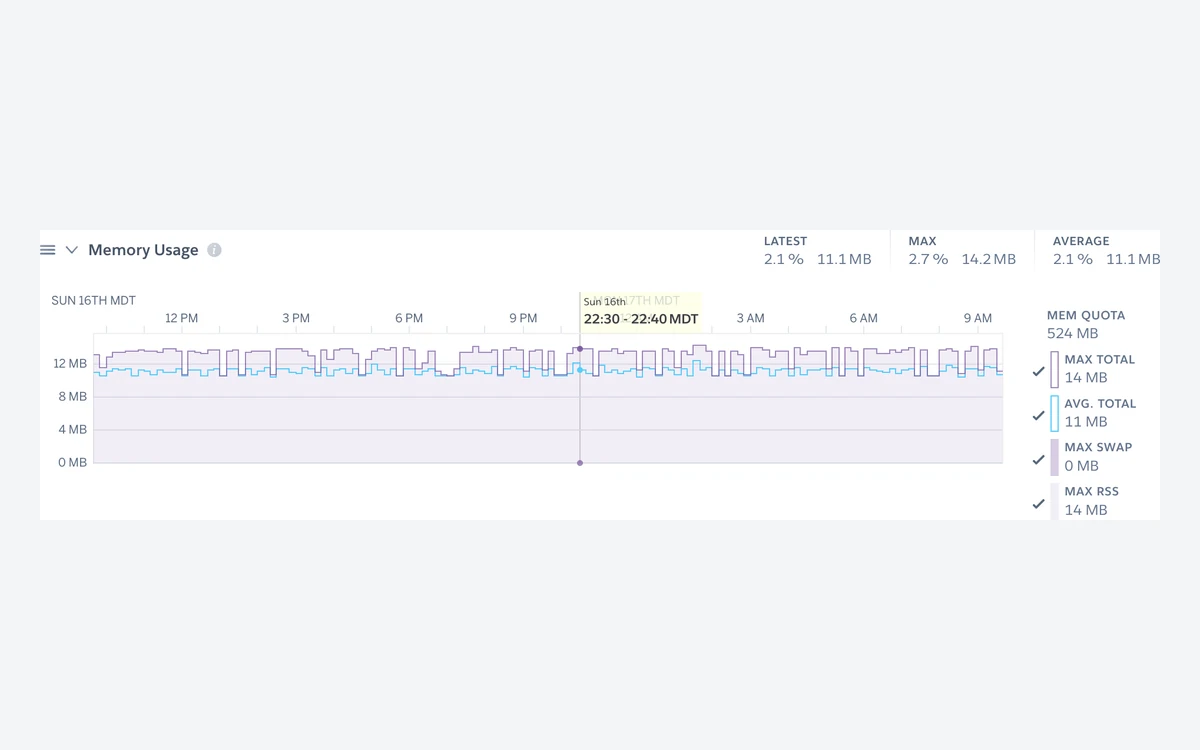
Ephemeral filesystems are a further constraint: anything written to a dyno's disk disappears on restart, so uploads must go to object storage. That is standard for container platforms, but it surprises people moving from a VPS.
Reliability and support
Heroku's track record is long and mostly steady, but its worst recent incident was serious. On June 10, 2025 an unintended automated operating-system update broke dyno networking and caused up to 24 hours of downtime for many customers. Heroku's own status page ran on the affected infrastructure, which made communication harder. Heroku said it was not a security incident and no data was lost; it was resolved at 05:50 UTC on June 11.
Support comes in three tiers: Standard Success (self-guided), Premier Success and Signature Success with a technical account manager. Business hours are Monday to Friday, 9am to 9pm Eastern, excluding US holidays. With Enterprise contracts closed to new customers, new teams should assume they will be on the standard self-serve path.
Heroku AI and the Salesforce angle
Heroku Managed Inference and Agents sells model access per token. Examples from the pricing page: claude-4-5-haiku at $1.10 input and $5.50 output per million tokens, claude-opus-4-5 at $5.00 / $25.00, later Opus versions at $5.50 / $27.50, cohere-embed-v4 at $0.12 per million input tokens and Stable Image Core at $0.04 per image. MCP servers run on pay-as-you-go one-off dynos.
For teams already deep in Salesforce, this plus AppLink and Heroku Connect is the strongest reason to pick Heroku over a generic host: apps, data and agents sit next to the CRM with Salesforce-native integration. For everyone else it is a convenience rather than a deciding factor.
Heroku vs Render, Railway and Fly.io
The newer PaaS hosts copied Heroku's workflow and compete hard on price and features, and unlike Heroku they are still expanding their products. We cover them in our Render, Railway and Fly.io reviews. In broad terms:
- Choose Heroku for its maturity, the depth of the add-on marketplace, very well documented behavior, pipelines with review apps, managed Postgres up to large dedicated clusters, and Salesforce integration.
- Look elsewhere if you need a free tier, Asia-Pacific regions without paying for Private Spaces, long-running HTTP requests, or confidence that the platform will keep adding major features for years.
Moving off Heroku later is usually manageable because apps built for it follow twelve-factor conventions: config in environment variables, stateless processes and attached backing services. That lowers the lock-in risk of starting here.
Verdict: who should use Heroku
Heroku is still a polished, dependable place to run a web app, and a small production setup costs about $12 to $15 a month. For existing customers the February 2026 change alters very little: prices held, the platform is supported, and useful features keep landing.
For a brand-new project the question is time horizon. If you value a proven workflow today, are in the Salesforce ecosystem, or want managed Postgres without operating it, Heroku is a reasonable choice. If you need a free tier, cheap global regions or a platform that is clearly investing in new capabilities, a newer PaaS will likely fit better.
Frequently asked questions
Is Heroku shutting down?
No. In February 2026 Heroku moved to a sustaining engineering model and stopped selling Enterprise contracts to new customers, but it describes the platform as actively supported and production-ready, and no sunset date has been announced.
Does Heroku have a free tier in 2026?
No. Free dynos, free Postgres and free Key-Value Store plans were removed on November 28, 2022. The cheapest option is the $5 Eco plan, and the only free route is the GitHub Student offer of $13 a month in credit for 24 months.
How much does a small Heroku app cost per month?
About $12 for an always-on Basic dyno with Essential-0 Postgres, or $15 with a Mini Key-Value Store. A sleeping Eco side project with a database is around $10.
Do Eco dynos sleep?
Yes. Eco web dynos sleep after 30 minutes without web traffic and wake on the next request after a short delay. The $5 plan gives 1,000 hours shared by all Eco dynos in the account, enough for one dyno running all month but not two.
Will I be charged if my app gets no traffic?
Yes, for any dyno scaled above zero. Billing is on wall-clock time and prorated to the second, so scale dynos to zero to stop charges. Eco is a flat $5 for every subscribed month regardless of use.
Can I host a Heroku app in Asia or Australia?
Only with Private Spaces. Common Runtime apps run in the US or Europe, while Private Spaces add regions including Mumbai, Singapore, Sydney and Tokyo, with Private-S dynos from $125 a month.
Does Heroku need a credit card?
Yes. A payment method on file is required to verify an account and pay for resources, including for the GitHub Student offer.
Why does my request fail after 30 seconds?
Heroku's router requires a response to start within 30 seconds, otherwise it returns an H12 error. Move slow work to a background worker and have the web request return immediately.
Key takeaways
- Heroku is in sustaining engineering since February 6, 2026, but it is supported, prices are unchanged and features still ship.
- There is no free tier; Eco is $5 for a shared 1,000-hour pool that sleeps, and always-on starts at $7 with Basic.
- A small production app with Postgres runs about $12 to $15 a month; Standard dynos plus a dedicated database is about $75.
- Plan around daily dyno restarts, the 30-second request timeout, 1,500-line log retention and US/EU-only Common Runtime regions.
- Postgres Advanced brings decoupled storage up to 100 TB from $150 a month, but PGBackups isn't supported on it yet.
- Best fit: teams that want a proven workflow or Salesforce integration; look elsewhere for free hosting or a fast-moving roadmap.
More in Cloud Computing
Browse Cloud Computing