HeyGen Review 2026: Credits, Digital Twins and the Real Cost
HeyGen turns a script into an on-camera avatar video. We break down the 2026 credit pricing, how fast credits burn per avatar engine, the consent rules for custom avatars, and the traps in pausing and cancelling.
HeyGen sells the same promise as every AI video tool: paste a script, pick a presenter, get back a finished video with no camera, no studio and no voice actor. What makes HeyGen worth a careful look in 2026 is not the avatars, which are good, but the meter behind them. In May 2026 the company retired its old Unlimited plans and moved everyone onto credits, and credits are where the real cost of this product lives.
The sticker prices are easy to read. The credit table is not, because a minute of video can cost you 4 credits or 48 credits depending on which avatar engine renders it — a twelvefold spread that the plan page does not put in front of you. Two people on the same $29 plan can get wildly different amounts of video out of it.
This review works through what each plan actually includes, how fast credits drain per feature, what HeyGen requires before it will build an avatar of a real person, and the specific places — pausing a plan, cancelling one, downgrading to Free — where credits and avatar slots quietly disappear. Every figure below comes from HeyGen's own pricing page, help centre and API docs, checked in August 2026.
What HeyGen actually does
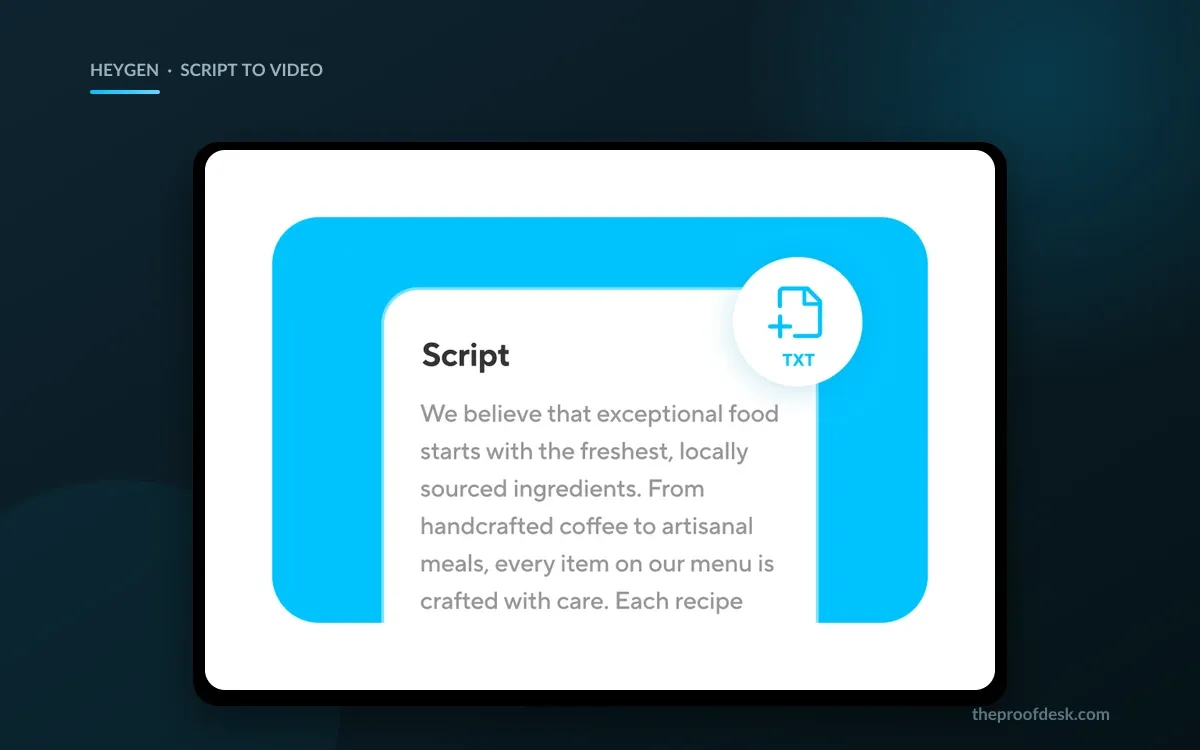
HeyGen is a browser-based studio built around synthetic presenters. You supply a script as typed text, an uploaded TXT file or an audio track; you choose an avatar and a voice; the platform renders a video in which that avatar delivers your words with matched lip movement, and you export an MP4. Around that core sit the pieces you would expect from a video editor — scenes, captions, background music, stock elements, brand templates and layers.
Three product lines matter for buyers. Avatar Studio is the script-to-video editor. Video Translate takes an existing video and re-voices it in another language, optionally re-syncing the lips. Digital Twin is the custom avatar built from footage of a real person — usually you. Each one bills from the same pool of monthly credits, which is why understanding the credit table matters more than comparing plan prices.
HeyGen pricing in 2026
There are four public tiers plus Enterprise. All prices are USD, and annual billing takes roughly 17% off the monthly rate.
- Free — $0. No monthly credits at all; instead you get one to three free videos depending on your region, plus three Video Agent videos a month, capped at one minute each. Videos carry a HeyGen watermark that cannot be removed. One custom avatar slot, up to three photo avatars, one voice clone, 30+ languages.
- Creator — $29/mo, or $24/mo billed annually ($288 for the year). 600 credits a month, 1080p export, watermark removal, Video Translate, unlimited photo avatars and voice clones, 175+ languages, videos up to 30 minutes.
- Pro — from $49/mo, or $41/mo billed annually ($488 for the year), for 1,000 credits. Pro is a ladder of identical tiers that differ only in credit allocation: 1,500 credits at $74, 2,000 at $99, 3,000 at $149, 5,000 at $240, and on up to 100,000 credits at $4,300/mo. Adds 4K export.
- Business — $149/mo, or $119/mo billed annually ($1,428 for the year), for the first seat, plus $20 per additional seat per month. 1,500 credits, 4K export, brand kit, SSO, priority support, videos up to 60 minutes.
- Enterprise — contact sales. Custom pricing, no video duration cap, and the only tier with contractual data protections that are on by default.
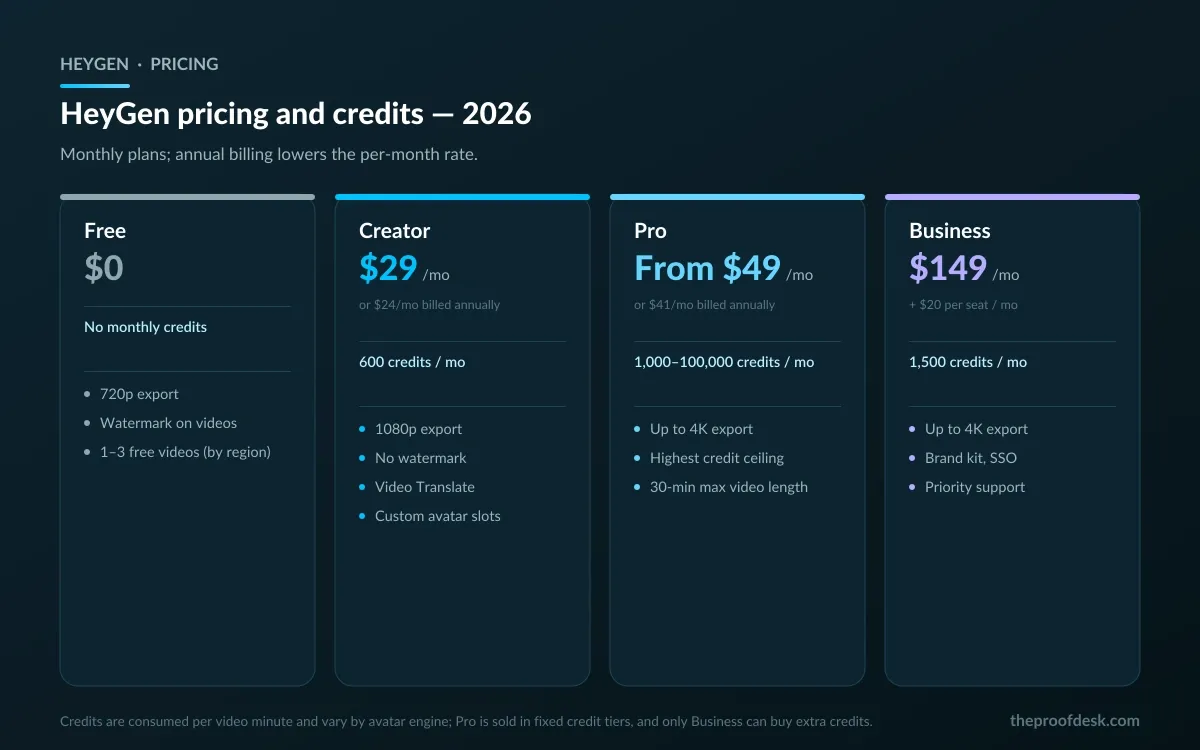
One structural detail catches people out on Business: extra seats do not bring extra credits. HeyGen's help centre is explicit that the credit pool is shared across everyone in the space, so a five-person team on Business is dividing the same 1,500 credits five ways while paying $80/mo for the extra seats.
Legacy Unlimited plans are a one-way door
If you signed up before May 2026 you may still be on a legacy Unlimited plan. HeyGen lets you keep it as long as the subscription stays active and paid, but the door only swings one way: "If you cancel your legacy plan or switch to a credit-based plan, you will not be able to switch back to the old legacy plan." Think hard before touching that subscription.
How fast credits actually burn
A credit is not a minute. What a minute of video costs depends entirely on which engine renders it, and the spread is enormous. These are HeyGen's published rates:
- Avatar III — 4 credits per minute for a video look, 7 for a photo look. The cheap, older engine.
- Avatar IV — 16 credits per minute for a photo look, 31 for a video look.
- Avatar V — 48 credits per minute, photo or video. The newest, highest-fidelity engine.
- Video Translation — 4 credits per minute audio-only, 6 for Speed mode with lip sync, 10 for Precision lip sync.
- Video Agent — 40 credits per minute in standard mode, 120 in Seedance mode.
- One-off costs — AI model training 60 credits per training run, generated images 2 credits each, Motion Designer assets 3 credits each, VEO3 video assets 90 credits regardless of length.
Run those numbers against the allocations and the picture changes. Creator's 600 credits a month is 150 minutes of Avatar III video — genuinely a lot — but only 12 and a half minutes of Avatar V. Pro's entry tier of 1,000 credits is about 20 minutes of Avatar V. If you want the best-looking output HeyGen makes, you are on a far smaller plan than the price suggests.
Rollover is more generous than most competitors. Monthly subscribers carry unused credits into one additional billing cycle; annual subscribers accumulate them until the annual renewal date. Note that annual plans do not front-load the year's credits — they arrive monthly on your billing anniversary.
Pausing wipes your credit balance
Pausing is not a safe halfway house between keeping and cancelling. HeyGen's own cancellation article states that pausing "expires your credit balance entirely. Any unused credits will be permanently lost when the pause takes effect." A pause only postpones the next charge by 30 days, and you pay for it with every credit you were saving.
Topping up is only possible on one tier. Creator cannot buy one-off credits at all — the documented remedy is to upgrade to Pro. Pro has no credit packs either; you move up the tier ladder instead. Only Business can buy extra credits, at $0.05 per credit in blocks of 100 for $5, with optional auto-reload. At that rate a minute of Avatar V costs $2.40 in overage.
One reassurance, and it is in writing: failed and cancelled renders do not cost you. HeyGen states that "if a video is cancelled mid-way or failed - you will not be charged any Credits under any circumstances," and that video translations of unsupported source languages fail instantly without consuming credits. Third-party complaint threads claim otherwise; the documented policy is unambiguous, and it is the thing you would cite in a support ticket.
Custom avatars and the consent rules
Stock avatars come with every plan, though HeyGen cannot keep its own count straight: the pricing page advertises 500+ on Free and 700+ on paid tiers, while the avatars marketing page claims 1,100+. Treat any specific number with suspicion and judge the library by browsing it.
The more interesting product is the Digital Twin — an avatar of a real person built from real footage. HeyGen asks for at least two minutes of uninterrupted speech to camera, and recommends up to five for better training results, though it also offers a quick path where a 30-second phone or webcam recording gets you started and extra looks are added later.
Every video-based Digital Twin requires a consent video, recorded separately and submitted at the same time as the footage. It must be under 30 seconds, must feature the same person as the footage, and cannot be a recording of a screen playing the consent statement back. If you are building an avatar for someone else, that person records their own consent video — they can do it remotely by scanning a QR code from their phone, but they must do it themselves. HeyGen also refuses footage generated by other AI platforms.
Slot counts are the one place where HeyGen's documentation openly contradicts itself. The Digital Twin FAQ says Free gets one slot and Creator, Pro and Business each get five. The newer credit-pricing article says Creator and Pro get one slot and only Business gets five. Both pages are live and current. If avatar slots are central to your buying decision, ask support in writing before you pay. Extra video avatar slots are an add-on at $29/mo — listed as $288/year on one page and $300/year on another. Each slot supports up to 500 looks from a single consent video, and you can redo an avatar once per billing cycle by deleting the current one and starting over.
Video Translate
Video Translate is the feature most likely to justify the subscription on its own. You upload an existing video, pick target languages, and get back a re-voiced version — optionally with the speaker's lips re-synced to the new audio.
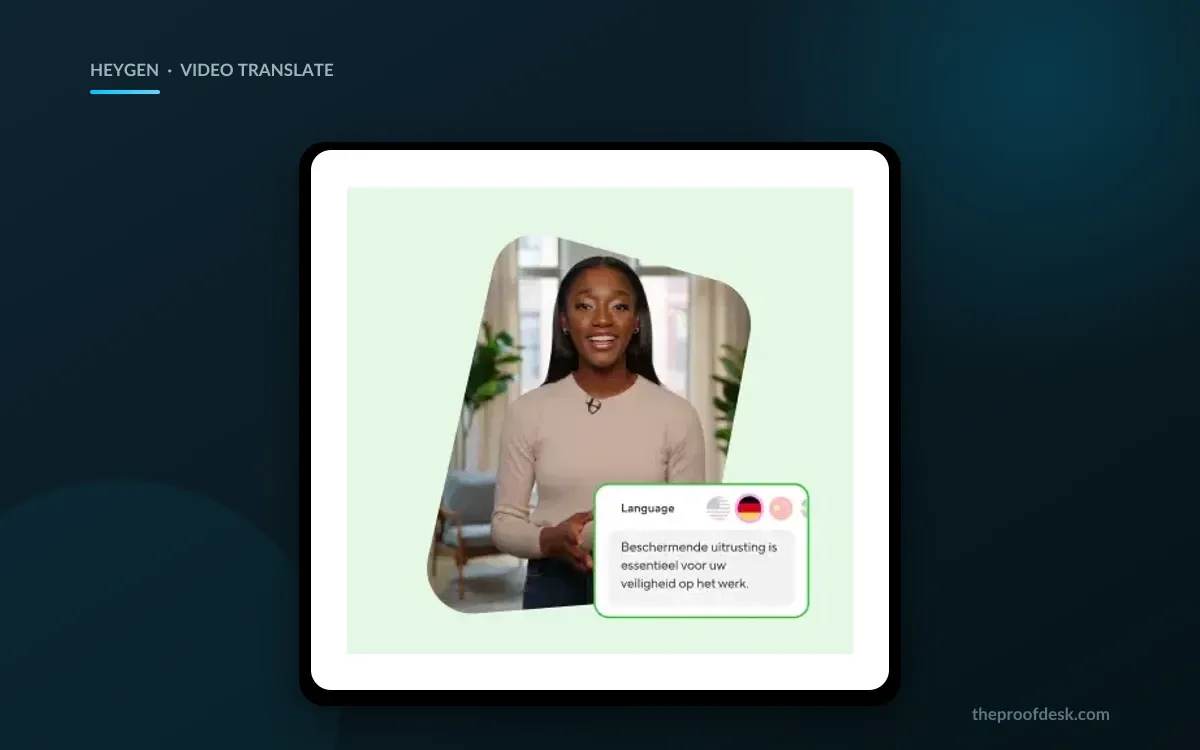
Three modes bill at different rates: Audio Only at 4 credits per minute with no lip sync, Speed at 6 credits per minute with natural lip sync optimised for front-facing video, and Precision at 10 credits per minute for the best lip sync. HeyGen's own worked examples put Creator's 600 credits at 100 minutes of Speed-mode translation, Pro's 1,000 at 166 minutes and Business's 1,500 at 250 minutes.
Practical limits: source files can be MP4, MOV or WebM, up to 5GB and from two seconds to five hours, but the per-video duration cap follows your plan — 30 minutes on Creator and Pro, 60 on Business, five hours on Enterprise. Longer content has to be split. Translated exports top out at 720p on Free, 1080p on Creator and 4K on Pro and above, and only if the source is already at that resolution.
The existence of a Precision tier tells you something about the Speed tier. HeyGen positions Precision as the fix for side-profile shots, changing camera angles and partially obscured faces — which is a candid admission that the cheaper lip sync struggles with anything other than a person talking straight down the lens.
Exports, watermarks and how long you wait
Export resolution ladders up with the plan: 720p on Free, 1080p on Creator, up to 4K on Pro, Business and Enterprise. HeyGen's pricing comparison table muddies this by listing "up to 1080p" against Free while the plan-detail article promises only a 720p sharing link; assume 720p.
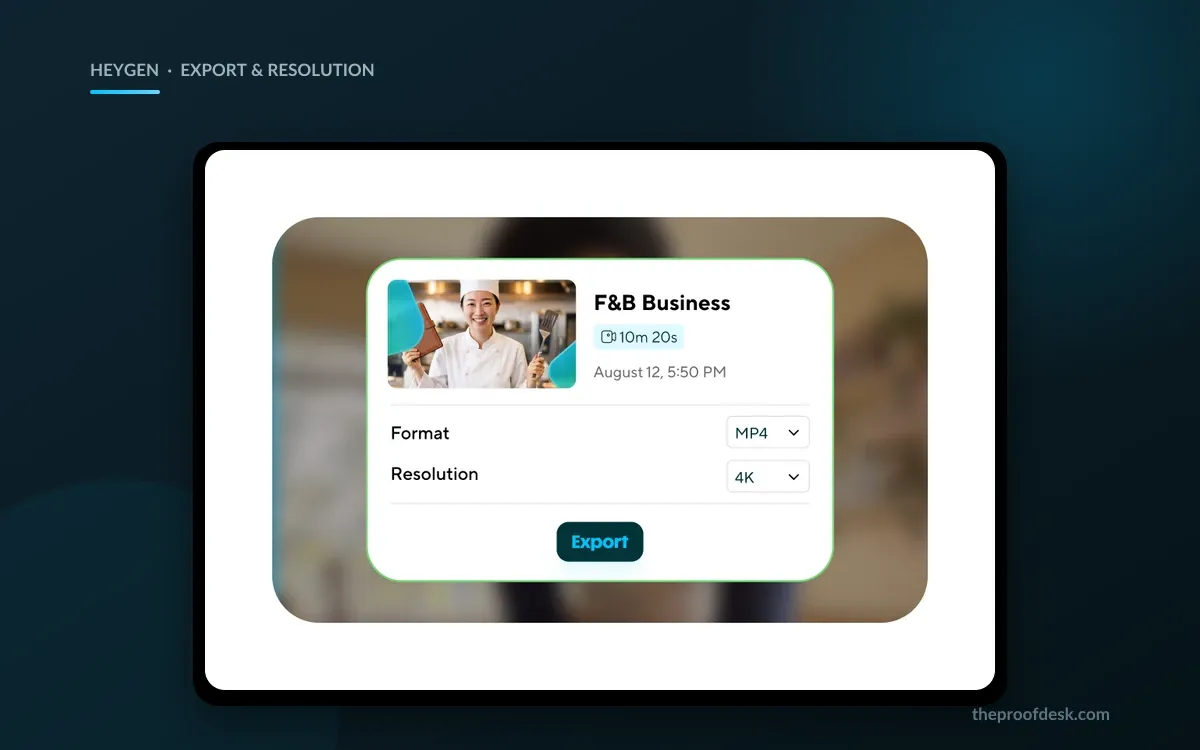
Every video on the Free plan carries a HeyGen watermark with no option to remove it. Watermark removal begins at Creator and applies to every paid tier above it.
Throughput is capped two ways. Concurrency — how many videos process simultaneously — runs 1 on Free, 3 on Creator and Pro, 6 on Business, 20 on Enterprise and 10 on the pay-as-you-go API. And rendering is not fast: HeyGen's own figure is that one minute of Avatar Studio video takes about ten minutes to generate, and one minute of video translation about five. Plan a batch of localised videos as an overnight job, not an afternoon one.
The API is now a separate purchase
As of 2026 you do not need any subscription to use the HeyGen API. It runs on pay-as-you-go credits bought standalone, billed in dollars by the second of generated output, and available even to Free accounts. There are no free API credits — HeyGen stopped offering them in February 2026 — and pay-as-you-go credits expire twelve months after purchase.
- Avatar III — $0.0167 per second for a Digital Twin or Studio avatar, $0.0433 for a photo avatar.
- Avatar IV — $0.05 per second for a photo avatar, $0.0667 for a Digital Twin or Studio avatar.
- Avatar V — $0.0667 per second, roughly $4 per finished minute.
- Video Translation — $0.0333 per second in Speed mode, $0.0667 in Precision.
- Avatar creation — $1.00 per call. AI clipping $0.15 per clip. Cinematic Avatar a flat $7.00 per video.
Documented ceilings worth designing around: 10 concurrent jobs before you get a 429, 5,000 characters of script per request, 10 minutes of audio input, 32MB asset uploads outside the direct-upload flow, 50 scenes and 30 minutes per output video. Creating a custom Digital Twin through the API, and using Proofread mode, are Enterprise-only.
Data handling and what you are not allowed to make
The security posture is solid on paper: TLS 1.2 or higher in transit, AES-256 at rest, all customer data stored in the United States on AWS, annual third-party penetration testing, and claimed compliance with SOC 2 Type II, GDPR, CCPA, the EU-US Data Privacy Framework and the EU AI Act, with a Data Protection Officer based in Europe.
Model training is opt-out, not opt-in
The training default deserves attention. HeyGen states that "Enterprise customers' data is excluded from AI model training by default" and that "Non-enterprise customers may opt out at any time by contacting" their privacy address. Read that the other way round: on Free, Creator, Pro and Business, your uploads are in scope for model training unless you send an email asking out. Subprocessors are contractually barred from training on your data, but HeyGen itself is not, by default, on the plans most readers will buy.
The moderation policy is strict about likeness, and it is the rule most likely to get a project rejected. Creating an avatar of another person without their explicit consent is prohibited outright, avatars of anyone who appears to be under 18 are banned, and public figures and celebrities require the same explicit consent as anyone else. Anyone whose likeness is used may request its removal at any time. Content categories including fraud, hate speech, political campaigning, sexual content and IP infringement are prohibited, enforced by automated moderation with human review and an email appeals route.
Refunds, cancelling and what you lose
Payments are "generally non-refundable, except in specific cases where required by law." Where refunds are considered, the windows are 15 days for purchases made through HeyGen or Google Play and 14 days through the Apple App Store, reviewed case by case, and HeyGen notes that a request may be refused if a significant amount of credits has already been used. There is no time-limited free trial — the Free plan is the trial.
Cancelling keeps your account fully active until the end of the current billing cycle. Annual plans run to the end of the paid year, with no proration and no automatic refund for unused months. What does not survive is everything you were saving: unused credits expire rather than roll over, and avatar slots drop to the Free limit of one, with extra avatars locked rather than deleted.
For what it is worth on the reputation side, HeyGen holds 3.6 out of 5 on Trustpilot across 3,041 reviews — 63% five-star but a notable 18% one-star, a split that usually signals a product that works well until a billing or moderation decision goes against someone.
Who should buy it
HeyGen is a strong buy if your work is repetitive talking-head content in many languages: training modules, product updates, onboarding, localised marketing. Video Translate at 6 credits a minute is priced well against hiring voice talent per language, and the Digital Twin makes a recognisable in-house presenter reusable indefinitely.
It is a poor fit if you want the newest avatar engine at volume — Avatar V at 48 credits a minute turns even a $99 plan into about 40 minutes of output — or if you need fast turnaround, given ten-to-one render times. Teams should also price Business carefully, since seats add cost without adding a single credit.
The honest recommendation: start on Free to judge avatar quality on your own script, then buy Creator monthly rather than annually for the first few months and watch what your actual credit burn looks like against the engine you prefer. Only commit to annual billing, or to a specific Pro tier, once you have a month of real usage data.
Sources
Frequently asked questions
How much does HeyGen cost in 2026?
Creator is $29/mo, or $24/mo billed annually. Pro starts at $49/mo ($41 annually) for 1,000 credits and scales up the same feature set to 100,000 credits at $4,300/mo. Business is $149/mo ($119 annually) for the first seat plus $20 per additional seat. There is a permanently free tier and a custom-priced Enterprise tier.
How many minutes of video do I get per month?
It depends entirely on the avatar engine, not the plan. Creator's 600 credits buy 150 minutes on Avatar III at 4 credits a minute, but only about 12 minutes on Avatar V at 48 credits a minute. Video translation sits in between at 4 to 10 credits a minute depending on lip-sync quality. Work out your engine first, then divide.
Do unused HeyGen credits roll over?
Yes, with conditions. Monthly subscribers carry unused credits into one additional billing cycle; annual subscribers accumulate them until the annual renewal date. Credits are lost entirely if you downgrade to Free, if you cancel, or — the one that surprises people — if you pause your plan, which expires the whole balance immediately.
Does HeyGen give refunds?
Rarely. Payments are described as generally non-refundable except where the law requires otherwise. Requests are reviewed case by case within 15 days for HeyGen and Google Play purchases or 14 days via the Apple App Store, and may be declined if you have already spent a significant number of credits. Use the Free plan as your trial instead.
Can I make an AI avatar of someone else?
Only with their explicit, verifiable consent. That person must record their own consent video — under 30 seconds, showing the same face as the training footage, submitted alongside it, and not a recording of a screen. They can do this remotely via a QR code. Avatars of anyone appearing under 18 are banned, and celebrities and public figures need the same explicit consent as anyone else.
Does HeyGen train its AI on my videos?
On Enterprise, no — that data is excluded by default. On Free, Creator, Pro and Business, your data is in scope unless you actively opt out by emailing HeyGen's privacy team. Subprocessors are contractually prohibited from training on customer data either way. Data is stored in the US on AWS, encrypted with AES-256 at rest and TLS 1.2+ in transit.
Does the free plan put a watermark on videos?
Yes, and it cannot be removed on Free. You also get one to three videos depending on region, capped at one minute each, exported at 720p with one video processing at a time. Watermark removal starts at Creator, which is also where 1080p export and Video Translate unlock.
Key takeaways
- Credits, not minutes, are the unit — and a minute costs 4 credits on Avatar III but 48 on Avatar V, so the same plan can yield twelve times more or less video depending on the engine you pick.
- Creator at $29/mo ($24 annually) gets 600 credits; Pro starts at $49 for 1,000; Business is $149 plus $20/seat for 1,500 credits shared across the whole team, since extra seats add no credits.
- Pausing a subscription permanently destroys your entire credit balance, and cancelling expires unused credits while locking avatar slots down to one.
- Only Business can buy top-up credits, at $0.05 each; Creator and Pro have to move up a tier instead.
- Custom avatars need a separate consent video from the person being cloned, and HeyGen's own docs contradict each other on whether Creator and Pro get one avatar slot or five — confirm in writing before paying.
- On every non-Enterprise plan your uploads can be used for AI model training unless you email HeyGen to opt out.
- Renders take roughly ten minutes per finished minute of video, so treat HeyGen as a batch tool rather than a same-hour one.
More in Artificial Intelligence
Browse Artificial Intelligence