Huawei Cloud Review 2026: Free Trial Gone, $9 Flexus L, Real Prices and the Fine Print
Huawei Cloud reviewed: the free trial is offline, Flexus L starts at $9 a month, ECS is billed per second, plus refunds, arrears rules, regions and AI, checked October 2026.
Huawei Cloud is the world's largest cloud you have probably never priced. Its international site at huaweicloud.com sells the same building blocks as AWS or Alibaba Cloud - virtual machines, object storage, managed databases, Kubernetes and, increasingly, AI model hosting - across 34 regions that lean heavily toward Asia, Latin America, the Middle East and Africa.
We went through the international site, its billing documentation and its official price calculator in October 2026 to answer the questions a new customer actually has: is there still a free tier, what does the cheapest server cost, what happens if a bill goes unpaid, and can you get your money back. The short version: the free trial page has been switched off, the cheapest useful server is a $9 a month Flexus L instance, and the billing fine print is stricter than most rivals'.
Verdict: who Huawei Cloud is for
Huawei Cloud makes sense if your users are in Southeast Asia, Latin America, the Gulf, Turkey or Africa, where it runs its own regions and often has better local presence than the US hyperscalers. Entry pricing is competitive - $9 a month buys a 2 vCPU, 2 GiB Flexus L server with 3 TB of monthly traffic - and its 2026 AI push gives access to open models such as DeepSeek V3.2 and Qwen3-32B as pay-per-token services.
It is a weaker fit for US and EU buyers. There is no Huawei-operated region in either market, Europe is served only by partner-run 'Cloud Alliance' regions, and Huawei's place on the US Entity List means a compliance review is likely before procurement signs off. Add a free trial that is no longer live, no free support tier and a 10% fee for cancelling a subscription early, and Huawei Cloud is better suited to deliberate buyers than to casual experimenters.
- Best for: workloads serving Asia Pacific, LatAm, the Middle East and Africa; teams wanting cheap bundled servers; AI teams that want hosted open-source models outside the US clouds.
- Watch out for: no current free trial, Visa/Mastercard only, 15-day grace plus 15-day retention before data is deleted, 10% unsubscription handling fee, no free support plan.
- Skip it if: you need a US or EU region run by the provider itself, or your compliance team rules out Entity List vendors.
Is there still a Huawei Cloud free tier?
Not in any form worth signing up for. The international free-trial page at activity.huaweicloud.com still loads, but it now reads 'This page is no longer available. Please go to our homepage to see more.' Its footer is dated September 10, 2026, and we found no replacement offer anywhere on the international site.
The last archived version of the page, from June 2026, described an offer running from January 1, 2025 to December 31, 2026: customers who registered after January 1, 2025 were 'eligible for the free usage of specified products for 12 months from the registration date.' In practice, the products listed were all management and security services tagged 'Always Free' - Auto Scaling, DNS, Anti-DDoS (500 Mbit/s of basic protection), IAM, Cloud Trace Service basics, AOM 1.0, the SoftWare Repository for Container (SWR), Resource Formation Service, Server Migration Service and Cloud Eye monitoring.
None of those is compute or storage. There was no free ECS server, no free Flexus instance and no free OBS bucket in the 2026 list. Older offers, such as a two-month free ECS trial or a bundle of free services 'for up to 1,500 hours', still turn up in search results, but they did not appear in the 2026 snapshot and should not be treated as current.
What the free offer rules said
Each new user could claim only one newcomer package, and Huawei treated accounts as the same user when they shared a mobile number, device, IP address, ID, passport or business registration number. When a free package expired or its quota ran out, usage was billed 'based on the standard prices on the official website.' Brazil, Peru and Chile were excluded from free trials entirely.
The practical takeaway: budget for paid usage from day one. Unlike the Alibaba Cloud and Oracle Cloud offers we have reviewed, Huawei Cloud does not currently advertise a new-user credit you can test against.
Flexus L: the $9 starter server
Flexus L is Huawei Cloud's answer to Lightsail and Alibaba's Simple Application Server: a bundled virtual server with a fixed monthly price that includes a disk, a public IP and a traffic allowance. It is the cheapest sensible way to run a website, a small API or a VPN endpoint on Huawei Cloud.
- 2 vCPUs, 2 GiB RAM, 3 TB/month traffic (Linux): $9.00 per month
- 2 vCPUs, 4 GiB RAM, 4 TB/month traffic (Linux): $19.00 per month
- 4 vCPUs, 8 GiB RAM, 6 TB/month traffic (Linux): $59.00 per month
- Traffic beyond the bundle: $0.114 per GB
Huawei labels these prices 'for reference only', and they can vary by region. The $9 plan's spec sheet lists a 60 GiB General Purpose SSD system disk, a 30 Mbit/s peak bandwidth and a 3,072 GB monthly data package. Smaller 0.5 GiB and 1 GiB configurations exist in the documentation, but we could not find public prices for them.
Flexus L fine print
- Monthly or yearly only. 'FlexusL instances only support the yearly/monthly billing mode' - there is no pay-per-use option, so you cannot spin one up for an afternoon.
- Unused traffic is lost. 'Any unused portion of the data package cannot be rolled over to the next month.'
- Bandwidth is not guaranteed. Huawei says the peak bandwidth 'is not used as a service commitment' and may be limited 'if resource contention occurs.'
For more headroom, Flexus X is the step up. It supports both monthly/yearly and pay-per-use billing, and you can switch between them at any time. Reference prices are quoted per year: about $238.59 for 2 vCPUs and 2 GiB, $538.07 for 4 vCPUs and 8 GiB, and $1,076.15 for 8 vCPUs and 16 GiB.
ECS, storage and bandwidth prices
Elastic Cloud Server (ECS) is the full-featured virtual machine service. Pay-per-use ECS 'is calculated by the second and billed every hour', so short-lived test machines cost only what they use. The figures below come from Huawei's official price calculator for Linux instances in the CN-Hong Kong region at the time of writing; treat them as approximate, because Huawei marks all prices as reference figures and they differ by region.
- t6.small.1 (1 vCPU, 1 GiB, burstable): about $0.0137 per hour, $6.44 per month or $64.40 per year
- t6.medium.2 (1 vCPU, 2 GiB, burstable): about $0.0242 per hour or $11.96 per month
- s6.medium.2 (1 vCPU, 2 GiB): about $0.033 per hour or $17.10 per month
- s6.large.2 (2 vCPUs, 4 GiB): about $0.066 per hour or $34.30 per month
- s7n.large.2 (2 vCPUs, 4 GiB, newer generation): about $0.0732 per hour or $38.47 per month
- x1.2u.4g (2 vCPUs, 4 GiB, flexible): about $0.0732 per hour, $38.47 per month or $282.14 per year
A few patterns stand out. Yearly billing on most families works out to ten months' price for twelve months of use. The flexible x1 family is the exception, with yearly rates far below twelve monthly payments. And the bare ECS price does not include a public IP or bandwidth: in Hong Kong a dynamic BGP elastic IP adds about $0.009 per hour, traffic-billed outbound bandwidth costs about $0.153 per GB (inbound is free), and a General Purpose SSD V2 disk runs about $0.10 per GB-month.
Spot instances are available for interruptible work. You set a maximum price between the market price and the pay-per-use price, and Huawei releases the instance automatically when inventory runs short or the market price passes your cap. Reserved instance plans also appear in the calculator, but we could not confirm their upfront and hourly structure, so we have not quoted RI figures.
Object Storage Service (OBS)
Huawei's example pricing for a CN-Hong Kong bucket puts single-AZ Standard storage at $0.0230 per GB-month and single-AZ Infrequent Access at $0.0140 per GB-month. Outbound internet traffic from OBS is $0.1180 per GB, and inbound traffic is free. Note that each product has its own egress rate - Flexus L overage, OBS downloads and ECS bandwidth are all priced differently - so model them separately.
Signing up: cards, deposits and verification
Registration takes an email or phone number, but you will need a payment method before you can buy anything. Huawei's own terms state: 'Only Visa and Mastercard credit cards are supported.' American Express, debit-only cards and PayPal are not mentioned. When you add a card, Huawei places 'an authorization deposit to verify that your credit card is valid,' which is later returned to the card.
Real-name authentication is a second step. On the international site it is mandatory if you want to use regions or CDN points of presence in mainland China, get commercial discounts and expenditure quotas, or complete your account information. Individuals verify with a passport or other non-Chinese-mainland certificate, and companies with business registration documents. Huawei quotes a review time of one to three working days.
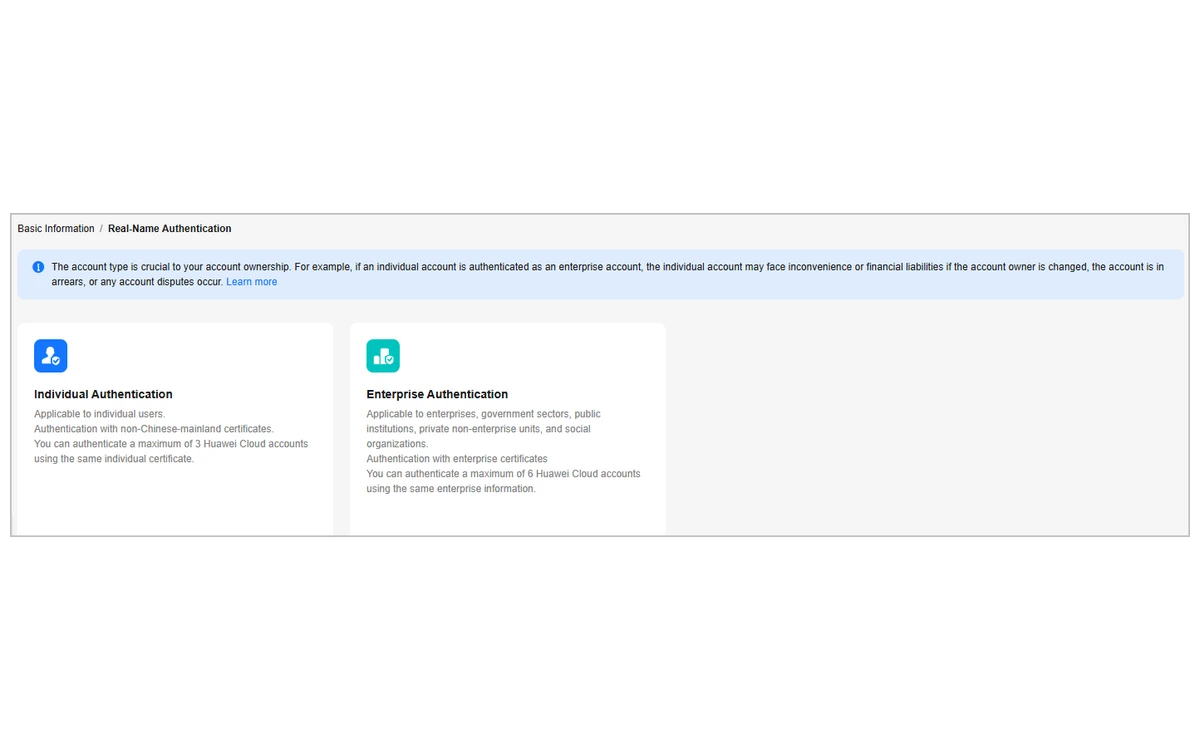
Plan for this if you are setting up accounts for a team or a client. The account limits per certificate, together with the free-offer rule that treats shared phones, devices and IP addresses as one user, mean Huawei Cloud is not designed for spinning up many throwaway accounts.
Billing fine print: arrears, refunds and fees
This is where Huawei Cloud is stricter than most rivals, and it is worth reading before you put anything important on it.
If a bill goes unpaid
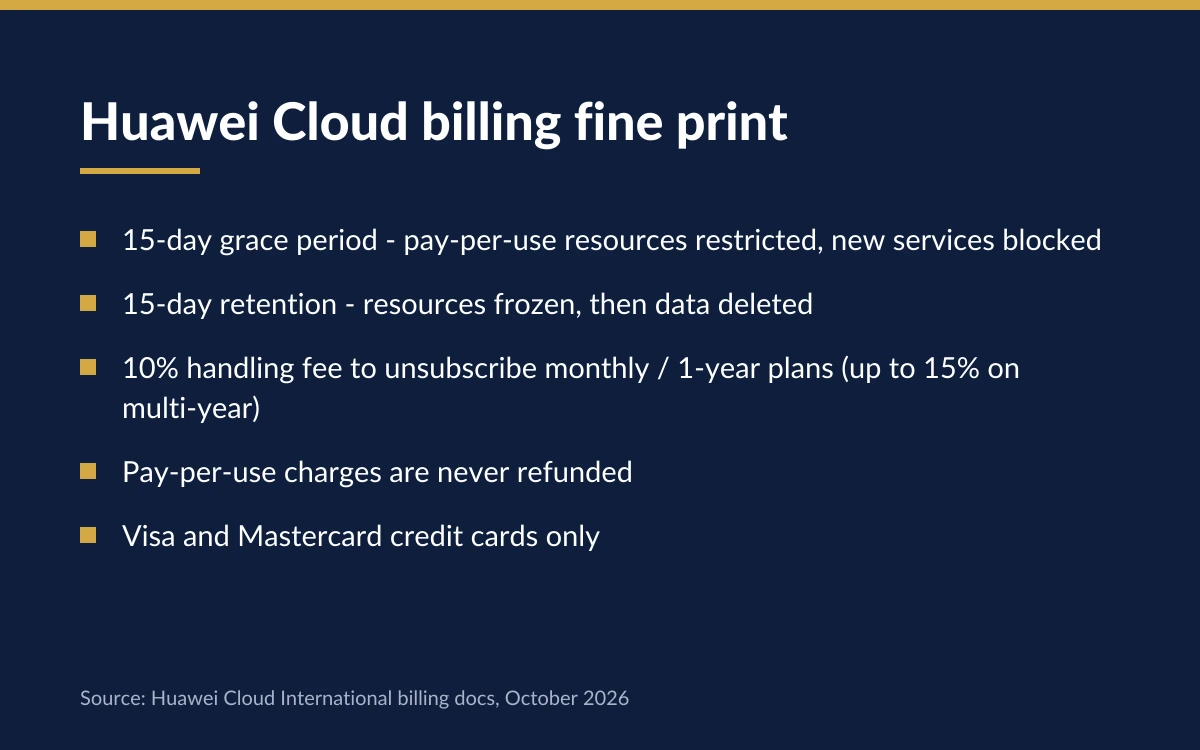
'The grace period for Huawei Cloud (International) is 15 days,' followed by a 15-day retention period. During the grace period, 'some pay-per-use resources will be inaccessible, and new services are blocked.' During retention, resources are frozen. When retention ends, 'the stored data will be deleted and the resources will be released.' Huawei also notes that the grace period 'may be changed to zero days.' In other words, a lapsed card can cost you your data in about a month, or sooner.
Refunds and unsubscribing
- Pay-per-use resources cannot be unsubscribed or refunded. 'Pay-per-use resources are postpaid and cannot be unsubscribed from.' You simply delete them to stop charges.
- Monthly and yearly resources can be unsubscribed. The refund equals the amount paid plus used cash coupons, minus what you consumed, minus a handling fee.
- The handling fee is 10% of the payable amount for monthly and 1-year subscriptions. For 2- and 3-year terms, it is 15% if you have used the subscription for a year or less, then 10%, and 5% in the final year of a 3-year term.
- Resource packages not used within five days of purchase are fully refunded, and cash coupons are returned.
- Refunds above $7,000 may be treated as a large-value unsubscription and handled separately.
Our advice
Start with pay-per-use ECS or a single month of Flexus L while you evaluate. Only commit to yearly or multi-year terms once you are sure, because getting out early costs 10-15% plus whatever you have used. Set a backup payment method and billing alerts so the 15-day grace window never starts by accident.
Regions, data residency and compliance
Huawei says it operates '103 availability zones across 34 regions' and offers more than 220 cloud services. Its published region list is concentrated outside the West:
- China: Beijing4, Shanghai1, East2, Qingdao, Guangzhou, Guiyang1 and Hong Kong
- Asia Pacific: Bangkok, Singapore, Jakarta and Manila
- Africa: Johannesburg and Cairo
- Latin America: Mexico City2, Sao Paulo1 and Santiago
- Turkey and Middle East: Istanbul and Riyadh
- Europe: Paris and Amsterdam, but only as partner-built 'Cloud Alliance' regions
The European regions come with a caveat in Huawei's own notes: the EU-Paris Cloud Alliance region 'is based on partner cloud construction' and 'the product SLA is mainly based on the capabilities provided by partners.' There is no US region at all. If you need low latency to North American or European users, or a provider-owned EU region for data protection reasons, this is a real gap.
On data residency, Huawei's commitment is clear: 'The region you select is where your data is stored. We will never move your data on the cloud across regions without your express authorization.' Choosing a non-China region keeps your data outside mainland China.
The compliance question is separate. Huawei Cloud entities were added to the US Commerce Department's Entity List in August 2020, according to the Congressional Research Service. That listing mainly restricts exports to Huawei rather than banning customers from buying its cloud services, but US and EU organisations, especially in government, defence, telecoms and regulated finance, should get a compliance opinion before signing up.
AI models as a service: MaaS goes global
Huawei Cloud's most active area in 2026 is AI. In April 2026, its Model-as-a-Service (MaaS) platform launched on the international site, expanding to nine more countries: Singapore, Thailand, Indonesia, Brazil, Mexico, Saudi Arabia, the United Arab Emirates, South Africa and Turkey. MaaS sells 'token services powered by leading open-source models such as DeepSeek V3.2, Qwen3-32B, and Zhipu GLM-5', so you pay per token rather than renting GPUs.
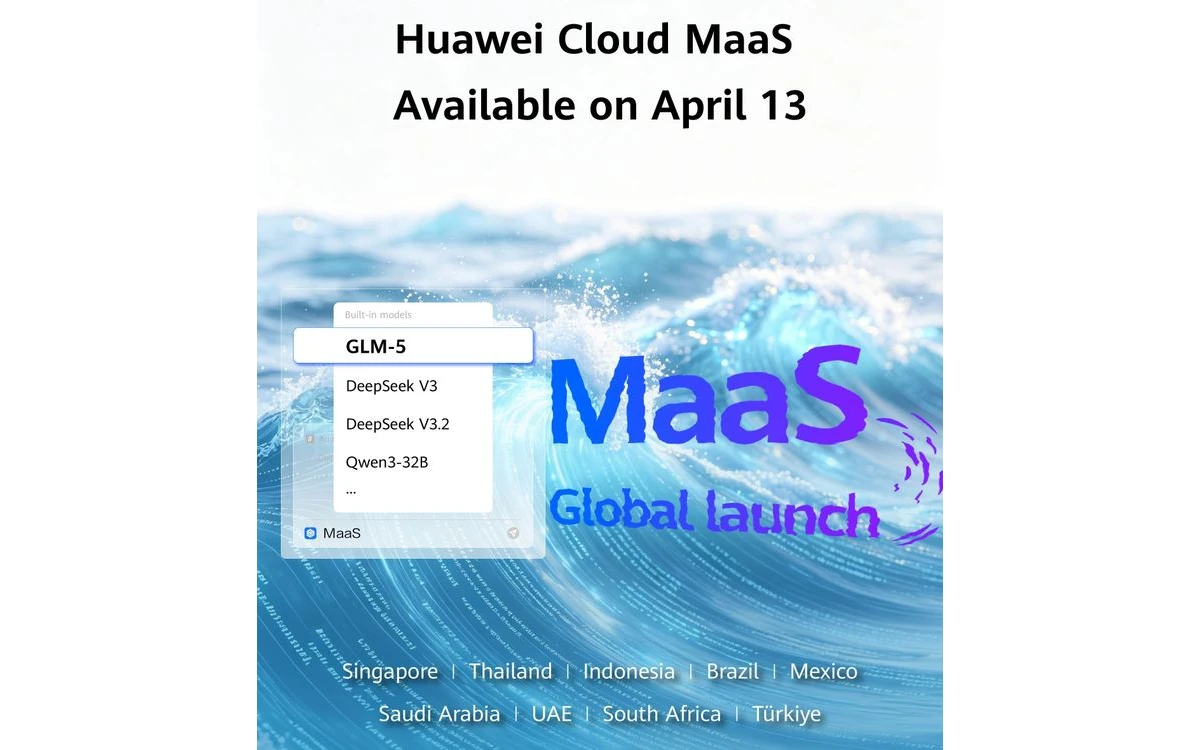
For teams in those markets, this is an easy way to call well-known open models with local data residency and without routing traffic through US providers. Developers elsewhere will find the model list narrower than Amazon Bedrock or Google Vertex AI, with no access to proprietary Western frontier models.
CloudMatrix and the AI Cluster Service
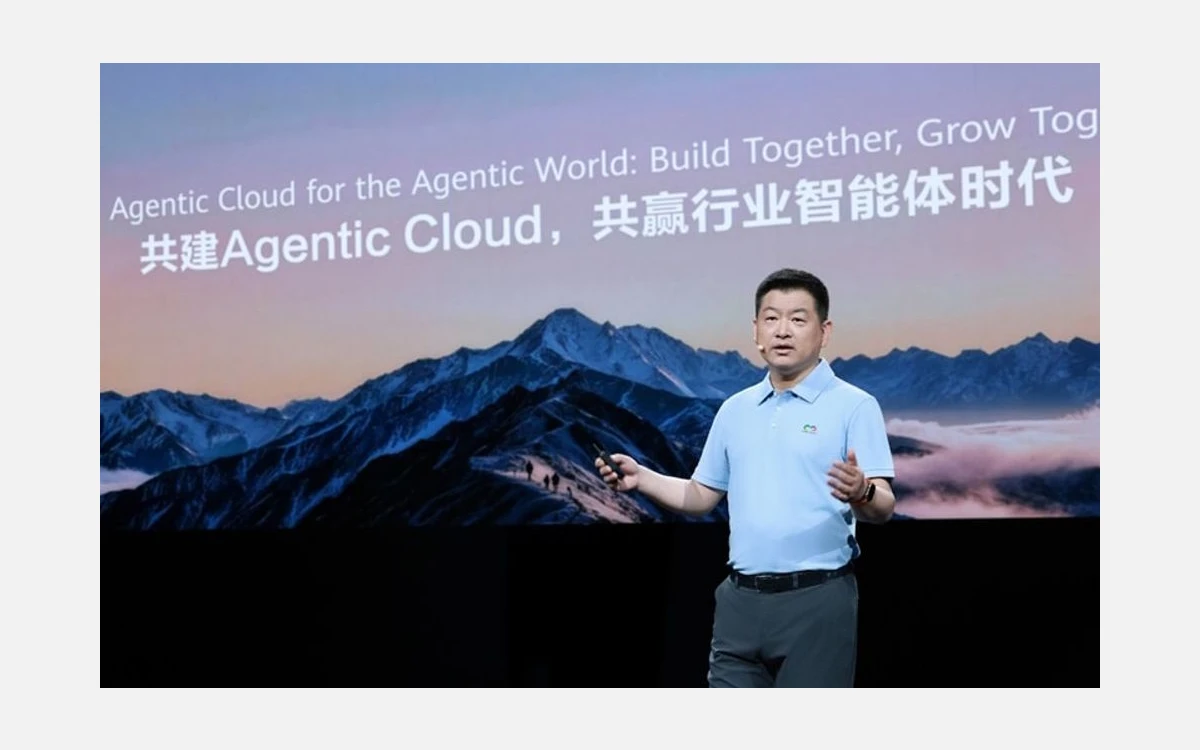
Under the hood, Huawei is building its AI offering on its own Ascend chips rather than Nvidia hardware. At HUAWEI CONNECT 2025, Huawei Cloud CEO Zhang Ping'an announced the AI Token Service powered by CloudMatrix384, a 384-chip 'supernode' that Huawei says will grow to 8,192 cards. Huawei claims CloudMatrix384 delivers average inference performance per card '3 to 4 times that of H20', Nvidia's China-market GPU. That is the vendor's own figure, not an independent benchmark.
At HUAWEI CONNECT 2026 in September, under the theme 'Agentic Cloud for the Agentic World', Huawei announced an Agentic MaaS platform, Context Memory Storage and a new AI Cluster Service (AICS). AICS became commercially available in China on September 30 and is scheduled for markets outside China on November 30, 2026. Pangu models, the open-source openPangu family and the ModelArts development platform round out the stack.
Support plans
Huawei's support page lists four paid plans and no free Basic tier:
- Developer: $26 per month, with responses in under 24 business hours for general guidance and under 12 business hours when a system is impaired.
- Business: the greater of $90 per month or a tiered share of spend - 10% of the first $9,000, then 7%, 5% and finally 3% of spend above $225,000.
- Enterprise On-Ramp: the greater of $5,000 per month or 10% of monthly spend.
- Enterprise: the greater of $13,500 per month or a tiered percentage of spend, with a response time under 15 minutes when a core system is unavailable.
The structure mirrors AWS closely. The difference for a small customer is that there is no published free tier: if you want a guaranteed response time on a $9 server, you add $26 a month.
How it compares
Against Alibaba Cloud, its closest rival, Huawei Cloud has similar entry pricing and a similar emerging-markets focus, but no current new-user credit and fewer regions in Europe and North America. Alibaba also runs its own regions in Frankfurt, London and the US. See our Alibaba Cloud review for that comparison.
Against Oracle Cloud and Google Cloud, Huawei loses on free tiers: Oracle's Always Free compute and Google's free e2-micro have no Huawei equivalent today. It can win on price-to-traffic ratio in Asia - 3 TB of monthly transfer on a $9 Flexus L is generous - and on local presence in markets like Riyadh, Cairo, Johannesburg and Santiago. Our Oracle Cloud, Google Cloud and IBM Cloud reviews cover those providers in the same format.
Frequently asked questions
How much does Huawei Cloud cost to start?
About $9 a month. That buys a Flexus L server with 2 vCPUs, 2 GiB RAM, a 60 GiB SSD and 3 TB of monthly traffic on a monthly plan. A pay-per-use ECS t6.small.1 instance in Hong Kong costs about $0.0137 per hour, but a public IP and bandwidth are billed on top.
Does Huawei Cloud have a free tier in 2026?
No usable one. The international free-trial page was taken offline in September 2026. Its last archived version listed only 10 'Always Free' services such as DNS, IAM, Cloud Eye and basic Anti-DDoS - no free compute or storage, and we found no new-user credit.
Can I get a refund from Huawei Cloud?
Partly, and only for prepaid resources. Monthly and yearly subscriptions can be cancelled for a refund of the unused amount minus a 10% handling fee, or up to 15% on multi-year terms. Resource packages unused within five days of purchase are fully refunded. Pay-per-use charges are never refunded.
What payment methods does Huawei Cloud accept?
Visa and Mastercard credit cards. Huawei places a temporary authorization deposit on the card to confirm it is valid and returns it later. Free trials were never offered in Brazil, Peru or Chile, where payment methods cannot be specified.
What happens if I don't pay my Huawei Cloud bill?
Your resources are restricted for a 15-day grace period, frozen for a 15-day retention period, and then deleted. During the grace period some pay-per-use resources become inaccessible and you cannot buy new services. Huawei says the grace period can be reduced to zero.
Where is my data stored on Huawei Cloud?
In the region you choose. Huawei says it will never move data across regions without your express authorization, so picking Singapore, Sao Paulo or Johannesburg keeps data there. Europe is available only through partner-run Paris and Amsterdam regions, and there is no US region.
Is it legal to use Huawei Cloud in the US or EU?
Generally yes for customers, but check with compliance first. Huawei Cloud has been on the US Entity List since 2020, which mainly restricts exports to Huawei. Regulated organisations may have their own policies against Entity List vendors.
Do I need ID verification to use Huawei Cloud?
Only for some features. Real-name authentication with a passport or business documents is required to use mainland China regions, unlock commercial discounts and expenditure quotas, and complete your account details. Huawei says review takes one to three working days.
Key takeaways
- Huawei Cloud's international free trial went offline in September 2026, and the last version offered no free compute or storage.
- Flexus L is the cheapest entry point: $9 a month for 2 vCPUs, 2 GiB and 3 TB of traffic, billed monthly or yearly only.
- Pay-per-use ECS is billed per second; Hong Kong prices start around $0.0137 an hour before IP and bandwidth.
- Billing is strict: Visa/Mastercard only, 15-day grace plus 15-day retention before deletion, 10% fee to unsubscribe early.
- 34 regions are strongest in Asia, LatAm, the Middle East and Africa; Europe is partner-run and there is no US region.
- MaaS brings DeepSeek, Qwen and GLM models to nine markets, and AICS reaches markets outside China on November 30, 2026.
More in Cloud Computing
Browse Cloud Computing