Jasper AI Review 2026: Agents, Brand Voice and Seat Cost
Jasper sells marketing agents by the seat, not by the word. Here is what 69 dollars a month buys, what Jasper IQ needs from you, and the limits that force a Business quote.
Jasper began as an AI copywriter that turned a prompt into a blog post. In 2026 it sells something narrower and more expensive: a workspace where marketing teams run agents against their own brand rules, then check the output in one place. The pitch is no longer speed of writing. It is control over what a hundred pieces of content sound like.
That repositioning changes who should buy it. This review covers what the platform contains, how Jasper IQ decides the quality of everything it produces, what a seat costs on each plan, and the limits that push teams onto a sales call. Prices and plan contents were checked on jasper.ai in August 2026 and Jasper changes them, so confirm at the checkout screen.
What Jasper is in 2026
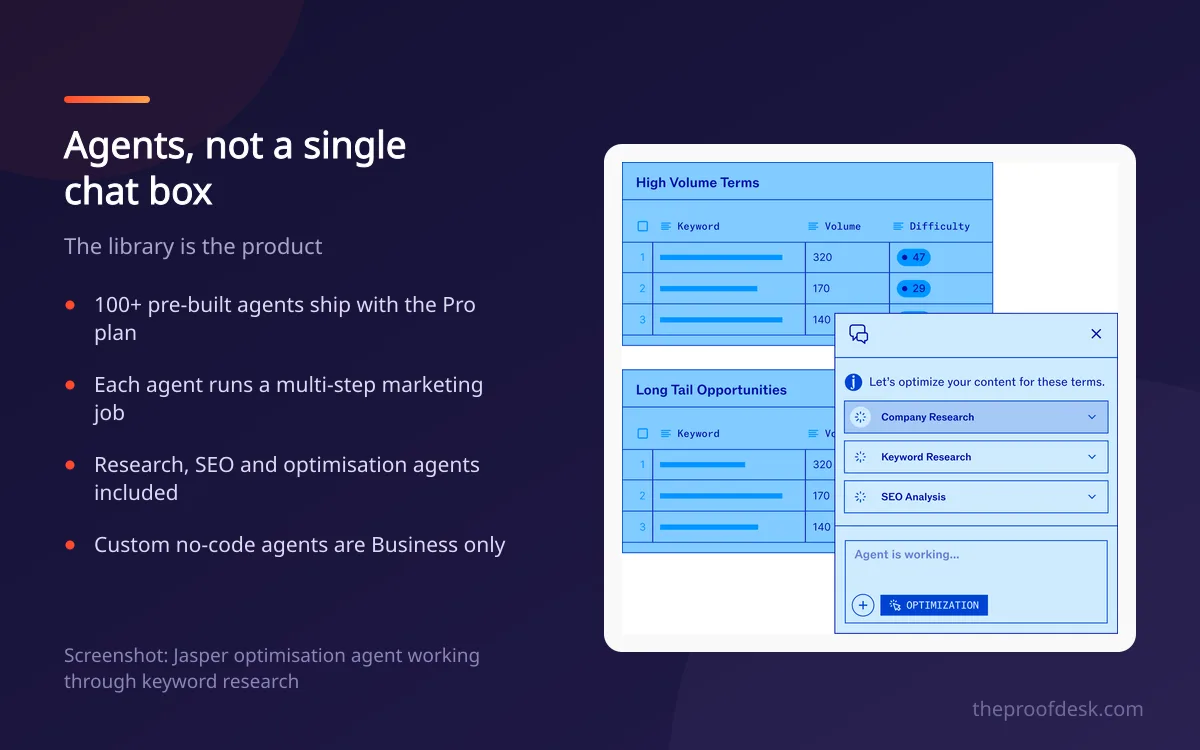
Jasper describes itself as an agent workspace built for marketing teams. The entry point is a chat window, but the product underneath it is a library of more than a hundred purpose-built agents, each one aimed at a specific job: keyword research, a campaign brief, a translation pass, a rewrite for search. You pick the agent, give it the context, and it runs the steps rather than answering a single question.
- Canvas, the shared surface where a campaign is planned and reviewed.
- Chat and a document editor for the drafting nobody wants to hand to an agent.
- More than 100 pre-built marketing agents, included from the Pro plan up.
- Image generation and editing, plus background removal and upscaling.
- A browser extension and integrations so the same voice follows you into other tools.
What it is not is a cheaper way to write one article. A general assistant does that for a fraction of the money. Jasper earns its price only when several people need the same output, in the same voice, without a human rewriting each draft.
Jasper IQ is the part you have to feed
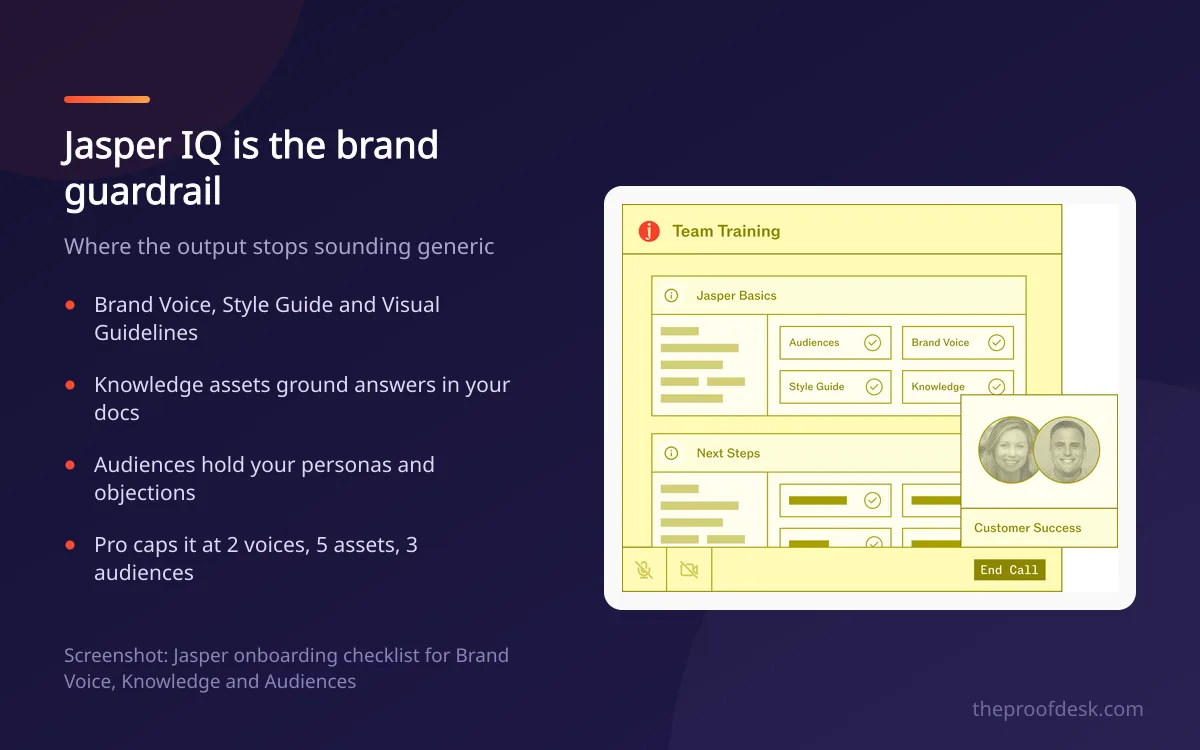
Jasper IQ is the governance layer, and it splits in two. Brand IQ holds the Brand Voice, the style guide and the visual guidelines. Marketing IQ holds Knowledge assets, which are your own documents, and Audiences, which are the personas you sell to. Every agent reads from that layer before it writes a word.
- Brand Voice is trained on content you already published, not on a tone slider.
- The style guide carries the rules a copy editor would otherwise repeat every week.
- Knowledge assets ground claims in your product documents instead of the open web.
- Audiences store pain points and objections, so the same brief lands differently per persona.
Budget the setup, not just the seat
Output quality tracks the effort spent loading brand material, and the first week is mostly that work. Pro caps you at 2 Brand Voices, 5 Knowledge assets and 3 Audiences, which is enough for one brand and thin for an agency juggling several.
What a seat actually costs
Pricing is per seat, not per word. Pro is 69 dollars per seat per month billed monthly, or 59 dollars per seat per month on an annual plan, a saving of roughly 20 percent for a twelve-month commitment. Pro includes one seat. Business is quoted by sales against seat count and usage, carries a twelve-month minimum term, and is the only way to add a team.
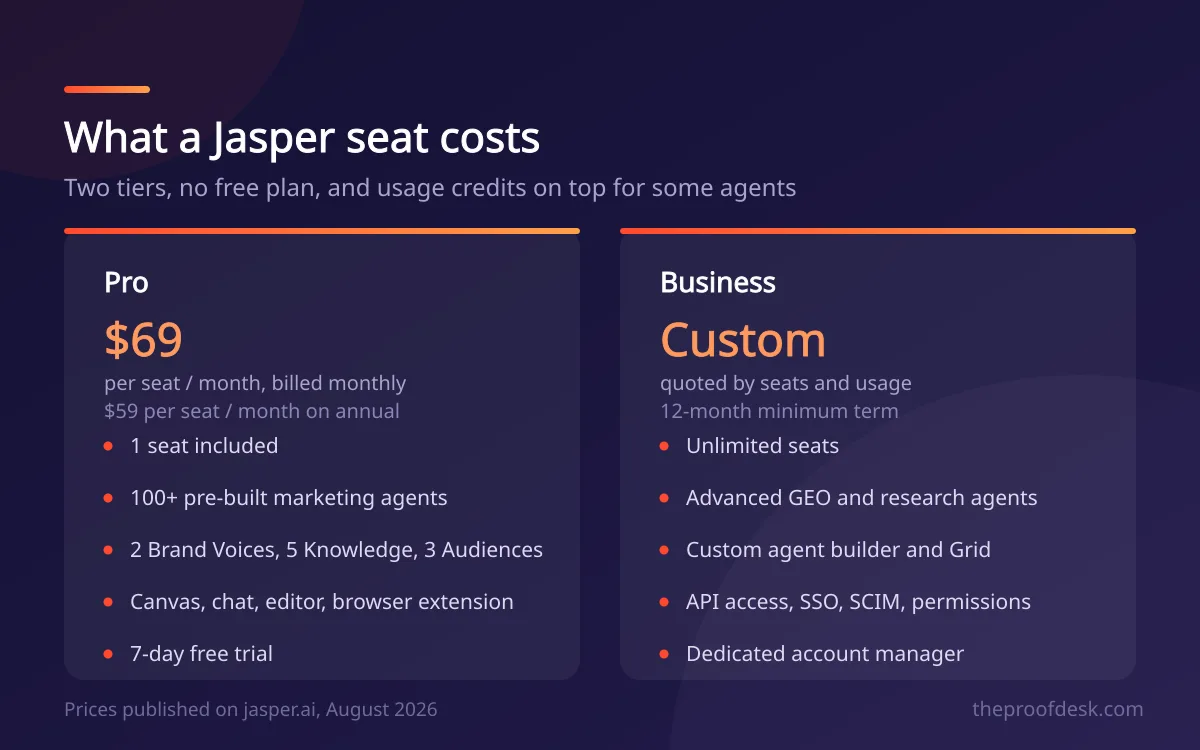
- Pro: Canvas, chat, the editor, the agent library, image tools, browser extension and personal usage analytics.
- Business: advanced agents for GEO, research and translation, plus a no-code builder for your own agents.
- Business: Grid for bulk execution, unlimited Jasper IQ customisation and API access.
- Business: SSO, SCIM, role-based permissions, user groups and a dedicated account manager.
Credits sit on top of the seat
Some usage-based features, including the GEO Hub and certain agents, consume credits, and the rate varies by action. The seat price is the floor of the bill, not the whole of it, so model a heavy month before committing a team.
Practical terms worth knowing before checkout: payment is by major credit or debit card, with no PayPal or prepaid cards; you can cancel at any time and keep access until the end of the billing cycle, though an annual plan is still a twelve-month commitment; and registered nonprofits can claim 20 percent off once the paperwork is verified.
Where it scales, and where the risk sits
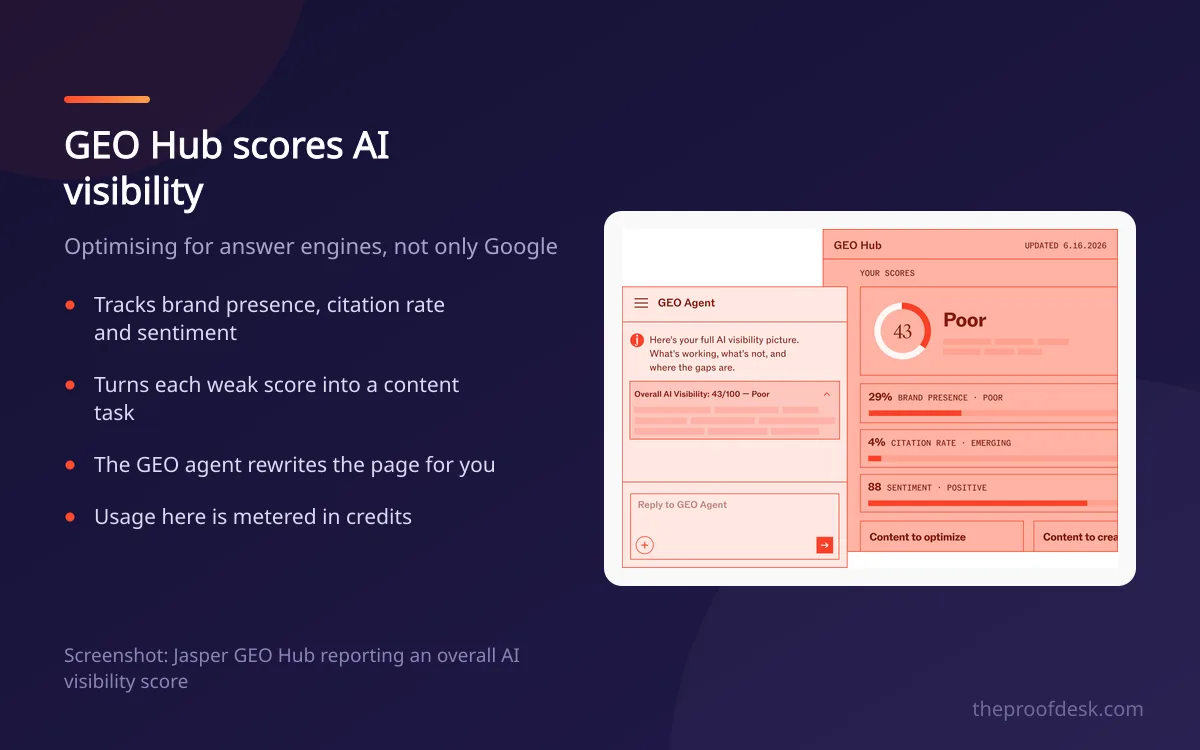
Two features explain why teams pay for Business. The first is the GEO Hub, which scores how visible your brand is inside AI answers rather than blue links. It reports brand presence, citation rate and sentiment, then hands each weak score to an agent that rewrites the page.
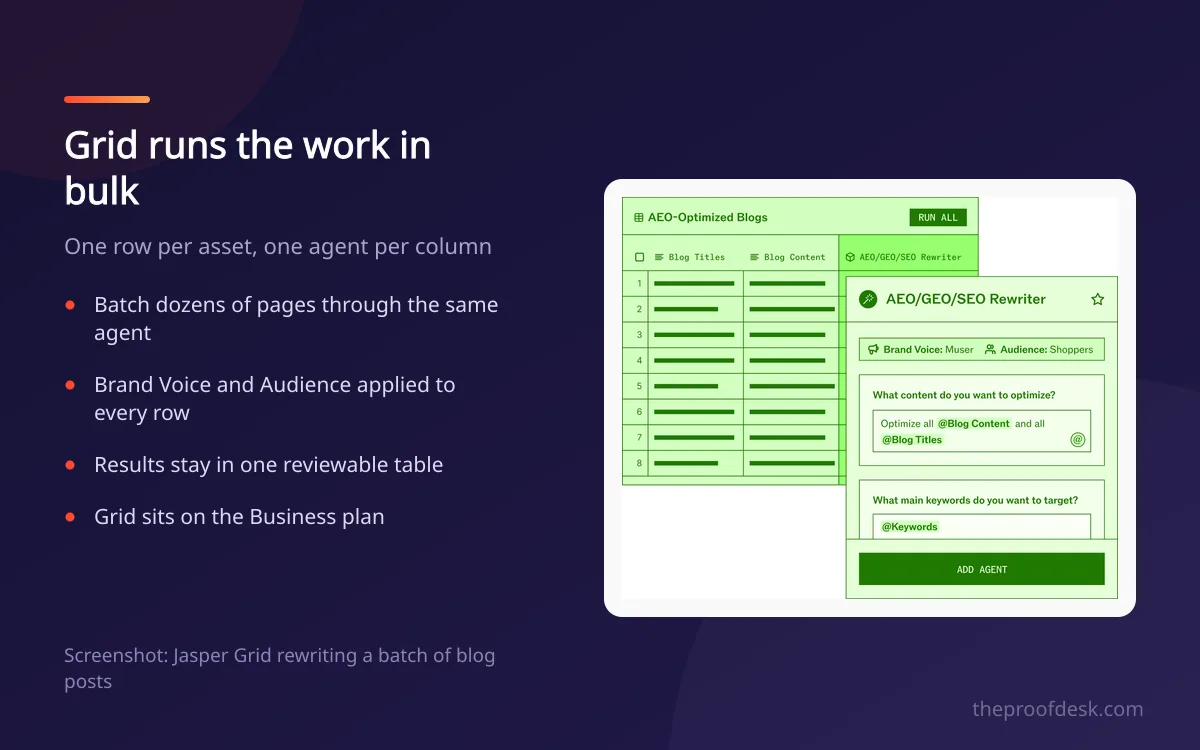
The second is Grid, a table where each row is an asset and each column is an agent. It is how a batch of forty product pages goes through the same rewrite with the same Brand Voice and Audience attached, and it keeps the results reviewable instead of scattered across chat threads.
On the governance side Jasper states that company data and outputs are never used to train third-party language models, and lists SOC 2, GDPR, CCPA, PCI and DPA compliance alongside SSO, audit logs and granular permissions. The platform is LLM-agnostic, so the model behind an agent can change without you rebuilding the workflow. None of that removes the real risk, which is volume: an agent that misreads one product limit will repeat it across every row of the grid, so keep a human reviewing before publication.
Frequently asked questions
Does Jasper have a free plan?
No. There is a 7-day free trial on the Pro plan and nothing permanently free. Plan the trial before you start it: a week is enough to load one Brand Voice, a few Knowledge assets and run a real campaign, but only if that work is scheduled rather than squeezed in.
How much does Jasper cost per month?
Pro is 69 dollars per seat per month on monthly billing and 59 dollars per seat per month on annual billing. Business is custom-quoted by seats and usage with a twelve-month minimum. Credits for usage-based features are billed on top of both.
What is the difference between Pro and Business?
Seats and governance, mostly. Pro is a single seat with the core agent library and capped Jasper IQ. Business adds unlimited seats, advanced GEO and research agents, a custom agent builder, Grid, API access, SSO, SCIM, role-based permissions and an account manager.
Can two people share one Pro seat?
No. Pro includes one seat, and adding people means moving to Business rather than buying a second Pro subscription. Solo consultants stay on Pro; the moment a second person needs their own Brand Voice access, the price becomes a sales conversation.
Does Jasper train AI models on my content?
Jasper states that your company data and outputs are never used to train third-party language models. It also publishes SOC 2, GDPR, CCPA, PCI and DPA compliance, and offers SSO, audit logs and granular permissions for teams that have to prove where their content went.
What are credits and when do they run out?
Credits meter the usage-based features, such as the GEO Hub and certain agents, and each action costs a different amount. A seat does not cover unlimited use of those features, so ask sales for the rate table if optimisation work is the reason you are buying.
Can I cancel, and what happens to my access?
You can cancel at any time and keep access until the end of the current billing cycle. An annual plan is still a twelve-month commitment, so cancelling stops the renewal rather than refunding the remaining months.
Is Jasper worth it instead of a general AI assistant?
Only if brand consistency across a team is the problem you are paying to solve. For drafting a handful of posts a month, a general assistant costs far less and writes about as well. Jasper wins when the same voice has to survive dozens of assets, several people and a review process.
Key takeaways
- Jasper is priced per seat, at 69 dollars monthly or 59 dollars per month on an annual plan, with no free tier.
- Pro is a single seat capped at 2 Brand Voices, 5 Knowledge assets and 3 Audiences.
- Teams, API access, SSO, Grid and custom agents all sit behind a Business quote with a twelve-month minimum.
- Credits are billed on top of the seat for usage-based features such as the GEO Hub.
- The output is only as good as the brand material you load first, so budget the setup week before judging it.
More in Artificial Intelligence
Browse Artificial Intelligence