Jenni AI Review: Academic Writing With Traceable Citations
Jenni grounds every AI suggestion in the PDFs you upload, so the citations are real. Here is what the free plan allows, what the paid tiers cost, and where your judgment is still required.
Every general chatbot will happily write you a paragraph about mitochondrial biogenesis, and a fair number will attach a citation that looks perfect and does not exist. Fabricated references are the fastest way to lose a supervisor's trust, and checking each one by hand undoes whatever time the draft saved. Students and researchers keep reaching for AI on the blank page, then quietly abandon it at the reference list.
Jenni is built for that specific hole. It calls itself an AI workspace where researchers read, write and cite, and it claims more than six million academic users. This review covers what it actually produces, how the citation grounding works, what a free account allows in a day, what the paid tiers cost as checked in August 2026, and the part no tool can settle for you: what your department counts as acceptable use.
What Jenni is, and what it will not do
Jenni is a writing assistant rather than an article generator, and the distinction is not marketing. You write, and it offers to continue the sentence or the paragraph you already started, which keeps the argument yours and the model in a supporting seat. Hand it a title and expect a finished essay back and you will be disappointed, because that is not the workflow it was designed around.
- Autocomplete: suggests the next sentence or paragraph, drawn from the sources sitting in your library.
- Citations: one-click inline references in over 10,000 styles, including APA 7th, Chicago, Harvard, IEEE and Vancouver.
- PDF chat: upload papers, then ask questions across the whole library instead of one file at a time.
- Reviews: a pass over your draft that flags unverified claims, contradictions and unsupported arguments across six categories.
- Discovery: semantic search over an index the company puts at more than 200 million papers, plus Zotero and Mendeley import.
There is also real-time co-authoring with comments and version history. That last one matters more than a feature list suggests, because version history is the evidence you can show a supervisor who asks how a particular paragraph came to exist.
The citation layer is the actual product
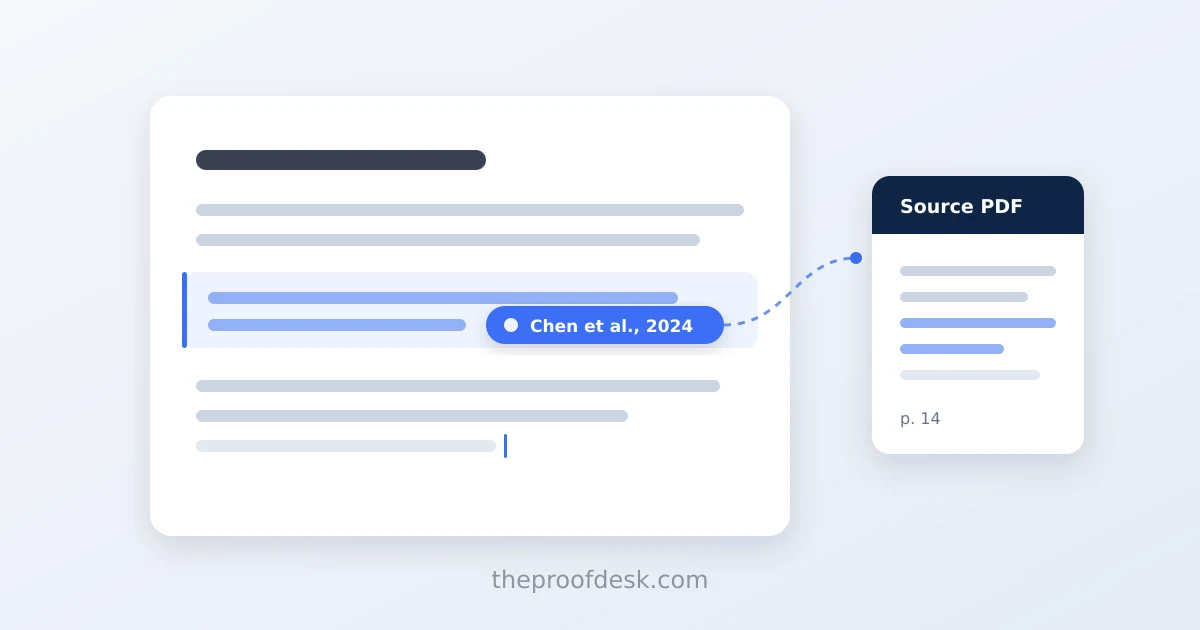
The interesting engineering here is retrieval, not generation. Jenni grounds its suggestions in the PDFs you upload rather than in generic training data, so a completion arrives already attached to a source you chose, with a link back to the specific document and page. You decide which papers inform which section. That inverts the usual failure mode, where a model invents a plausible author, a plausible year and a journal that never published the thing.
Grounding narrows the risk. It does not transfer the responsibility. A retrieved citation can still sit under a claim the paper does not quite support, and a tidy summary of a dense methods section can drift from what the authors actually did. Treat every inserted reference as a pointer to something you still have to open. On that basis it is genuinely faster than chasing a half-remembered study through three databases.
What writing in it feels like
In use it behaves like a plain editor with a very fast research assistant sitting beside it. You type a topic sentence, ask for a continuation, then accept it, rewrite it or throw it away. Sentence by sentence the draft moves. The rhythm suits literature reviews and background sections, where the job is synthesising what other people already established, and it suits anyone staring at an empty introduction at eleven at night.
It thins out as the writing gets harder. Reviewers report the same wobble on complex argumentation, and the pattern is easy to predict: the further you move from summarising sources toward defending an original position, the less a retrieval model has to offer. Your discussion section is still yours to write. Jenni claims users save an average of 5.2 hours per paper, which is a vendor figure, though it is plausible if you count the hours normally lost to reference formatting.
What the plans actually allow
The free tier is a demonstration, not a working setup. Checked in August 2026 it gives you 10 AI autocompletes a day, 5 chat messages, 5 AI edits, 3 document reviews a month, and 10 PDF uploads capped at 25MB and 150 pages. That is enough to learn whether the citation flow fits how you work. It is nowhere near enough to carry a chapter.
Plus is listed at $12 a month and raises the ceilings to 5,000 autocompletes, 500 chat messages, 500 edits and 10 reviews a month, with unlimited PDF uploads at 100MB and 500 pages, plus full document export. Pro at $29 removes the caps and lifts the PDF limit to 1,000 pages, which is the tier that matters if you are feeding it book-length material or working against a thesis deadline.
Check which price your checkout shows
The pricing page advertises a saving of around 60 percent for paying annually, and independent trackers list the month-to-month rate nearer $20, with $12 corresponding to the annual commitment. Read the total on the payment screen before confirming. A year up front is a long bet on a tool you are trialling for one term.
Detection, policy, and who this actually fits
No feature list settles the question your institution already answered somewhere in a handbook. The broad consensus across universities is workable: using AI to outline, organise, paraphrase your own sentences and manage citations is usually permitted, while submitting generated paragraphs as your own writing is misconduct. Jenni cannot tell you where your department drew that line, and a detector cannot either.
What detection testing found
Third-party tests in 2026 reported that Turnitin flagged roughly 73 percent of raw Jenni output, rising to about 80 percent on literature reviews. Turnitin's own March 2026 guidance states that its model can misidentify both human and AI text and should not be the sole basis for action against a student. Both facts point the same direction: raw generated prose is a poor thing to submit, and rewriting in your own voice is not optional.
Buy it if you are a postgraduate or researcher who reads a lot of PDFs and writes to a citation style, and who wants the reference plumbing handled without invented sources. Skip it for marketing copy, fiction or anything outside academia, where a general assistant does more for less, and skip it entirely if the plan was to hand in what it produces. Used as a reading and citation workspace with your own argument on top, it earns the $12. Used as a ghostwriter, it is an expensive way to fail a module.
Key takeaways
- Jenni is an academic writing assistant built around the PDFs you upload, not a chatbot that drafts an essay from a title.
- Suggestions arrive with a citation traceable to a specific document and page, which kills the fabricated reference problem but not your duty to check the claim.
- The free plan allows 10 autocompletes and 5 chat messages a day, enough to evaluate the workflow and not enough to write a chapter (checked August 2026).
- Plus is listed at $12 a month and Pro at $29 for uncapped use and 1,000-page PDFs; confirm on the checkout screen whether that figure is monthly or annual.
- Turnitin flagged around 73 percent of raw output in 2026 testing, so rewrite in your own voice and read your institution's AI policy before leaning on it.
More in Artificial Intelligence
Browse Artificial Intelligence