Midjourney Review 2026: What 10 to 120 Dollars Buys You
Midjourney sells GPU minutes, not images. Here is what each plan includes in 2026, how fast a job burns that time, and who owns the pictures you generate.
People sign up to Midjourney expecting to buy images and discover they have bought minutes. Every plan on midjourney.com is a block of GPU time, and the same prompt can cost 0.8 minutes or 26 minutes depending on what you asked for. That is why two subscribers on the same 30 dollar plan can have completely different months, and why the plan comparison page is harder to read than it looks.
This review covers what the four plans actually include in August 2026, how quickly ordinary work eats the included time, which features are locked behind the upper tiers, and what the terms of service say about owning and publishing the results. Prices and limits here come from Midjourney documentation and should be confirmed at checkout.
What midjourney.com is in 2026
Midjourney began as a Discord bot and is still often described that way, but the website is now the main interface. You create an account at midjourney.com with either a Discord login or a Google account, and one subscription covers both places. Discord remains available and a few actions, such as the free grid upscale, still only exist there.
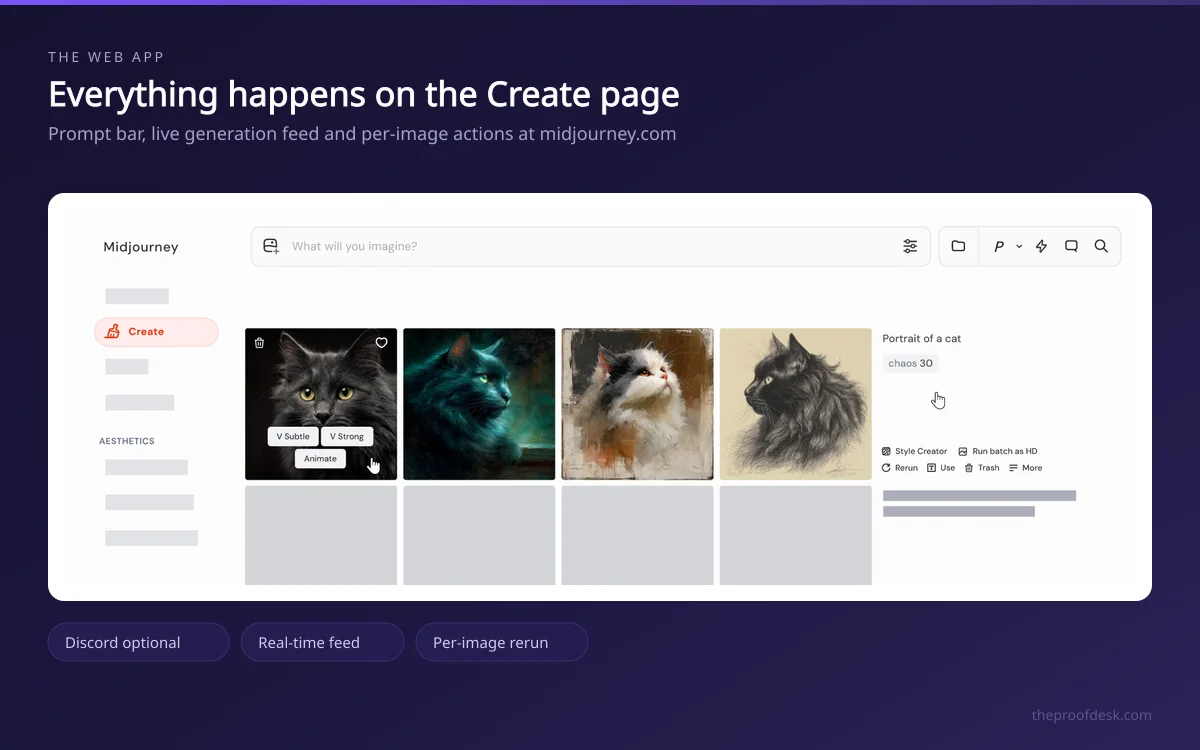
The default model is V8.2, which became the default on 24 July 2026 and is described as an aesthetics and personalization update rather than a speed release. V8.1 held the default slot from 10 June to 23 July 2026 and is still the fastest model on offer. V8.0 was an early access alpha that closed on 24 July 2026, and images made with it stay in your gallery even though the version can no longer be selected.
- Text to image at standard resolution, or 2K HD output without a separate upscale step.
- Five second video clips generated from a starting frame, with optional low or high motion and looping.
- An editor for inpainting, outpainting, pan and zoom, plus Describe to reverse engineer a prompt from an image.
- Style tools: personalization profiles, moodboards, style references and omni reference for character consistency.
The four plans and what separates them
Basic, Standard, Pro and Mega all reach the same models. What changes between them is throughput and privacy: how much fast time you get, whether you can keep generating once it runs out, how many jobs run at the same time, and whether your output stays off the public Explore feed. Annual billing takes 20 percent off but is charged upfront for the whole year.
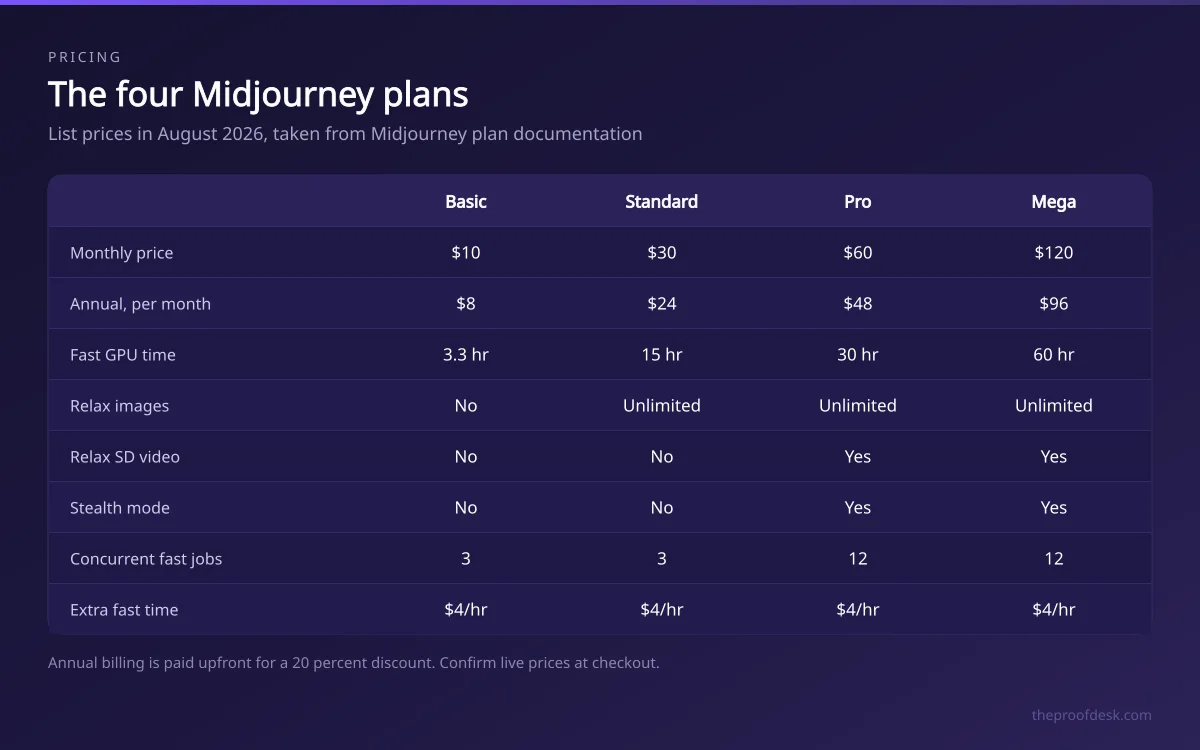
- Basic at 10 dollars is a trial in practice: 3.3 hours of fast time, no relax mode, so generation stops when the time is gone.
- Standard at 30 dollars is the first workable plan because relax mode makes still images unlimited once fast time runs out.
- Pro at 60 dollars adds stealth mode, relax video and twelve concurrent fast jobs, which is the tier most freelancers land on.
- Mega at 120 dollars only doubles fast time to 60 hours; it changes nothing else that Pro does not already do.
The one million dollar rule
If you are a company, or an employee of a company, with more than 1,000,000 US dollars a year in revenue, the terms of service require a Pro or Mega subscription for you to own what you generate. Cheaper plans do not carry that ownership for large companies, regardless of how the images are used.
GPU time is the unit you are actually buying
Fast time is the pool that resets each renewal, and it is consumed only while Midjourney is working on your job. Relax mode draws on an unlimited queue instead, with waits of roughly zero to thirty minutes that grow the more you use it. Turbo mode is up to four times faster than fast mode, spends the same fast pool more quickly, and is not supported on V8.1.
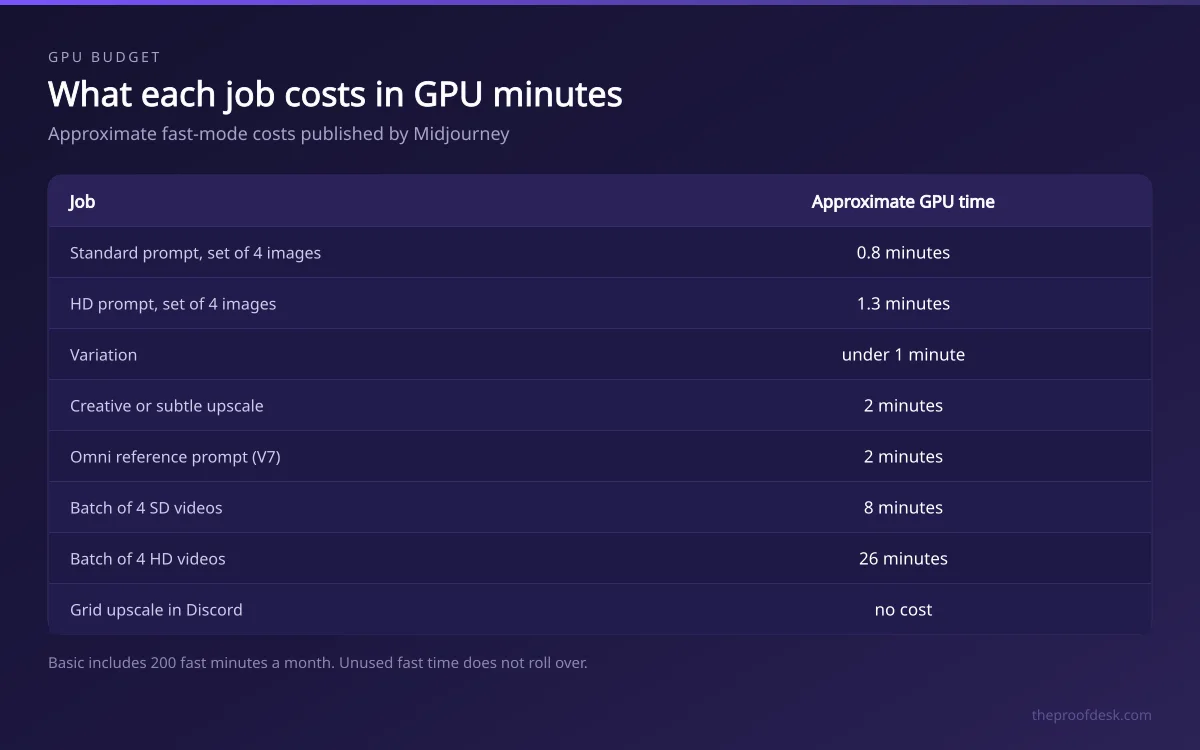
Run the numbers before choosing a tier. Basic includes 200 fast minutes, and a standard prompt returning four images costs about 0.8 minutes, so the entry plan is worth roughly 250 prompts or 1,000 images a month if you never touch video or upscales. Two HD video batches would take a tenth of that allowance. Unused fast time does not carry over, and extra hours cost 4 dollars each on every plan.
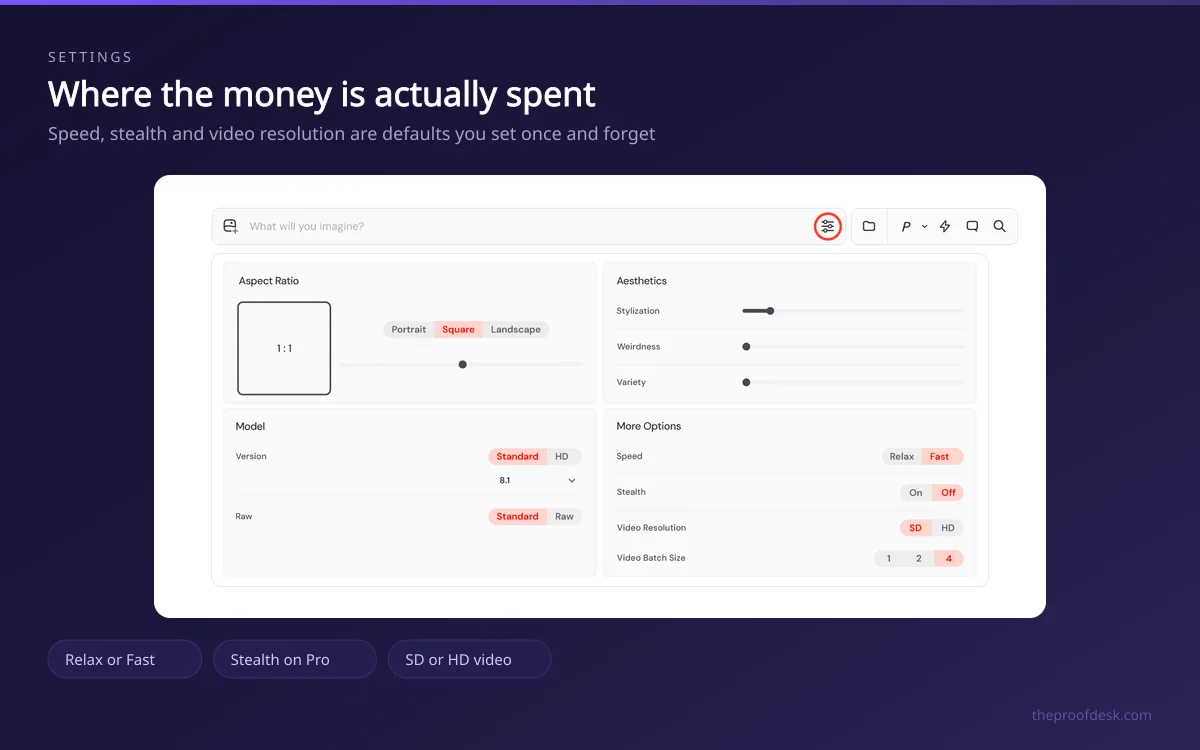
Relax mode has holes in it
Relax covers still images on Standard, Pro and Mega, and SD video only on Pro and Mega. Permutation prompts, the repeat parameter, HD resolution video and the legacy max upscaler all refuse to run in relax mode, so the features that generate the most work at once are exactly the ones that require fast time.
Getting the same look twice
Single impressive images are easy. The reason people pay for a subscription is repeatability: the same character across a series, or one house style across a campaign. Midjourney handles this with reference images attached to the prompt rather than with model training, and the reference type you pick decides what is copied.
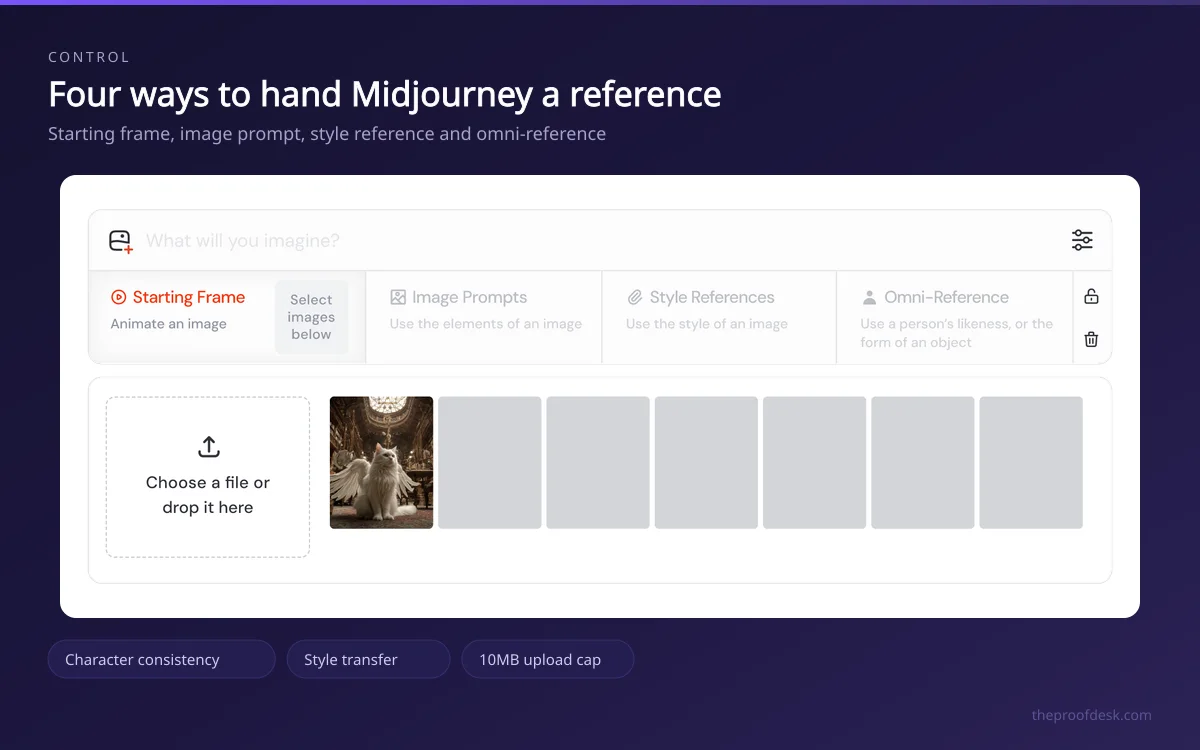
- Image prompt borrows the elements of a picture and is the bluntest of the four.
- Style reference copies the look and leaves the subject alone, which is what most brand work needs.
- Omni reference holds a person or object steady across prompts, but it runs on V7 and costs about 2 minutes per prompt.
- Starting frame is the video input: the still that the five second clip animates from.
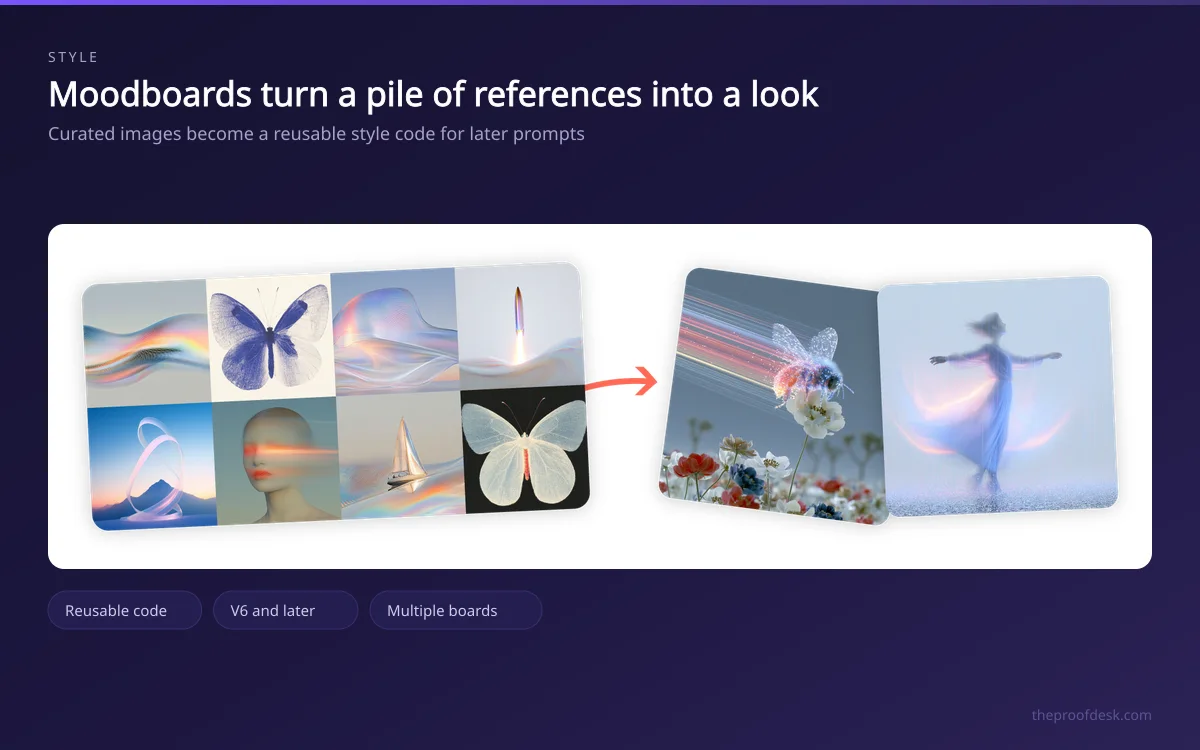
Above those sit the personalization tools. A personalization profile learns your taste from images you rate and applies it with the p parameter; the V7 global profile carries over to V8.2. Moodboards are the more deliberate version: you collect specific images into a named board, and Midjourney turns that board into a reusable code you can drop into later prompts. Both need version 6 or later.
Ownership, privacy and the open legal question
The terms of service, last updated on 11 August 2026, say you own the assets you create to the fullest extent possible under applicable law, and that this ownership survives downgrading or cancelling your plan. That is a clearer position than several competitors take, but it comes with conditions that are easy to miss.
- Companies above one million dollars in annual revenue need Pro or Mega for that ownership to apply.
- Images you upscale from other people stay owned by whoever created them.
- You grant Midjourney a perpetual, worldwide, irrevocable and sublicensable licence over what you upload and what you generate, and it survives you leaving.
- Everything is public and remixable by default, including work made in a private Discord server or a direct message.
Privacy is a paid feature. Stealth mode is limited to Pro and Mega, and Midjourney commits to best efforts not to publish what you make while it is on. It only covers the website: anything generated in a shared Discord channel is visible to everyone in that channel whatever your setting says. Content you made private stays private if you later downgrade.
The studio lawsuits are still open
Disney and Universal sued Midjourney over copyright in June 2025, and a Warner Bros. case was consolidated into it in November 2025. As of August 2026 the case is still in discovery with expert disclosures scheduled for October 2026, and no ruling has been issued. Nothing stops you subscribing today, but if you are producing work for a client, put the output through the same clearance process you would use for stock.
Frequently asked questions
Is there a free trial of Midjourney?
No, not on the website or in Discord. The only trial Midjourney currently offers is a limited one inside the niji journey mobile app for iOS and Android. Every route through midjourney.com requires a paid plan first, which is why the 10 dollar Basic tier is the usual way to test it.
Can I use Midjourney without a Discord account?
Yes. Sign up at midjourney.com with a Google account and you never have to open Discord. The web app carries the full feature set, and Discord is now the optional second interface rather than the required one. If you already have a Discord based account, keep using that login so your history stays in one place.
How many images does the Basic plan actually give me?
Roughly 1,000 images a month. Basic includes 200 minutes of fast time and a standard prompt returns four images for about 0.8 minutes, which works out at around 250 prompts. Upscales, HD output, older model versions and unusual aspect ratios cost more, and any video work will cut that figure sharply.
Does unused fast time roll over to next month?
No. Fast time resets when your subscription renews and anything left is lost, so there is no reason to save it. If you run out early you can buy more at 4 dollars an hour on the manage subscription page, at the same rate on every plan, or move to relax mode if your tier includes it.
Can I get a refund after subscribing?
Only if you have used fewer than 20 GPU minutes across the entire lifetime of the account, counting fast, turbo and relax time together. If you qualify, the refund option appears automatically when you cancel; if it does not appear, no refund is available. Processing takes up to ten business days.
Which plan do I need to keep my images private?
Pro at 60 dollars or Mega at 120 dollars, because stealth mode is restricted to those two tiers. Standard and Basic subscribers have their work published to the site by default. Remember that stealth only governs midjourney.com, so generating in a shared Discord channel still exposes the result to everyone in it.
Can I sell what I generate?
Yes, as a paid subscriber you own your assets to the fullest extent the law allows, and that ownership continues after you cancel. The exception is company revenue: if you or your employer earns more than one million dollars a year, Midjourney requires a Pro or Mega plan for the ownership terms to hold. Copyright protection for AI generated images is a separate question that depends on your jurisdiction.
Key takeaways
- Every plan sells GPU minutes rather than images, so what you generate decides the real cost far more than the tier does.
- Standard at 30 dollars is the first practical plan because relax mode makes still images unlimited once fast time is spent.
- Stealth mode and relax video are locked to Pro and Mega, and stealth does not cover anything made in a shared Discord channel.
- Paid subscribers own their output and keep it after cancelling, but companies over one million dollars in revenue must be on Pro or Mega.
- Refunds only exist under 20 GPU minutes of lifetime use, so treat the first month as a purchase rather than a trial.
More in Artificial Intelligence
Browse Artificial Intelligence