Murf AI Review 2026: Voices, Pricing and Export Limits
Murf turns a script into studio-style narration in 40 plus languages. Here is what the free plan blocks, what Creator and Business cost, and the jobs where a rival wins.
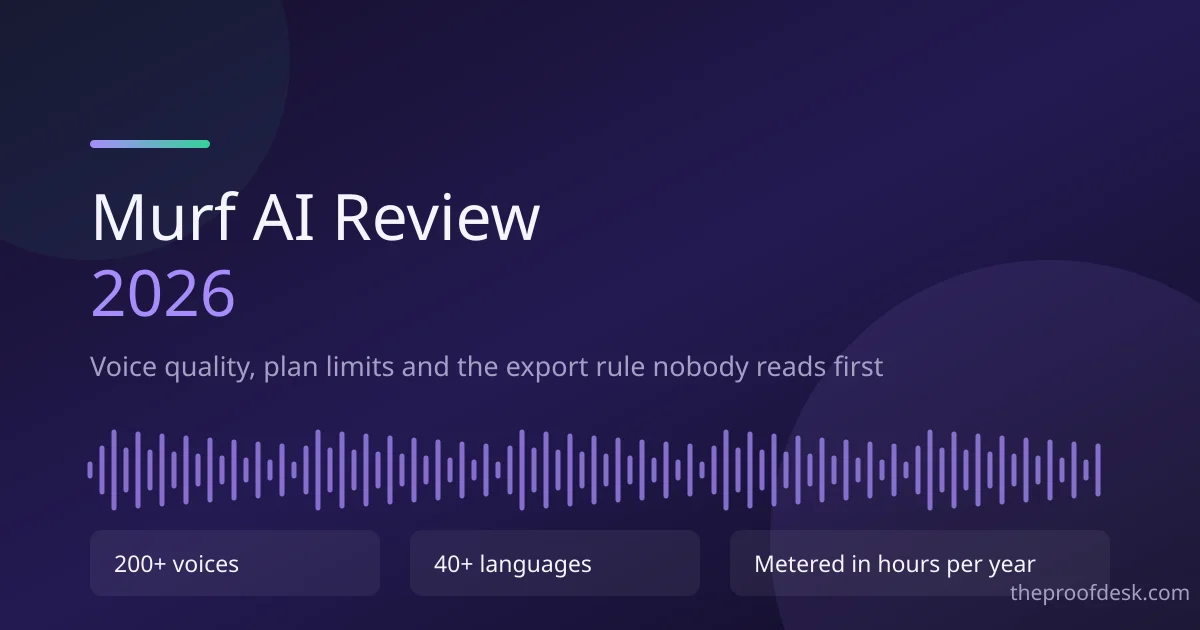
Murf turns a typed script into a voiceover that sounds recorded rather than synthesised. It is aimed at the people who need narration but not a studio: course designers, product marketers, agency editors and support teams building phone prompts.
This review covers what the platform actually contains, the free plan rule that catches most first-time users, what the paid tiers cost, and the jobs where a rival tool is the better buy. Plans and figures were checked in August 2026 and Murf changes them, so confirm at the checkout screen.
What Murf actually does
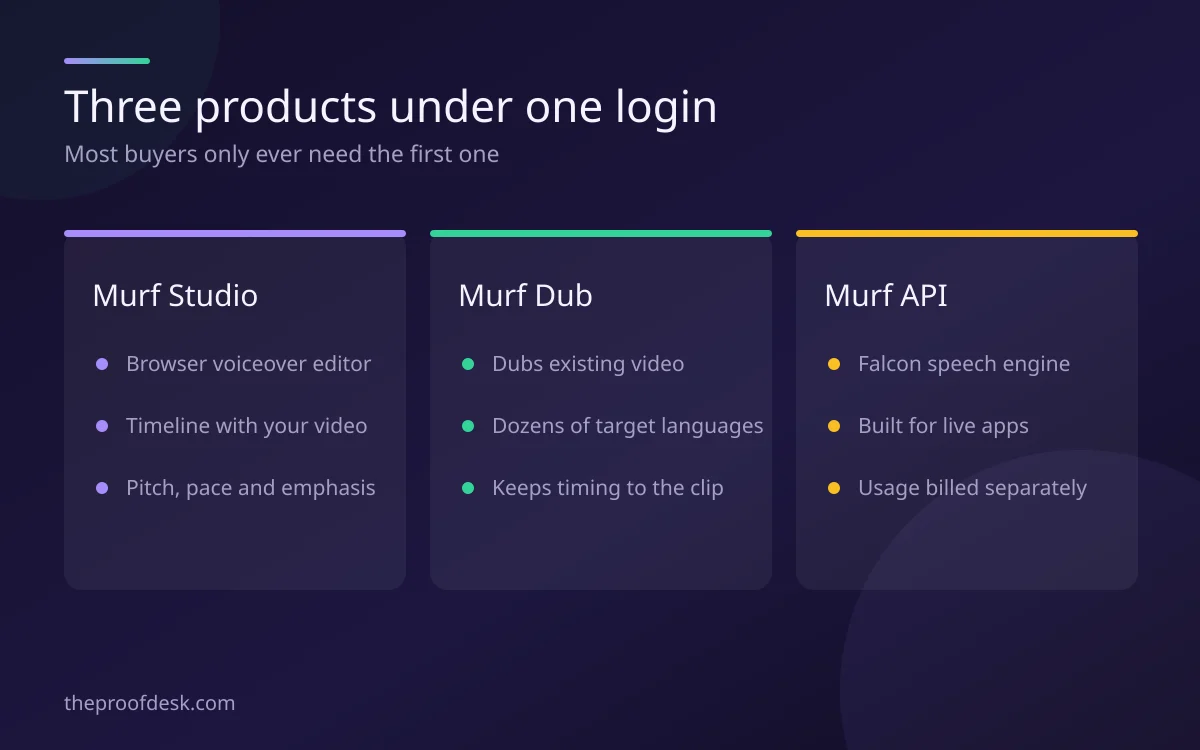
Murf is three products behind one login. Studio is the browser editor where you paste a script, pick a voice and adjust the delivery. Dub takes an existing video and re-voices it in another language. The API exposes the same speech engine to developers who want generated audio inside their own product.
- The help centre lists more than 200 voices across 40 plus languages and accents, with several regional variants for English, Spanish and Portuguese.
- Narration styles let one voice switch between a promo read, a calm explainer and a conversational take.
- MultiNative voices keep the same voice identity when the script switches language.
- Studio edits at the word level: pitch, pace, pauses and emphasis, plus a timeline that lines the audio up against your video.
Judge the voice with your own script
Marketing pages quote pronunciation accuracy figures and blind listening tests. Those numbers come from the vendor. Paste in your own copy, including product names and acronyms, because that is where synthetic voices usually give themselves away.
The free plan and the download rule
The free tier exists to let you hear the voices, not to produce work. You can generate a small one-off allowance of audio and share a link, but you cannot download the file and you have no commercial rights to what you make. People discover this after writing the script, which is the wrong moment.
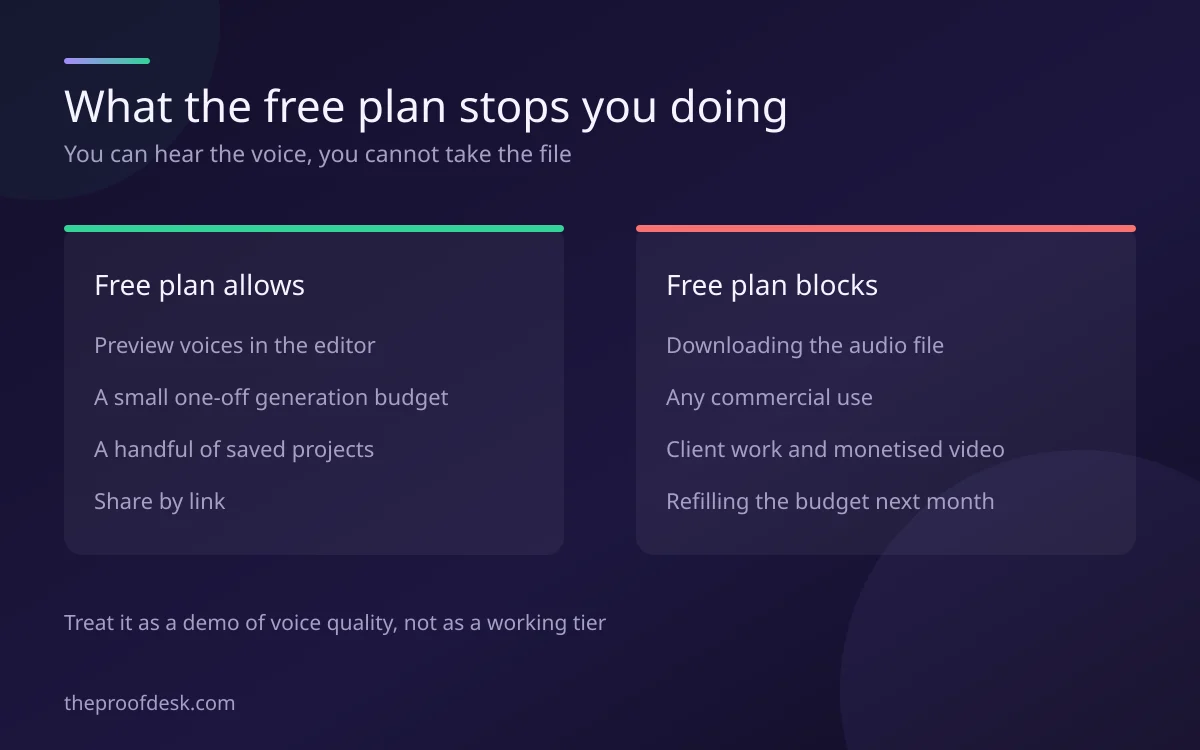
- The free allowance is a one-time budget rather than a monthly refill, so experimenting burns it quickly.
- No download means no editing in another tool, no upload to YouTube and no handoff to a client.
- Commercial use starts on the first paid tier, which matters even for a monetised video on your own channel.
- Project slots are capped too, so a long course cannot be split across dozens of drafts.
Used as intended, the free plan answers one question well: do these voices sound right for my material. Answer that first, then decide whether the subscription is worth it.
What the paid plans cost
Murf sells four tiers. Creator is listed at 29 dollars a month on monthly billing and drops to roughly 19 a month when paid for a year. Business is listed at 99 a month, falling to about 66 on annual billing. Enterprise is quoted per company and is the tier where voice cloning and formal compliance paperwork live.
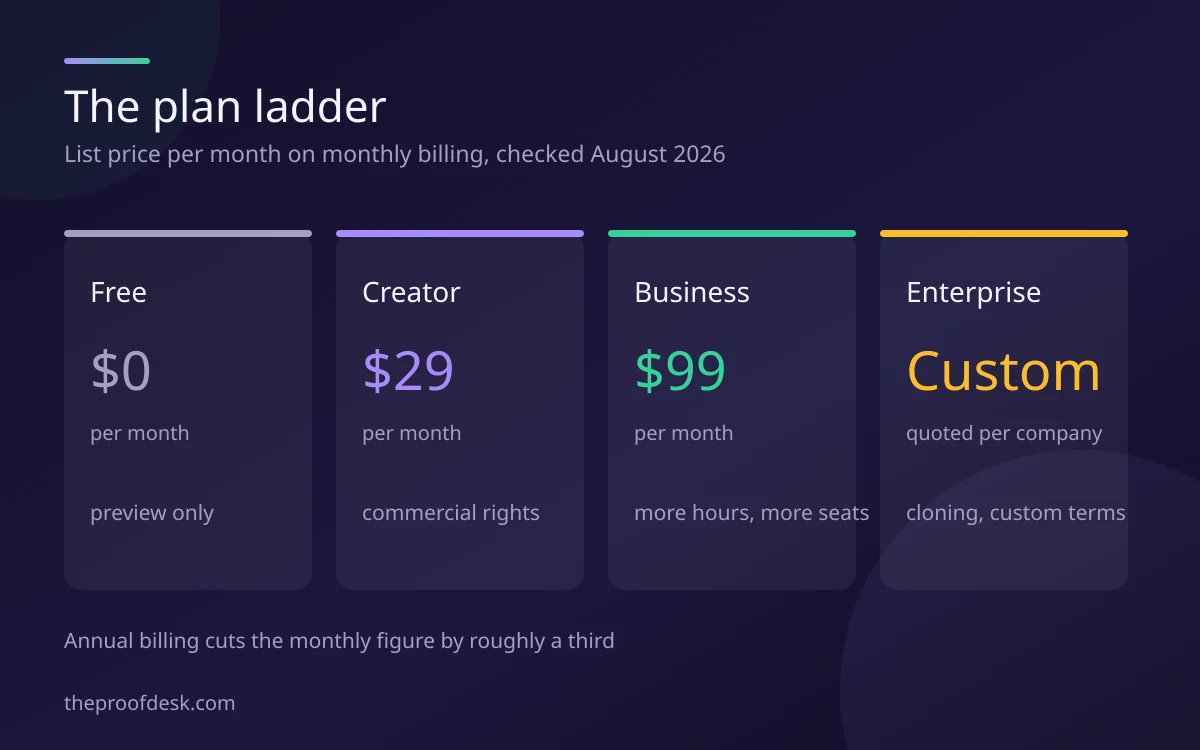
- Creator covers one seat with commercial rights and is aimed at a solo creator or a single marketer.
- Business raises the generation allowance and adds collaboration for a small team.
- Enterprise adds cloning, security review documents and account management, and is priced by negotiation rather than a public number.
- The API is billed on its own usage, so a Studio subscription does not cover an application you are building.
The unit that trips people up
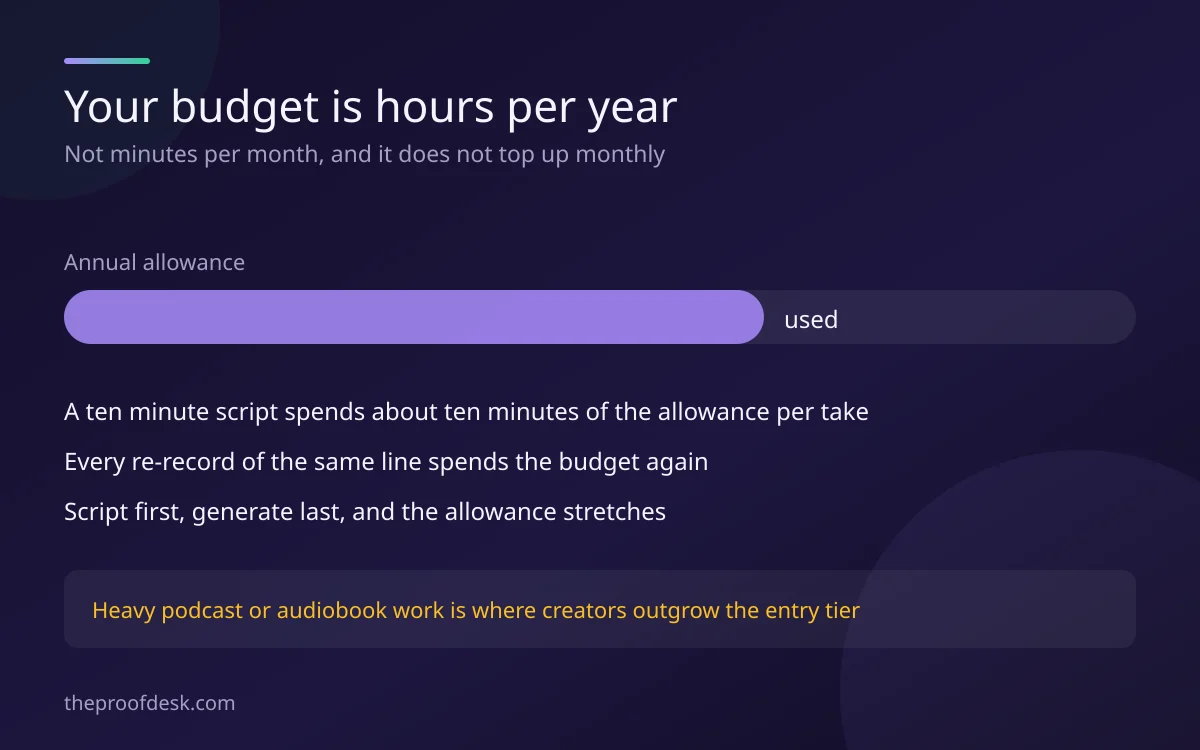
Paid allowances are measured in hours of generated audio per year, not minutes per month. A ten minute script costs about ten minutes of budget each time you render it, so rewriting in the editor and rendering once is far cheaper than generating after every small edit.
Who it fits, and where it loses
Murf is at its best on the corporate register: onboarding modules, explainer videos, internal training, phone prompts and product tours. The English voices are the strongest part of the catalogue and the editor is calm enough for someone who has never touched audio software.
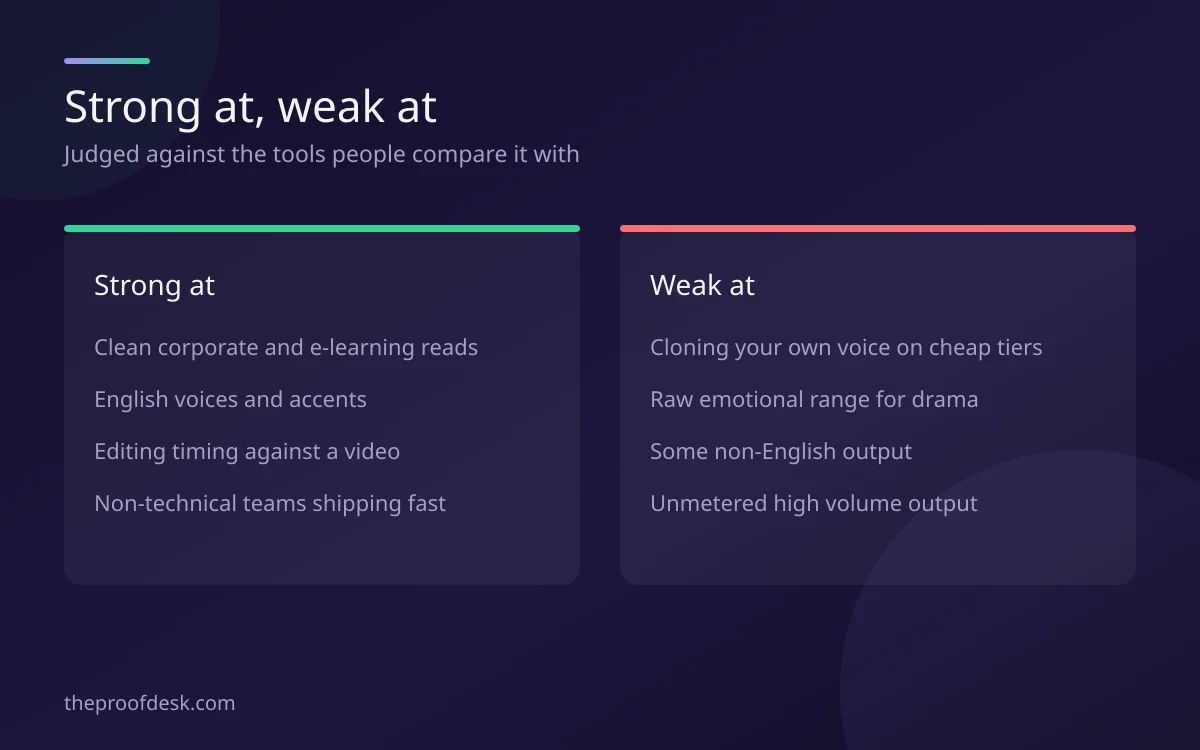
- If you need your own cloned voice, check the tier before subscribing, since cloning sits on Enterprise while some rivals include it far lower down.
- If you need acted emotion for fiction or games, expect to audition several tools; clean narration is not the same skill.
- If your work is mostly non-English, test that specific language rather than trusting the English demos.
- If volume is unpredictable, model your monthly minutes against an annual allowance before committing to a year.
Against ElevenLabs, the usual comparison, the split is roughly this: Murf sells a production workspace with timing controls and a tidy team workflow, while the rival sells raw voice modelling and cheaper access to cloning. Neither answer is universal, and both can be judged in an afternoon on your own script.
Frequently asked questions
Is Murf free to use?
There is a free plan, but it cannot export. You get a small one-off generation allowance to preview voices in the browser and share a link, with no downloads and no commercial rights. Any real deliverable needs a paid tier.
How much does Murf cost?
Creator is listed at 29 dollars a month and Business at 99 on monthly billing, with annual billing cutting each by roughly a third, to about 19 and 66. Enterprise is custom quoted. Those were the published figures in August 2026 and Murf runs promotions, so read the checkout total rather than the pricing page headline.
Can I clone my own voice?
Only on Enterprise, as the tiers stand in 2026. Creator and Business give you the stock catalogue, not a model of your own voice. If cloning is the reason you are shopping, price Enterprise properly or look at a competitor that offers it on a consumer tier.
Can I use Murf voiceovers on monetised YouTube or client work?
Yes, on any paid plan, which is what the commercial rights in Creator and above cover. The free plan does not permit commercial use, so a monetised upload made on the free tier is a licensing problem even though the audio came out of your own account.
How is my usage measured?
In hours of generated audio per year on paid plans. Each render of a script deducts its full length, including regenerated takes of the same line, so the allowance goes further if you finish the wording before you start generating.
How many voices and languages does it support?
More than 200 voices across 40 plus languages and accents, according to the Murf help centre. English has the widest choice of accents and styles, and English output is generally the most convincing, so test any other language you plan to publish in.
Can I get a refund if I change my mind?
Assume not. Murf treats subscription payments as largely non-refundable and points refund requests at its support team, with only a narrow window reported for people who cancel almost immediately and have barely generated anything. Cancelling stops the next renewal and leaves access running to the end of the paid period, and a pause option exists if you only need a break.
Should I pick Murf or ElevenLabs?
Pick Murf if the job is narration with editing, timing against video and a team workflow. Pick ElevenLabs if the job is voice cloning or expressive character work on a small budget. Both offer enough free access to compare with the same script before you pay for either.
Key takeaways
- Murf is a voiceover workspace rather than a single generator: Studio for narration, Dub for translation, an API for developers.
- The free plan cannot download and carries no commercial rights, so treat it as an audition, not a tier.
- Creator is around 29 dollars a month, Business around 99, with annual billing taking off roughly a third, checked August 2026.
- Allowances are counted in hours of generated audio per year and every retake spends it, so finalise wording before rendering.
- Voice cloning is an Enterprise feature here, which is the main reason buyers who need it end up elsewhere.
More in Artificial Intelligence
Browse Artificial Intelligence