Play.ht Review (2026): The AI Voice Generator Meta Bought and Shut Down
Play.ht was one of the best-known AI voice and text-to-speech platforms until Meta acquired the team and shut it down on December 31, 2025. An honest retrospective on what it did, what happened to user data, and where to go now.
Play.ht (also styled PlayHT and later PlayAI) spent years as one of the most recognizable AI text-to-speech and voice-cloning platforms on the web. If you researched TTS tools any time between 2022 and 2025, you almost certainly ran into it. So this review has to start with the single most important fact about it in 2026: you can no longer sign up, and it is gone for good.
Meta acquired the PlayAI team in July 2025 and folded it into Meta Superintelligence Labs. The studio, the API and the Voice Agents product were all shut down permanently on December 31, 2025, and user accounts, saved audio and voice clones were deleted with no export tool. As of mid-2026 the play.ht domain no longer even resolves.
This is therefore a retrospective, not a buying guide. We cover what Play.ht actually offered, the timeline of its shutdown, what it used to cost, what happened to people's data, and the honest question every former user is asking: where do you go instead?
What happened to Play.ht
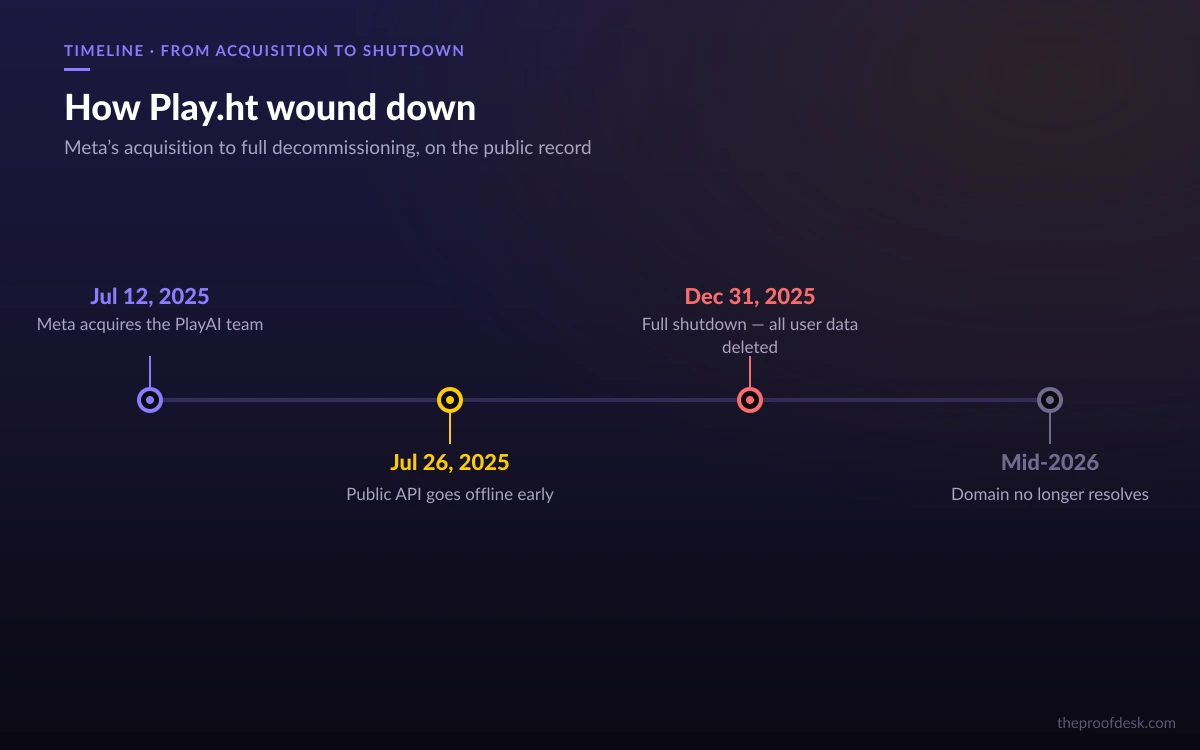
On July 12, 2025, Meta publicly confirmed it had acquired the PlayAI team. Reporting put the group at roughly 35 people, absorbed into Meta Superintelligence Labs; the financial terms were never disclosed.
An internal Meta memo framed the fit plainly: PlayAI's work "creating natural voices, along with the platform for easy voice creation, is a great match for our work and road map, across AI Characters, Meta AI, Wearables and audio content creation." In other words, the value was the team and the voice technology, not the standalone product.
For existing customers, the wind-down was rough. The PlayHT API went offline ahead of schedule, around July 26, 2025, breaking developer integrations weeks before the announced sunset. Then on December 31, 2025, everything closed permanently: the Play.ht studio, the API and Voice Agents.
The part that stings
User accounts, saved audio and voice clones were deleted at the sunset, and no export tooling was provided beforehand. If you had generated audio or trained a custom voice on Play.ht, it is gone — there is no archive to log back into and download.
By July 2026 the play.ht domain no longer resolves at all. Any link you still have to the site, the pricing page or the docs is dead.
What Play.ht used to offer
At its peak, Play.ht positioned itself squarely as a premium AI voice generator. Its homepage tagline promised to "generate multi-speaker AI voices indistinguishable from humans with the best AI voice generator & text to speech platform," with support for multi-turn, multi-speaker output.
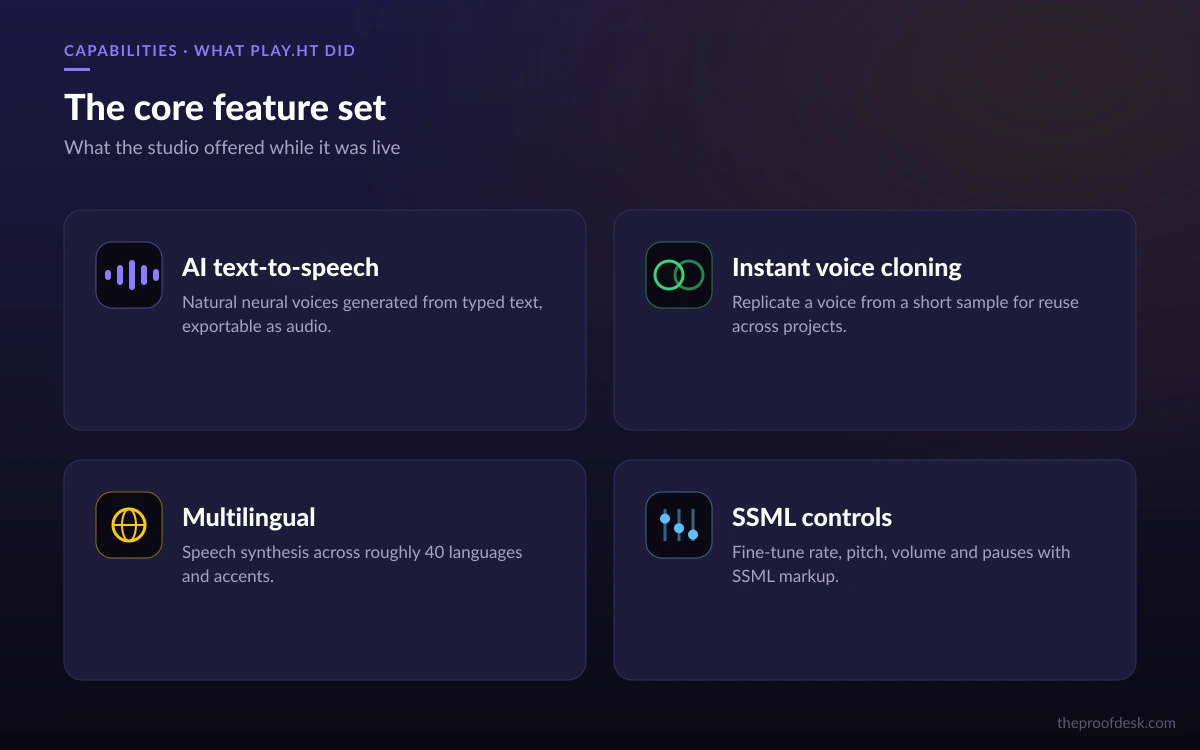
The core product was a browser-based studio for turning text into speech, plus instant voice cloning and a developer API. It leaned on SSML-style controls — rate, pitch, volume and custom pronunciations — along with custom pauses for punctuation, which gave power users real control over delivery.
How many voices and languages, really?
Here the vendor's own marketing was inconsistent, and it is worth being honest about it rather than quoting a single tidy number. On the same homepage, the studio-facing section advertised "206 AI Voices... across 30+ languages and accents," while the API-facing section claimed "800+ natural-sounding AI Voices." Language coverage was variously described as 40+ and "over 42 languages."
The takeaway is not a precise count but a scale: a large multilingual voice library in the low hundreds of curated voices, expandable via cloning, covering roughly 40 languages. Treat any exact figure you still see quoted around the web with caution — the source contradicted itself.
The voice models: from PlayHT 2.0 to PlayDialog
Play.ht's model lineage ran PlayHT 2.0 → PlayHT 2.0 Turbo → Play 3.0 Mini → PlayDialog. If you see references to a "PlayHT 3.0 Turbo," ignore them — no such model existed; the naming just gets muddled in secondhand roundups.
PlayHT 2.0 Turbo was the low-latency workhorse, quoted at sub-300ms network latency and sub-100ms on-premise, which made it viable for near-real-time applications.
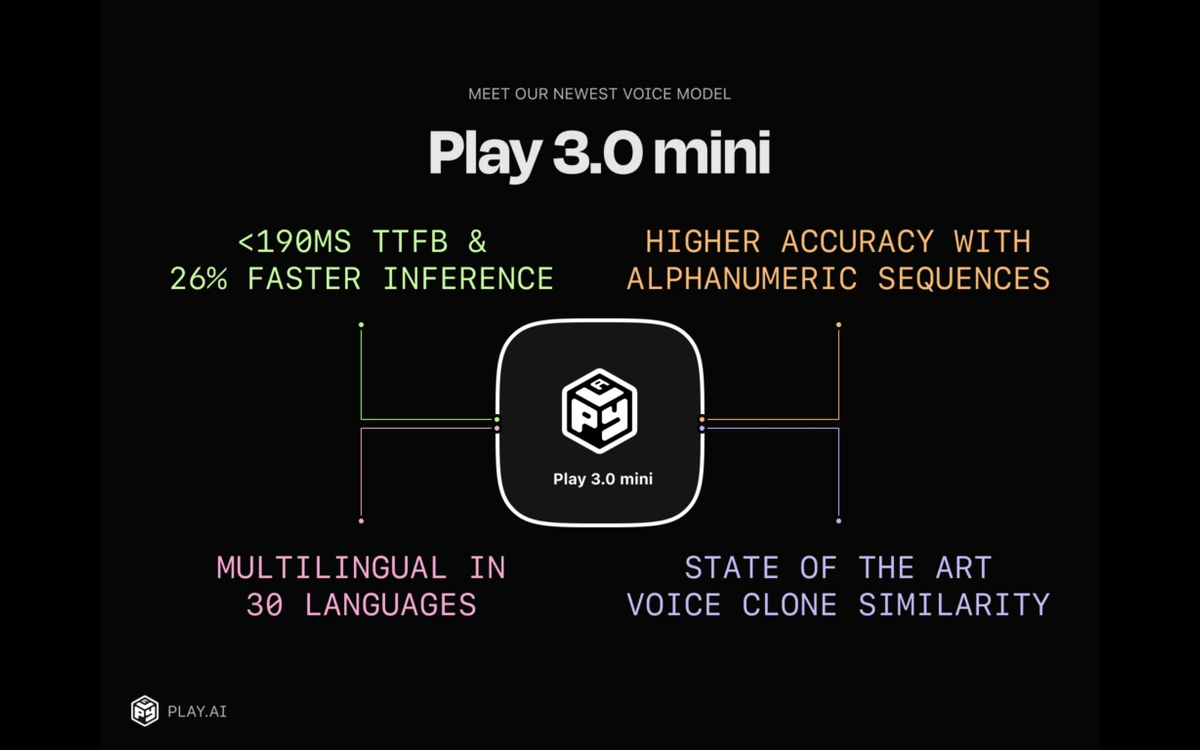
Play 3.0 Mini, released October 14, 2024, was the headline model near the end. Play.ht called it "our most capable and conversational voice model that can speak in 30+ languages using any voice or accent, with industry leading speed and accuracy." It claimed "a mean latency of 143 milliseconds for TTFB" — time to first byte — "making it our fastest AI Text to Speech model," running inference 28% faster than Play 2.0.
PlayDialog ("Dialog 1.0") was the last step, oriented toward multi-speaker, conversational audio — exactly the kind of AI-character and agent voice work Meta cited as its reason for the acquisition.
What Play.ht used to cost
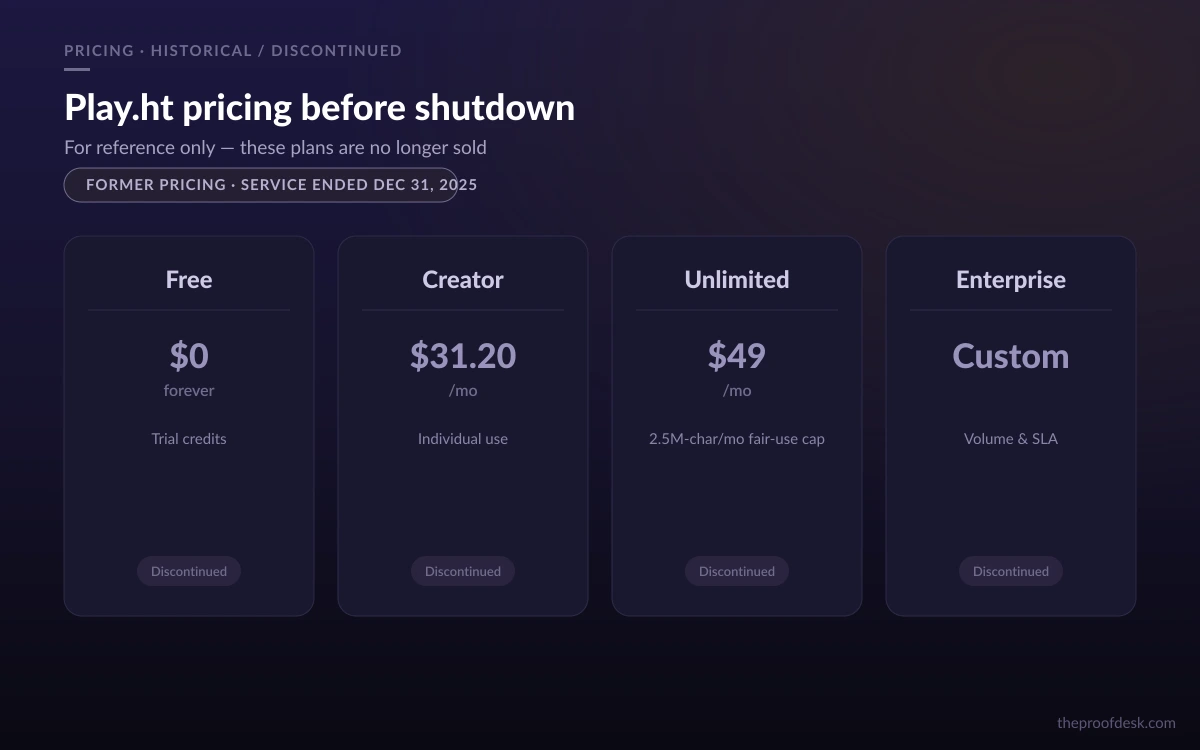
For the record — and only for the record, since none of these plans are purchasable now — here is the last live pricing captured before shutdown (May 2025). Figures are from the official archived pricing page.
- Free: $0 — 1,000 characters, 1 instant voice clone, access to all voices and languages.
- Creator: $31.20/month (billed annually at $374.40) — 3 million characters per year, 10 instant voice clones, high-fidelity clones, attribution-free use, multilingual models, advanced export and API.
- Unlimited: a "limited time deal" at $49/month, down from $99 (billed annually at $588) — "unlimited" characters, unlimited instant clones, 3 high-fidelity clones and API.
- Enterprise: custom pricing, contact sales.
“Unlimited” had a ceiling
The Unlimited plan carried a fair-usage limit stated verbatim as "2.5 million monthly and 30 million yearly characters," beyond which users were asked to contact the company. Worth remembering whenever any AI tool markets an "unlimited" tier.
A common third-party pricing aggregator listed the free tier at 12,500 characters per month, but that conflicts with the official archived page's 1,000-character figure and could not be verified. Trust the official 1,000-character number.
Discounts: Play.ht offered "a flat 20% discount to students, educators, and non-profits," plus special Enterprise pricing. Refunds were tight — requests had to be made "within 24 hours of purchase, and the character usage must be below 5000 characters," with no refunds for change of mind or dissatisfaction.
How users actually rated it
Before the shutdown, Play.ht's reputation was solid but not spotless. On G2 it held roughly a 4.2 out of 5 rating across about 89 reviews, with users praising realistic voice quality and ease of use. The recurring complaint was customer support responsiveness.
That support theme showed up more sharply elsewhere. Trustpilot-style feedback included complaints about slow refunds — some users reporting waiting months — and billing or account-access problems, particularly for subscriptions bought through Google accounts.
None of this is disqualifying for a product of its era, but in hindsight the support and billing friction looks like a warning sign for anyone who later had to chase a refund or recover data during the wind-down.
Where to go instead
Since Play.ht no longer exists, the only useful buying advice is about migration. If you built on the API, you need a new provider; if you cloned a voice, you unfortunately have to re-clone it from your original audio, because the trained voice on Play.ht is gone.
- For general AI voice generation and cloning, ElevenLabs is the most common destination and the closest feature-for-feature match.
- For developers who need a drop-in API and conversational/agent voices, platforms like Inworld published dedicated Play.ht migration guides — a practical starting point if you are porting integrations.
- For occasional narration or accessibility use, the built-in TTS in your operating system or cloud voices from major providers may be enough without a subscription.
Whichever you pick, verify the current pricing and feature limits yourself before committing — this whole story is a reminder that AI-voice vendor terms, and the vendors themselves, can change fast.
Frequently asked questions
Can I still sign up for or buy Play.ht in 2026?
No. Play.ht shut down permanently on December 31, 2025, and the domain no longer resolves. There is no account to create and nothing to purchase. Any site still selling "Play.ht access" is not the original service.
What happened to my Play.ht account, audio and voice clones?
They were deleted at the December 31, 2025 sunset, and no export tool was offered beforehand. Generated audio and trained voice clones are not recoverable. If you still have your original source recordings, you can re-clone the voice on another platform.
Why did Play.ht shut down?
Meta acquired the PlayAI team in July 2025 and moved them into Meta Superintelligence Labs to work on AI Characters, Meta AI and audio content. The standalone product was wound down rather than continued — the API even went offline early, around July 26, 2025.
How much did Play.ht cost before it closed?
Its final pricing ran from a free tier (1,000 characters, 1 instant clone) to a Creator plan at $31.20/month billed annually, an "Unlimited" plan at a discounted $49/month with a 2.5M-character monthly fair-use cap, and custom Enterprise pricing. None of these are available now.
Can I get a refund for a Play.ht subscription?
Refunds are no longer processable through a live service. Even before shutdown the policy was strict — requests within 24 hours of purchase and under 5,000 characters of usage — and refund delays were a common complaint. If you were charged after the shutdown, dispute it with your payment provider.
What is the best Play.ht alternative?
For most users migrating from Play.ht, ElevenLabs is the closest equivalent for AI voice generation and cloning. Developers porting API integrations should look at providers that published migration guides, such as Inworld. Confirm current pricing and limits directly with each vendor.
Key takeaways
- Play.ht is discontinued: Meta acquired the team in July 2025 and shut the product down permanently on December 31, 2025. You cannot sign up or buy it.
- All user data — accounts, saved audio and voice clones — was deleted at the sunset with no export option. If you have original recordings, re-clone elsewhere.
- At its peak it was a strong, premium TTS and voice-cloning platform with a large multilingual voice library and low-latency models like Play 3.0 Mini (143ms TTFB).
- Its marketing numbers were inconsistent (206 vs 800+ voices), and support and refund friction were the most common user complaints.
- For migration, ElevenLabs is the closest general alternative and Inworld published a developer migration guide; always verify current pricing yourself.
More in Artificial Intelligence
Browse Artificial Intelligence