Pressable Review: Automattic's Install-Based Managed WordPress Host
A hands-on review of Pressable, the Automattic-owned managed WordPress host that prices by install count on WP Cloud. Plans, overage rules, features and how it stacks up against WP Engine.
Most managed WordPress hosts sell you tiers: the cheap plan hides the good features, and you climb the ladder to unlock a WAF here or staging there. Pressable does the opposite. Every plan ships the same full stack, and the only thing that changes as you pay more is how many WordPress installs and how much traffic you're allowed. For an agency juggling client sites, that flips the whole buying decision.
Pressable is also not a scrappy indie host. It has been majority-owned by Automattic — the company behind WordPress.com, WooCommerce and Jetpack — since 2016, and it runs on WP Cloud, the same infrastructure that powers WordPress.com and WordPress VIP. That puts it in direct competition with WP Engine, the host Automattic has publicly clashed with, at a lower price point on almost every line item.
This review breaks down how Pressable's install-based pricing actually works (including the annual-versus-monthly trap in its headline numbers), what you get on every plan, and where it beats — and doesn't beat — WP Engine and Kinsta for teams running more than one WordPress site.
What Pressable is and who owns it
Pressable is a managed WordPress hosting company founded in 2010. Automattic took a majority stake in 2016, so while it operates as its own brand with its own dashboard and support team, it sits inside the same corporate family as WordPress.com, WooCommerce and Jetpack.
The technical part that matters is the infrastructure. Pressable runs on WP Cloud, Automattic's WordPress-tuned hosting platform — the same platform behind WordPress.com and the enterprise-grade WordPress VIP. Pressable was actually the first host to run on WP Cloud, using it from summer 2019, two years before WP Cloud's official launch in August 2021. In practice that means the servers, caching layer and CDN under your site are the ones Automattic runs at massive scale for its own properties.
Why the ownership matters
Pressable and WP Engine are the two big Automattic-adjacent stories in managed WordPress — except Pressable is the one Automattic actually owns. If you want a host tied directly to the people who build WordPress core, Jetpack and WooCommerce, Pressable is the most direct option short of WordPress.com itself.
How Pressable's pricing works
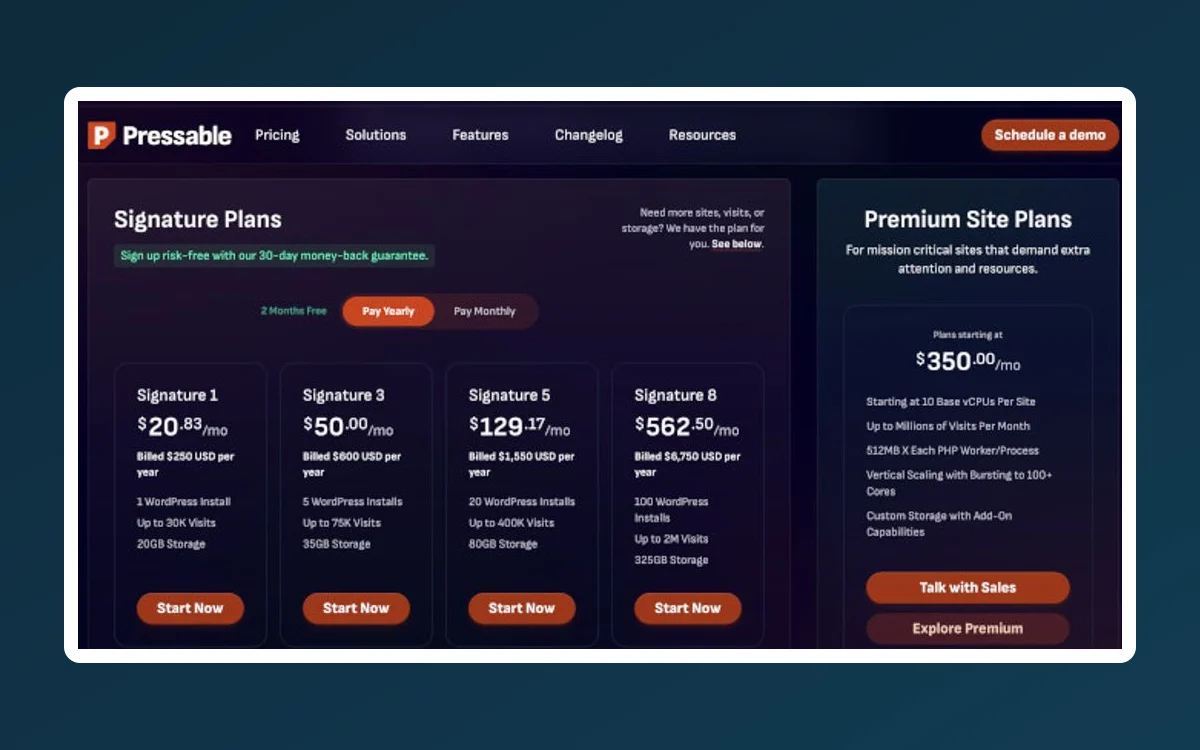
Pressable prices by WordPress install count, not by feature tier. Its main lineup is called Signature, running from Signature 1 (a single site) up to Signature 8 (100 sites). Each step raises three limits together: the number of installs, the monthly visitor cap and the amount of storage.
Read the per-month numbers carefully
The headline prices below are the annual billing rate divided by twelve — you only get them by paying for a full year up front. Pressable also sells a plain month-to-month rate that is higher (roughly $25/mo for a single site). Budget for the annual figure only if you can commit annually.
The Signature plans, at their annual-billing (paid-yearly) rate:
- Signature 1 — $20.83/mo ($250/yr): 1 install, 30K monthly visitors, 20GB storage
- Signature 2 — $37.50/mo ($450/yr): 3 installs, 50K visitors, 30GB storage
- Signature 3 — $50.00/mo ($600/yr): 5 installs, 75K visitors, 35GB storage
- Signature 4 — $75.00/mo ($900/yr): 10 installs, 150K visitors, 50GB storage
- Signature 5 — $129.17/mo ($1,550/yr): 20 installs, 400K visitors, 80GB storage
- Signature 6 — $291.67/mo ($3,500/yr): 50 installs, 1M visitors, 200GB storage
- Signature 7 — $454.17/mo ($5,450/yr): 80 installs, 1.6M visitors, 275GB storage
- Signature 8 — $562.50/mo ($6,750/yr): 100 installs, 2M visitors, 325GB storage
Above the Signature range, Pressable offers premium/custom plans for mission-critical sites starting at $350/month, with custom resources scaling to 100+ vCPUs and millions of monthly visits.
Overages and renewals
Going over your plan limits doesn't get your site suspended — Pressable bills the overage: $1.20 per 1,000 visits above your cap, and $1.00 per GB of storage above your allowance. That makes it easy to model the cost of a traffic spike instead of being forced onto the next tier permanently.
One genuinely good policy: Pressable states it does not raise prices at renewal. The rate you sign up at is the rate you keep paying, which is the opposite of the intro-price-then-hike pattern common across shared and managed hosting.
What every plan includes
This is Pressable's real pitch. There is no feature ladder — Signature 1 and Signature 8 ship the exact same capabilities; you're only buying more installs, traffic and storage as you climb. Every plan includes:
- 5 dedicated PHP workers (5 vCPUs) per site
- Hourly and daily automated backups
- Geo-redundant high-availability cloud hosting
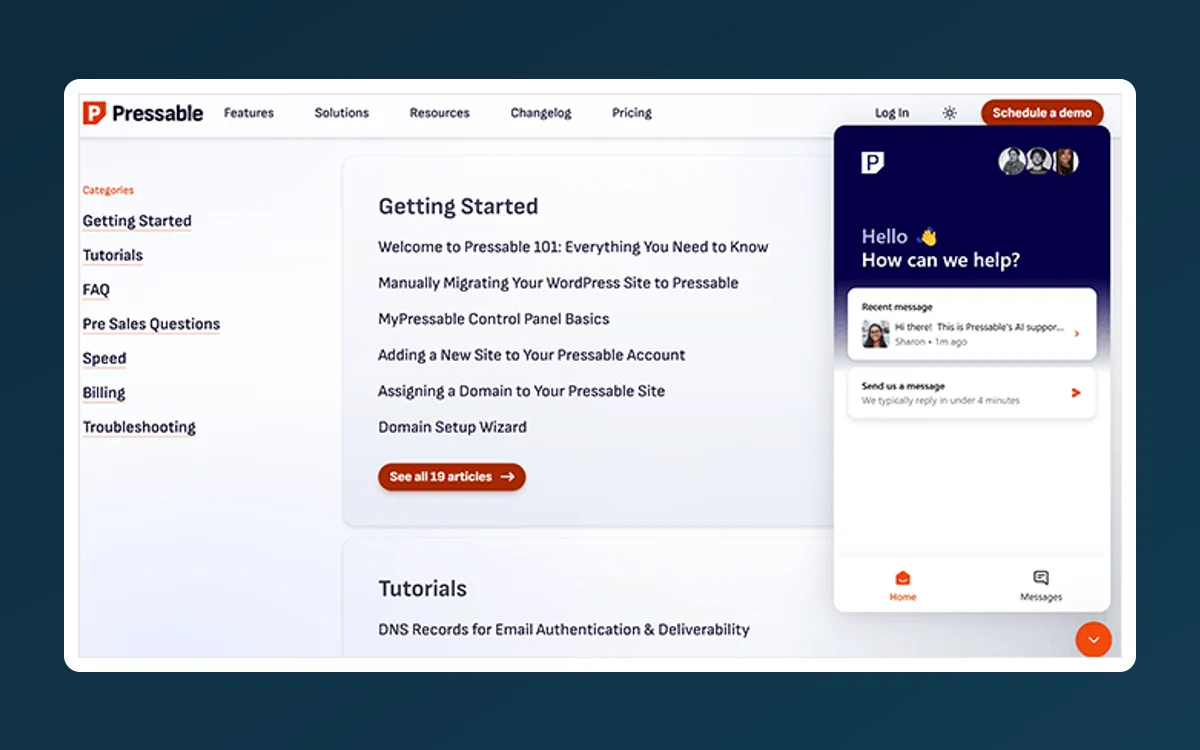
- 24/7 WordPress-specialist support
- Jetpack Security bundled free (a $239/year value)
- Free white-glove site migrations
- Free SSL certificates
- The full caching and CDN stack
- One staging site
A few features are gated by plan size rather than by feature tier. WordPress Multisite (subdomain or subdirectory networks) requires a Signature 5 plan or higher. Optional add-ons include Titan email hosting at $3.50/month and a Plugin Update Scheduler (from $3/month) that performs automated rollbacks when an update breaks a site.
The Jetpack angle
Because Pressable is an Automattic property, Jetpack Security ships bundled at no extra cost on every plan. That covers a managed firewall, brute-force protection and real-time backups — the kind of thing rival hosts often reserve for higher tiers or sell as an add-on.
Pressable vs WP Engine
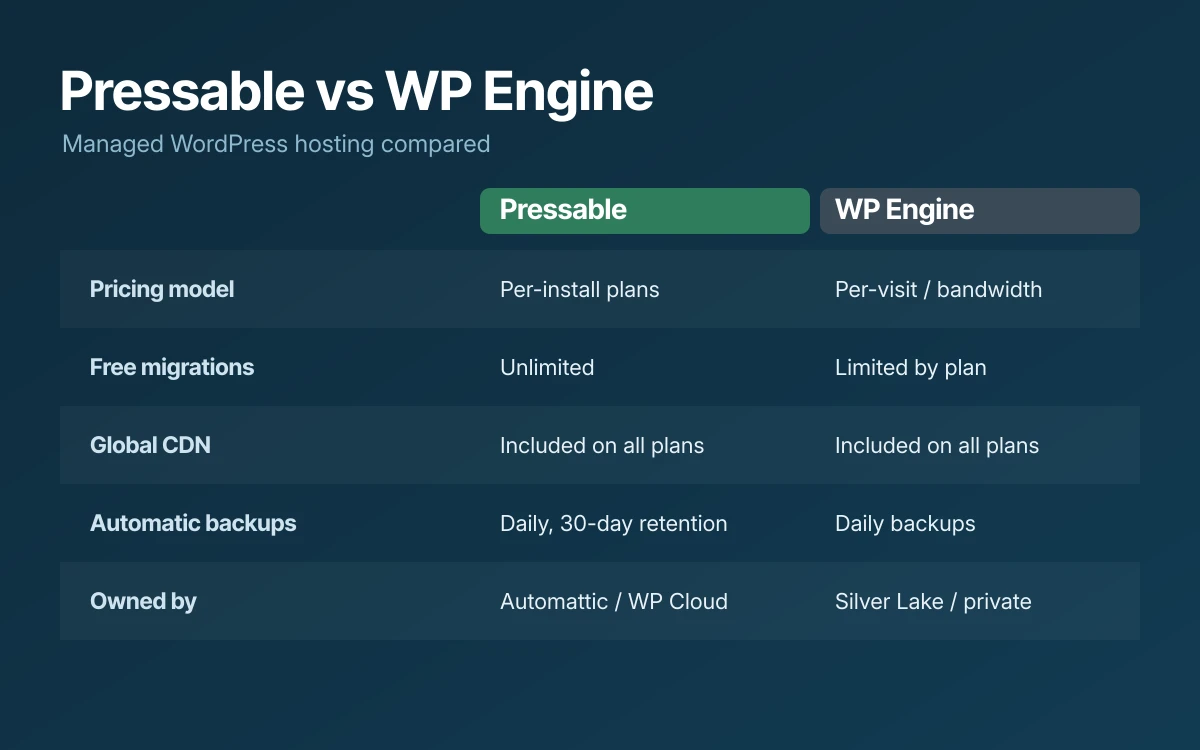
WP Engine is the obvious comparison — it's the market-leading managed WordPress host, and Pressable positions itself directly against it. The figures below come from Pressable's own comparison, so read them as Pressable's framing, but the line items are concrete and checkable.
- Entry price: Pressable starter $20.83/mo vs WP Engine starter $25/mo
- Agency plans: Pressable from $292/mo vs WP Engine from $400/mo
- Starter storage: 20GB (Pressable) vs 10GB (WP Engine)
- Bandwidth: unlimited (Pressable) vs from 75GB, varying by plan (WP Engine)
- Starter visits: 30K (Pressable) vs 25K (WP Engine)
- Uptime guarantee: 100% (Pressable) vs 99.99% (WP Engine)
- Email: Titan Email at $3.50/mo (Pressable) vs no email accounts at all (WP Engine)
- Site monitoring: free (Pressable) vs $5/mo (WP Engine)
- Migrations: free white-glove on all plans (Pressable) vs no migration service currently (WP Engine)
It isn't a clean sweep. WP Engine includes both a staging site and a separate development site, where Pressable gives you one staging site. WP Engine's Smart Plugin Manager ($3+/month) does visual regression testing on plugin updates, a different and arguably more thorough approach than Pressable's rollback-based Plugin Update Scheduler. And on Multisite, WP Engine sells it as a $30/month add-on on lower plans (free at $400+/month), where Pressable simply requires you to be on Signature 5 or above.
For a fuller picture of WP Engine itself — including the Automattic dispute that made headlines — see our separate WP Engine review. For this comparison, the short version is that Pressable undercuts WP Engine on entry price, storage, bandwidth, uptime SLA, email and several included extras, while WP Engine keeps an edge on developer environments and plugin-update tooling.
Who Pressable is for
The install-based model makes Pressable most compelling for agencies and freelancers managing several WordPress sites. Instead of buying a full-featured plan per client, you buy a bucket of installs and traffic and pack multiple sites into it — every one of them getting the complete feature set, not a stripped-down cheap tier.
For a single high-traffic site, the calculus is closer. You're paying for install slots you won't use, and dedicated single-site specialists like Kinsta compete hard on raw performance. But the WP Cloud infrastructure, 100% uptime guarantee, free migrations and bundled Jetpack Security still make Pressable a strong single-site option, particularly if you value the direct Automattic lineage.
Where it's a weaker fit: teams that lean heavily on separate development environments, or anyone who needs a true month-to-month commitment without the annual-billing discount — the pay-monthly rate erodes much of Pressable's price advantage.
Frequently asked questions
How much does Pressable cost?
Pressable's Signature plans run from $20.83/mo ($250/yr) for a single site up to $562.50/mo ($6,750/yr) for 100 sites, at the annual-billing rate. Custom premium plans start at $350/month. Note the headline monthly figures assume you pay for a full year up front; the plain month-to-month rate is higher (about $25/mo for one site).
Is Pressable owned by Automattic?
Yes. Automattic — the company behind WordPress.com, WooCommerce and Jetpack — has held a majority stake in Pressable since 2016. Pressable was founded independently in 2010 and still runs as its own brand, but its hosting is built on Automattic's WP Cloud infrastructure.
What happens if I exceed my plan's visitor or storage limit?
Your site keeps running; Pressable bills the overage. It charges $1.20 per 1,000 visits above your monthly cap and $1.00 per GB of storage above your allowance, so a temporary traffic spike costs a predictable overage fee rather than forcing a permanent upgrade.
Does Pressable raise prices at renewal?
No. Pressable states that the rate you sign up at is the ongoing rate — it does not hike prices at renewal. That's a meaningful difference from hosts that advertise a low intro price and increase it on the second term.
How is Pressable different from WP Engine?
Pressable prices by install count with every feature included on every plan, is Automattic-owned, and undercuts WP Engine on entry price, storage, bandwidth, uptime guarantee and email. WP Engine counters with a separate development site alongside staging and visual-regression plugin testing. Pressable is generally the better value for multi-site agencies.
Does Pressable include free site migrations?
Yes. Free white-glove migration is included on every Pressable plan, where the Pressable team moves your existing WordPress site over for you. WP Engine, by contrast, does not currently offer a migration service.
Can I run WordPress Multisite on Pressable?
Yes, but it requires a Signature 5 plan or higher. Multisite (subdomain or subdirectory networks) is not available on the smaller Signature 1–4 plans.
Key takeaways
- Pressable prices by WordPress install count, and every plan ships the same full feature set — you pay for more installs, traffic and storage, never to unlock features.
- It's majority-owned by Automattic and runs on WP Cloud, the same infrastructure behind WordPress.com and WordPress VIP.
- Headline per-month prices are annual-billing rates divided by twelve; the true month-to-month rate is higher, so the value case depends on committing annually.
- Overages are billed ($1.20/1,000 visits, $1.00/GB) instead of forcing an upgrade, and Pressable does not raise prices at renewal.
- Against WP Engine, Pressable wins on entry price, storage, bandwidth, uptime guarantee, email and free migrations; WP Engine keeps an edge on dev environments and plugin-update testing.
- Best fit: agencies running multiple WordPress sites who want every site on the full stack for one predictable bill.
More in Cloud Computing
Browse Cloud Computing