Remini Review 2026: What the AI Photo Enhancer Costs, Limits and Keeps
Remini sharpens faces and repairs old photos well, but it has no fixed price list, weekly-first plans, pay-to-dismiss limits and separate web and app billing. Here is what you actually get.
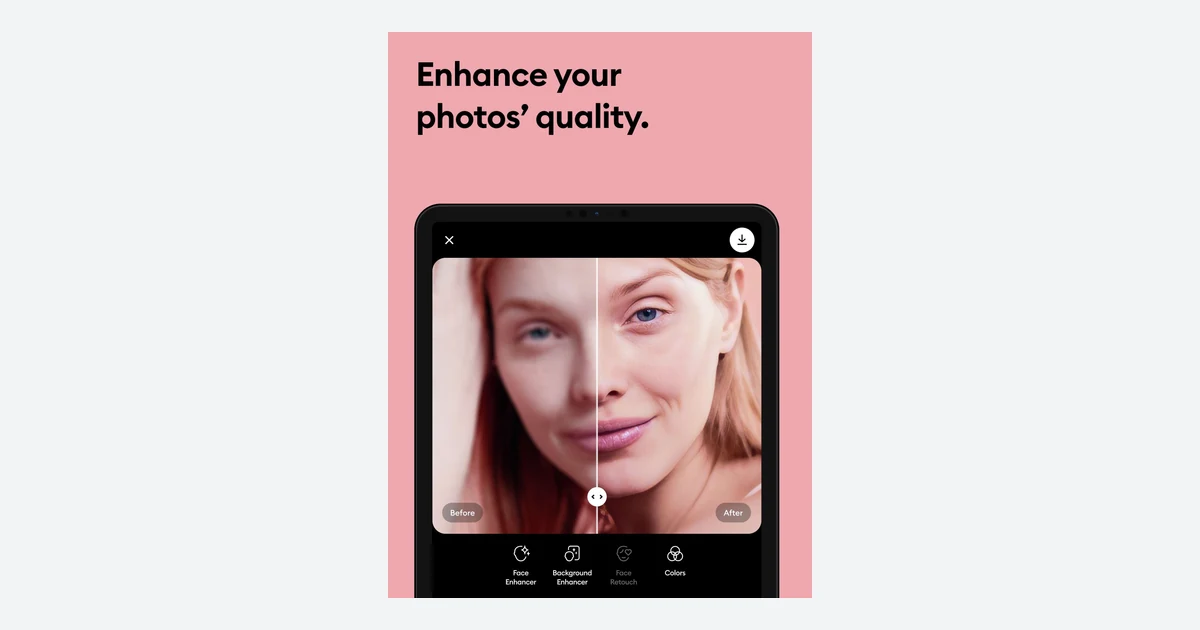
Remini is the photo app people reach for when a family picture is blurry, a scan is scratched or a selfie came out soft. It is also, by 2026, an AI portrait generator with anime filters, a baby predictor and a yearbook maker bolted on. Bending Spoons, the Milan company that owns it, calls it 'a consumer-focused image and video enhancement and generation application' in the F-1 it filed before going public on Nasdaq on July 1, 2026.
The enhancement itself is the easy part to judge. The harder questions are about money and data: Remini publishes no fixed price list, sells weekly plans first, charges separately for the web version and the mobile app, and can ask for an extra fee to lift a usage limit. This review, checked against Remini's own help centres, store listings and the privacy policy updated on September 21, 2026, covers what it does well, what it really costs and what happens to the faces you upload.
What Remini is in 2026
Remini started life at a developer called BigWinePot, which is why its Android package is still named com.bigwinepot.nwdn.international. Bending Spoons bought it in June 2021, and the F-1 describes what happened next: 'we rewrote the codebase in full, developed dedicated tooling, redesigned user experience and monetization, and delivered powerful new features.' The legal entity behind the web version and the App Store copyright is AI Creativity S.r.l. in Milan, while the App Store seller is Bending Spoons Apps ApS.
It is one of Bending Spoons' main businesses, but not a growing one right now. The company's Q2 2026 results, released on August 13, 2026, reported total revenue of $704 million, up 126% year on year, and added that 'growth in these businesses was partly offset by a decline in Remini and Splice revenue.' No Remini-specific figure was disclosed. The most recent usage headline is from November 2025, when Bending Spoons said Remini hit 1.16 million weekly installs after integrating Google's Nano Banana image model.
That model integration matters for how you read the app. Remini's generative features are not all in-house: the privacy policy names its third-party AI providers as 'currently Black Forest Labs, Google, and OpenAI'.
- Platforms: iOS, Android and Remini Web (remini.ai redirects to the web app).
- App Store (US): 4.61 average from 354,506 ratings, first released August 1, 2019.
- Google Play: 4.1 stars from about 5.8 million reviews, 500M+ downloads, marked 'Contains ads'.
- Developer API: discontinued. Remini's help centre says 'Our API service has been officially discontinued.'
Photo enhancement: the part Remini is known for
Remini's Enhance tool 'uses AI technology to sharpen the photo's details, remove imperfections, and make it HD-quality.' The Play Store listing spells out the jobs it targets: sharpening and unblurring out-of-focus pictures, repairing old, blurry and scratched photos, and increasing the number of pixels in low-quality images.
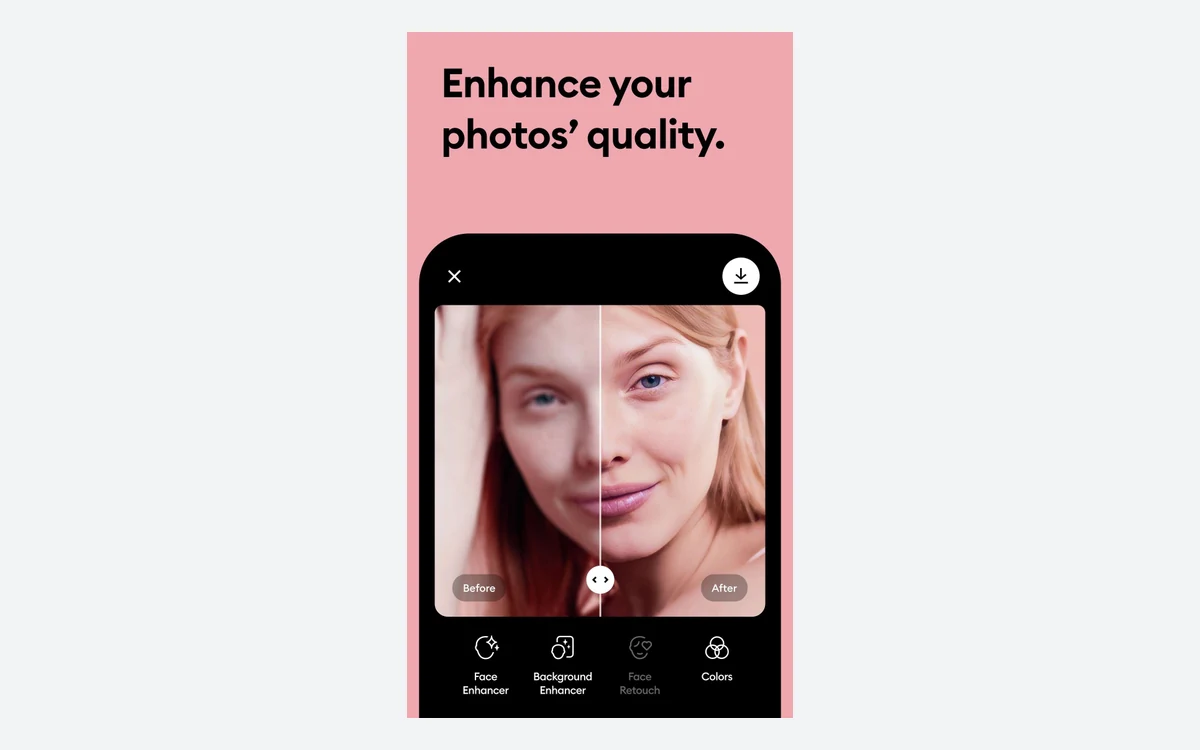
In the mobile app the tools are Face Enhancer, Background Enhancer, Face Retouch and Colors. Remini Web exposes a similar toolbar with Face Enhance, Beautify, Background Enhance, Color Correction and pre-applied settings. Faces are where Remini is strongest: a soft or low-resolution face comes back with crisp eyes, skin texture and hair edges.
Enhanced is not the same as recovered
A face enhancer adds detail the AI infers rather than detail the camera captured. On family archives, keep the original scan and compare the two side by side, because a restored face can look sharper and still look less like the person.
Limits worth knowing before you rely on it
- No custom output size: 'Custom output resolution isn't supported just yet.' Remini publishes no maximum upscale resolution.
- No batch processing in the mobile app, which 'doesn't support batch enhancement just yet'. Remini Web can enhance up to 15 photos at once, but only on a Business subscription.
- Video is subscriber-only in the app, and the video limit 'resets each Monday and can vary based on the plan you subscribed to.'
- Business web subscribers can use a Photoshop plugin; other plans cannot.
AI Photos and the generative extras
The second half of Remini is generation. AI Photos asks you to 'select up to 12 pictures you'd like Remini to use' and then produces styled portraits of you. The current App Store screenshots advertise a wider set of novelty tools built on the same idea.
- A '90s anime version of yourself' filter.
- 'See your future family', which generates a baby from two parent photos.
- 'Get the best face in every photo', which swaps a closed-eyes face for an open-eyed one from another shot.
- Cartoon pictures and '90's Yearbook' photos.
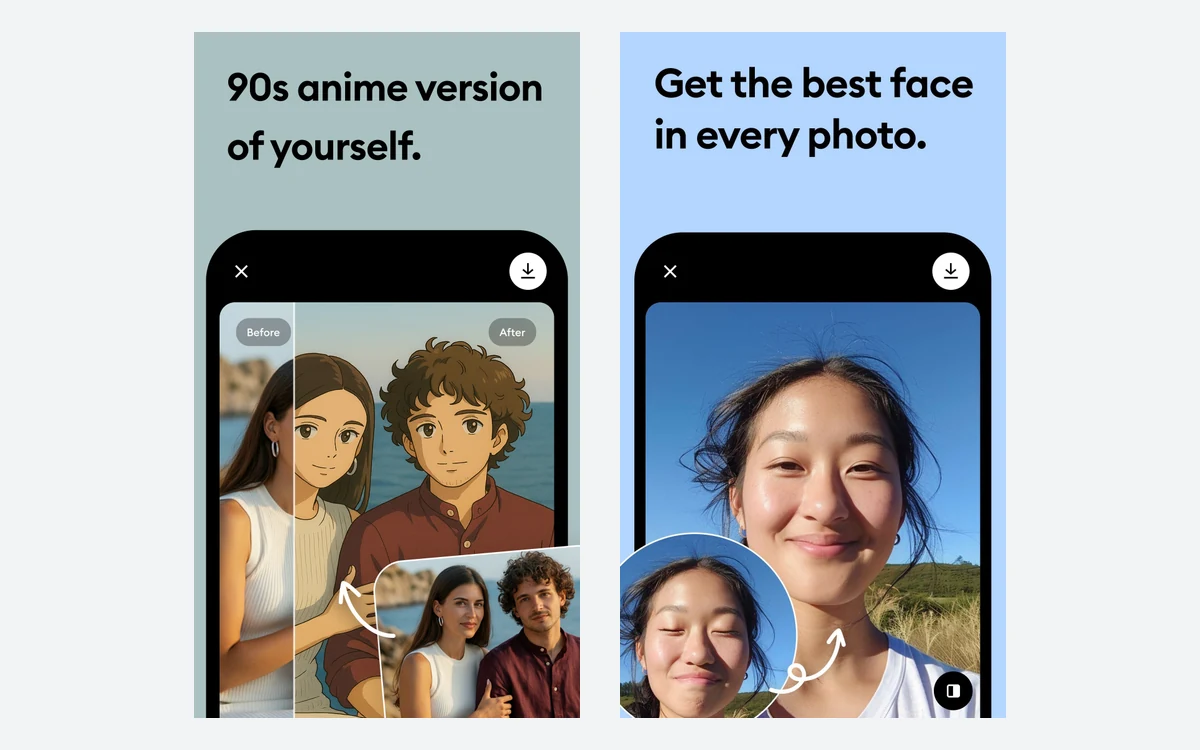
These features are fun and quick, but they are also where the usage limits and the extra fees tend to show up, and they are handled under different retention rules from plain enhancement (covered in the privacy section below). Remini does not publish a separate price for AI Photos.
Pricing: no price list, weekly plans first
Remini does not publish a fixed price. Its help centre says 'the cost of the app may vary depending on the specific offer available to you… there isn't a fixed price list to refer to,' and that prices differ by plan length and whatever promotion is running. What you pay depends on the offer you are shown.
The closest thing to an official list is the in-app purchase table on the US App Store:
- Remini Pro Weekly: $9.99
- 1 Month: $9.99
- Remini Lite Weekly: $7.99, $5.99 or $4.99, depending on the offer
No annual price appears by name. The App Store lists weekly, monthly and yearly subscriptions; the Play Store lists only weekly and yearly. If you are shown a weekly plan, work out what it costs over a month before you tap, because a weekly plan left running is easily the most expensive way to use the app.
Free tier, trial and watermarks
- Free: 'Remini offers limited access for free.' The Android app carries ads, and ad load is a recurring complaint; one July 2026 Play Store review reads 'now I have to see 3 minutes of adds just for one Photo edit'.
- Trial: 'Free trials are not always available', can be used only once and 'may not include all tools in the app'. No trial length is published. Cancel at least 24 hours before it ends or it converts.
- Watermarks: 'even paying users may still see a watermark, depending on the specific tool or feature used.'
The pay-to-dismiss limit
Remini describes two kinds of usage cap. A periodic limit 'usually resets the next day'. A quantitative limit 'blocks further generations, but can be dismissed by paying an additional fee that's proposed in the pop-up.' In other words, a subscription does not always mean unlimited, and the upsell can appear after you have already paid.
Remini Web and the app are separate purchases
This catches many buyers. 'Starting a subscription on Remini Web won't give you access to Remini's mobile app,' and in the other direction 'only higher in-app plans include access to Remini Web.' Decide where you will actually edit before you pay.
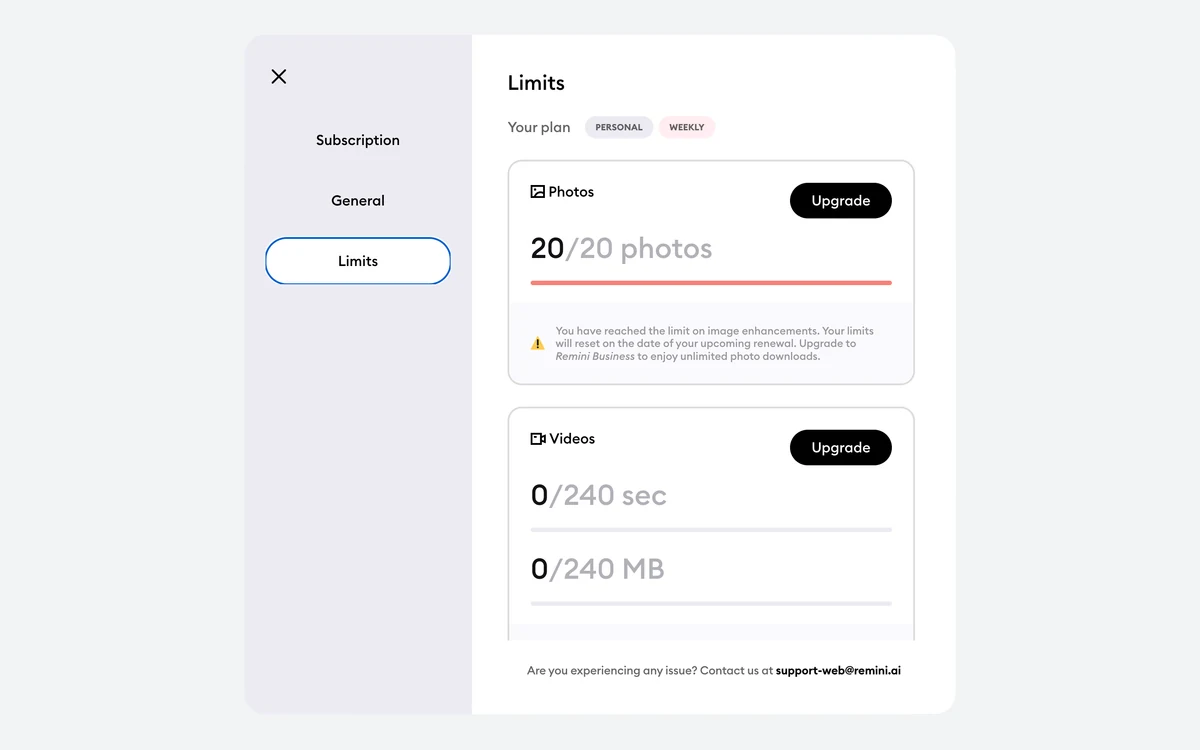
Remini Web has two tiers. Their features, from Remini Web's own help centre:
- Personal: JPG output, video enhance, no watermark after download. 20 photos on the weekly plan, 80 monthly, 1,040 yearly. Video up to 60 MB or 60 seconds per clip and 240 MB or 240 seconds per week.
- Business: JPG, PNG and TIFF output, video enhance, no watermark, high-priority processing and commercial use. Unlimited photos, batch enhancement of up to 15 photos, the Photoshop plugin, and video up to 120 MB or 120 seconds per clip and 480 MB or 480 seconds per week.
Web prices are charged in USD but are not published by Remini. Third-party reviewer Tools for Humans reported $6.99 per week for Personal and $9.99 per week for Business in March 2026; treat those as a guide, not a quote.
Older web billing through yourplan.remini.ai is closed to new sign-ups, though existing subscriptions there 'remain fully supported'.
Privacy: what happens to your face
Remini's privacy policy, last updated on September 21, 2026, is more specific than most in this category. The key commitments:
- Training is opt-in: 'Your images and videos aren't used to train our AI technologies, unless you explicitly opt in for that.'
- Enhancement data is short-lived: face data used to enhance a photo 'is deleted immediately after the enhancement', and uploads plus enhanced results are deleted one day after upload or enhancement.
- AI generation keeps more: uploads for generation are kept up to 20 days for subscribers or 7 days for free users, and never more than two years; generated images are kept up to 7 days.
- Opt-in training data is kept up to one year; other personal data up to three years from your last interaction.
- Face data is not used to identify or authenticate people, is not collected from US users to improve the features, and will 'never' be sold, leased or traded.
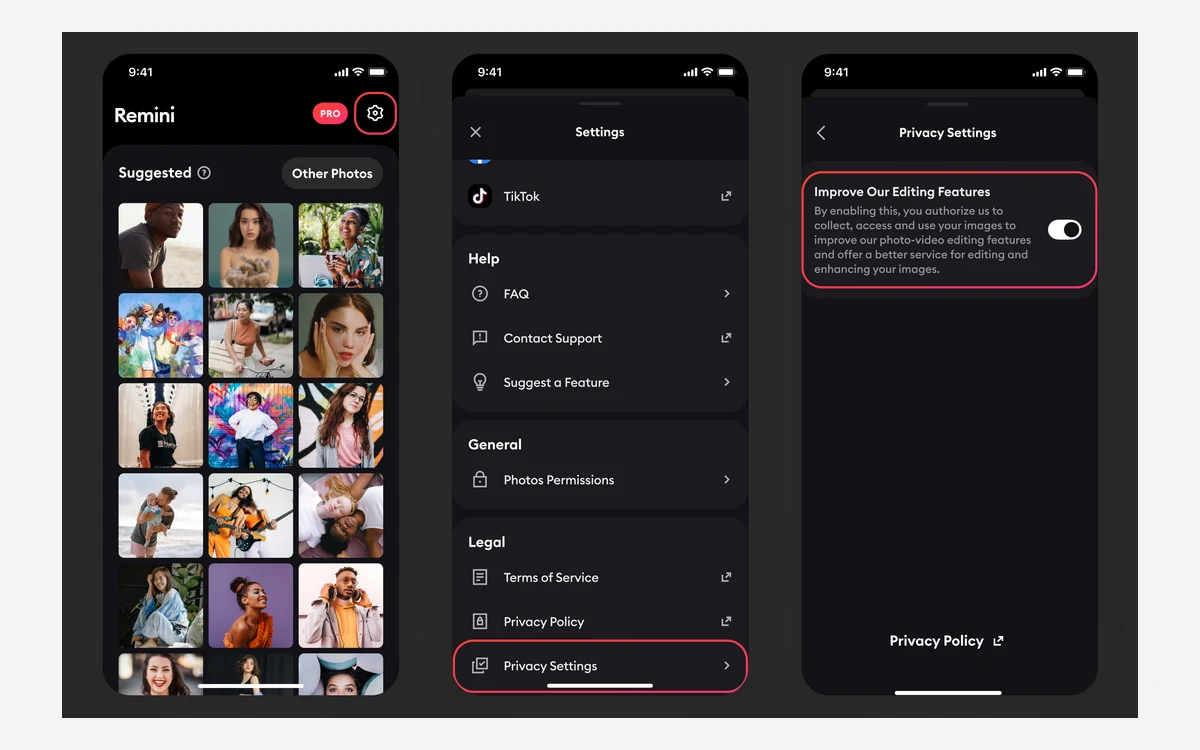
There are caveats. Generative features pass through outside providers (Black Forest Labs, Google and OpenAI). Bending Spoons is based in Italy and says it may transfer data outside the European Economic Area without naming a server region. The App Store privacy label lists 'Data Used to Track You: Identifiers'. And the age rules do not line up: the policy says the app 'isn't meant to be used by people under the age of 16', while the App Store rates it 4+ and Google Play rates it Everyone.
If you want out, check the 'Improve Our Editing Features' toggle in the app's Privacy Settings, and use Remini's separate data-erasure forms for Android, iOS and the web.
Cancelling and getting a refund
Subscriptions renew automatically unless auto-renew is turned off at least 24 hours before the period ends. Cancelling keeps the plan active to the end of the period, and the current period is not refunded automatically.
- iPhone and iPad: cancel in your Apple ID subscriptions. Remini says 'we can't perform the cancellation on your behalf as it's Apple that manages your subscriptions'.
- Android: cancel in Google Play subscriptions.
- Remini Web: go to My Account, then Subscription, then Cancel plan.
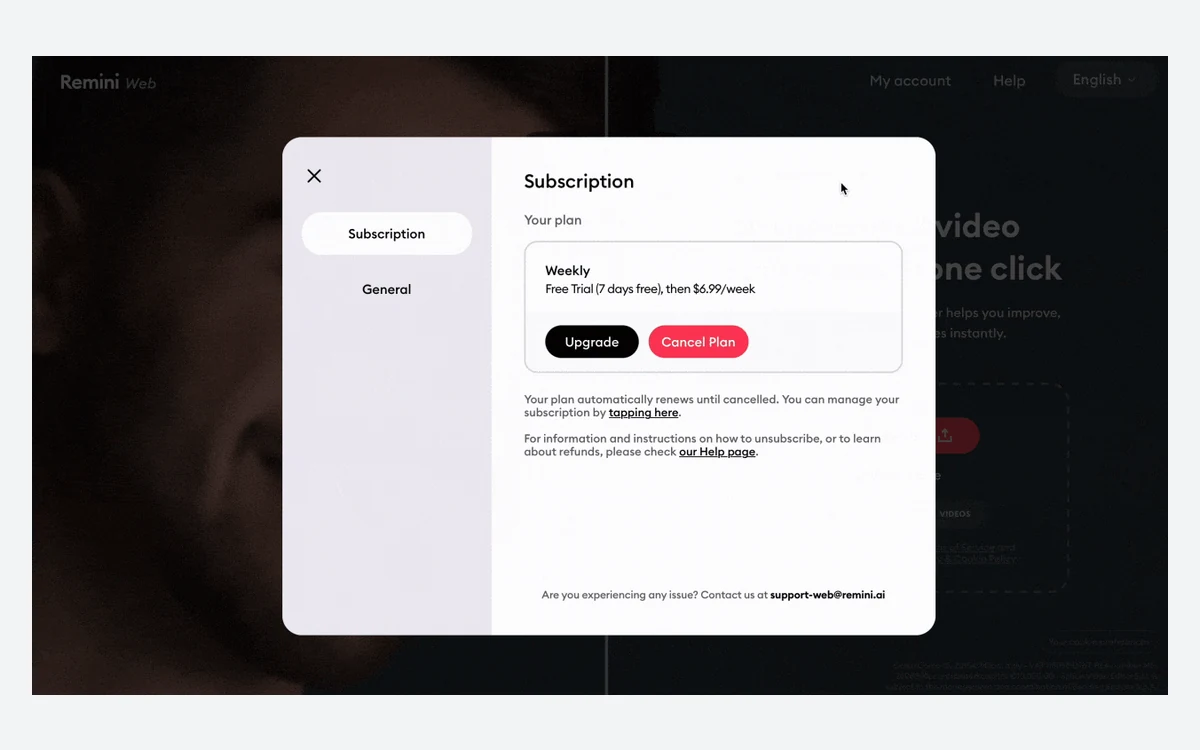
Remini's refund policy sets request windows of 20 days for weekly and monthly plans and 60 days for yearly plans, counted from the contested charge. Apple purchases are refunded by Apple, and Google Play purchases within 48 hours go to Google. On Remini Web, EU residents also have a 14-day right of withdrawal. Once a refund is processed, the account drops to the free plan immediately.
Verdict: who should pay for Remini
Remini is still one of the quickest ways to rescue a soft face or a damaged old print from a phone, and its privacy policy is clearer than most consumer AI apps about deletion and training. The ratings reflect a split: 4.61 on the App Store against 4.1 on Google Play, where the free, ad-supported experience draws most of the complaints.
- Good fit: a one-off batch of family photos. Buy the shortest plan you are offered, finish the job and turn off auto-renew the same day.
- Good fit: small businesses that need commercial use, TIFF or PNG output and batches, on Remini Web Business.
- Poor fit: anyone wanting a predictable price, precise output resolution or an API. There is no price list, no custom resolution and the API is gone.
- Poor fit: under-16s, whatever the store rating says.
Before paying, confirm three things on the paywall you see: the billing period, whether the plan covers the web or the app you actually use, and whether the tools you want still carry a watermark.
Frequently asked questions
How much does Remini cost?
There is no fixed price; Remini shows offers that vary by plan length and promotion. On the US App Store, in-app purchases include Remini Pro Weekly at $9.99, a 1 Month plan at $9.99 and Remini Lite Weekly at $4.99 to $7.99. Remini does not publish web prices or an annual price.
Is Remini free?
Partly. Remini offers limited free access with ads on Android, daily usage caps and watermarks. Video enhancement in the app is for subscribers only.
Does a Remini subscription remove the watermark?
Not always. Remini says even paying users may still see a watermark depending on the tool or feature. Remini Web Personal and Business both download without a watermark.
Does my app subscription work on Remini Web?
Only on higher in-app plans. A Remini Web subscription never unlocks the mobile app, so the two are effectively separate purchases.
Does Remini use my photos to train its AI?
No, unless you opt in. Enhancement uploads and results are deleted after one day, and face data used for enhancement is deleted immediately. AI-generation uploads are kept up to 20 days for subscribers or 7 days for free users.
How do I cancel Remini and get a refund?
Cancel through Apple or Google Play for app purchases, or under My Account, Subscription, Cancel plan on the web, at least 24 hours before renewal. Refund requests are accepted within 20 days for weekly and monthly plans and 60 days for yearly plans; Apple handles refunds for App Store purchases.
Does Remini have a free trial?
Sometimes. Trials are not always offered, can be used only once and may not include every tool. Remini does not publish a trial length, so check the paywall and cancel at least 24 hours before it ends.
Is there a Remini API for developers?
No. Remini's help centre says the API service has been officially discontinued. The closest option for professional workflows is the Photoshop plugin on a Remini Web Business plan.
Key takeaways
- Remini is strongest at face enhancement and repairing old or blurry photos; the AI generators are extras with their own limits.
- There is no fixed price list. US App Store plans include $9.99 Pro Weekly, $9.99 for one month and Lite Weekly from $4.99 to $7.99.
- Paying does not guarantee no watermark or no limits; some caps can only be lifted with an extra fee.
- Remini Web and the mobile app are billed separately, and only higher in-app plans include web access.
- Training is opt-in, enhancement uploads are deleted after a day and generation uploads after up to 20 days.
- Turn off auto-renew at least 24 hours before renewal; refund windows are 20 days for weekly and monthly plans and 60 days for yearly.
More in Artificial Intelligence
Browse Artificial Intelligence