Technology reviews & practical guides
Render review for October 2026: the flat $25 Pro workspace fee that replaced per-seat pricing, what each compute plan really costs, how the free tier spins down, when free Postgres expires, and the billing fine print.

Render had a busy 2026. It raised $100 million at a $1.5 billion valuation in February, scrapped per-seat pricing in April, moved every legacy workspace to the new plans on August 1, renamed all its compute plans on August 26 and cut Key Value prices on October 1. Many reviews still quote plan names and prices that no longer exist.
This review explains what Render actually costs as of October 22, 2026, what the free tier really gives you, how the databases are priced, and the fine print on refunds, bandwidth and spending limits. Every figure comes from Render's own pricing page, docs, changelog and terms.
Render is one of the easiest ways to run a real web app, API, worker or Postgres database without managing servers. You connect a Git repository, Render builds and deploys it, and you get HTTPS, custom domains, logs and metrics on day one. In 2026 it also became much cheaper for teams: the per-seat Professional plan is gone and the new Pro plan is a flat $25 per month per workspace with unlimited members.
The catches are real but manageable. The free tier sleeps after 15 minutes and takes about a minute to wake, free Postgres is deleted after 30 days plus a grace period, there are only five regions, the new plans include less bandwidth than the old ones, there is no account-wide spending cap, and the terms say no refunds. If you can live with those, Render is a strong Heroku-style platform at fair, predictable list prices.
Ease of use: excellent. Pricing transparency: very good. Free tier: usable for demos, not for production. Team value: excellent since the flat Pro fee. Global reach: limited to five regions. Best for: startups, small teams and solo developers shipping web apps, APIs and background jobs.
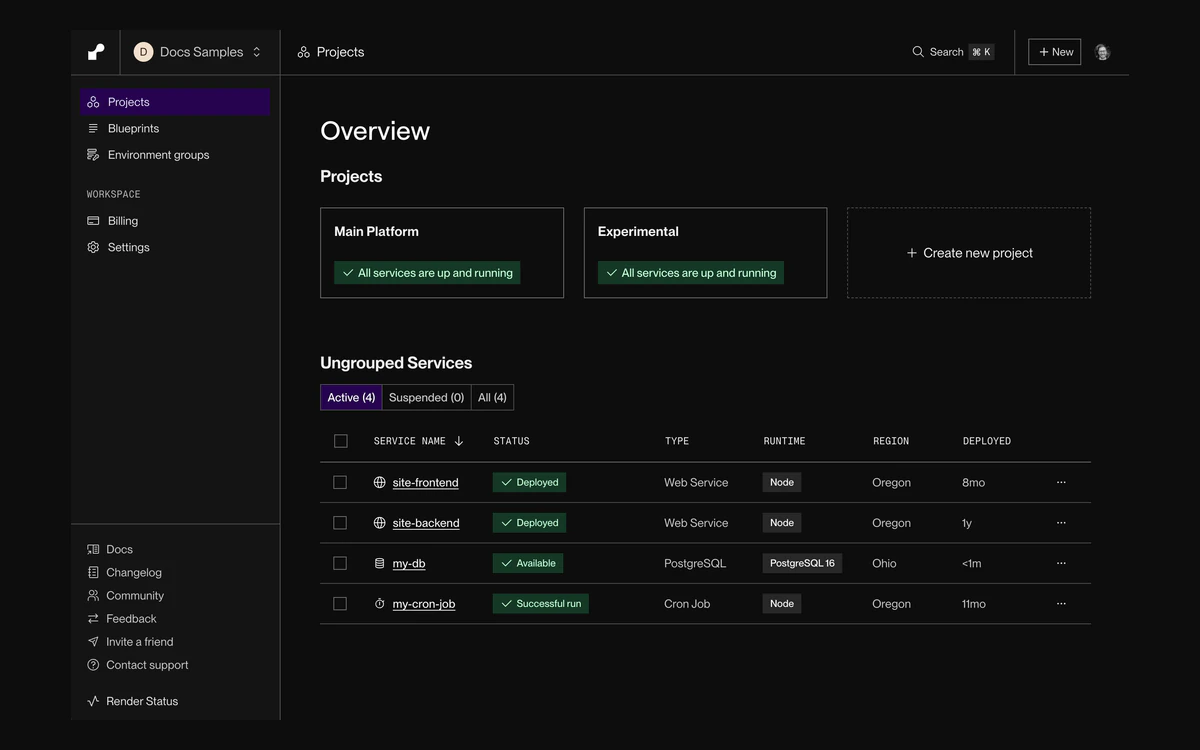
Render is a managed cloud platform that runs web services, private services, background workers, cron jobs, static sites, Render Postgres and Render Key Value (a Redis-compatible store). It builds Node, Python, Go, Rust, Ruby and Elixir natively and also runs any custom Docker container, so most stacks deploy without changes.
Infrastructure can be described in a render.yaml Blueprint and kept in the repository. Render also ships an MCP server (generally available since August 2025, with OAuth sign-in for Claude Code, Codex and Cursor added in July 2026), so AI coding agents can create and inspect services directly. Newer additions include edge caching, PostgreSQL 18, dedicated outbound IPs, Postgres connection pooling and Render Workflows for durable background tasks, which has been in public beta since April 2026.
The company is well funded. CNBC reported on February 17, 2026 that Render raised $100 million at a $1.5 billion valuation and that more than 4.5 million developers use its tools. The same report noted that Salesforce had said earlier that month it was backing away from new Heroku features, which is why Render is the platform many Heroku users are now evaluating.

Render bills three things: a flat workspace plan, metered features such as bandwidth and build minutes, and compute for each service you run. Compute is prorated to the second, so a paid service that runs for 24 hours is billed for 24 hours, not a full month. Invoices are issued monthly in arrears.
On April 23, 2026 Render replaced Professional ($19 per member per month) with Pro ($25 per month flat) and Organization ($29 per member per month) with Scale ($499 per month flat). On August 1, 2026 every remaining legacy workspace was moved to the matching new plan automatically. For a team of eight, seat fees drop from $152 a month to $25.
The trade-off is bandwidth. Render says the new Hobby and Pro plans include less bandwidth than the legacy plans because seat fees used to subsidize it. Overage is now billed per GB at $0.15 for public internet traffic ($0.03 per GB over private link) instead of in 100 GB blocks, and unused bandwidth does not roll over. If you read an older review quoting $30 per 100 GB, that rate ended in August 2025.
The Pro workspace plan is the $25 flat fee. The old Pro compute instance (2 CPU, 4 GB RAM, $85 per month) is now called 2c-4g. Many tutorials still use the old instance name.
Extras on top of the plan: additional custom domains are $0.25 per domain per month, dedicated outbound IPs are $100 per month per IP set, AWS PrivateLink is $30 per month for up to three links, and standard build minutes beyond the included amount cost $5 per 1,000. A workspace with no services and no activity in a month has that month's subscription fee waived.
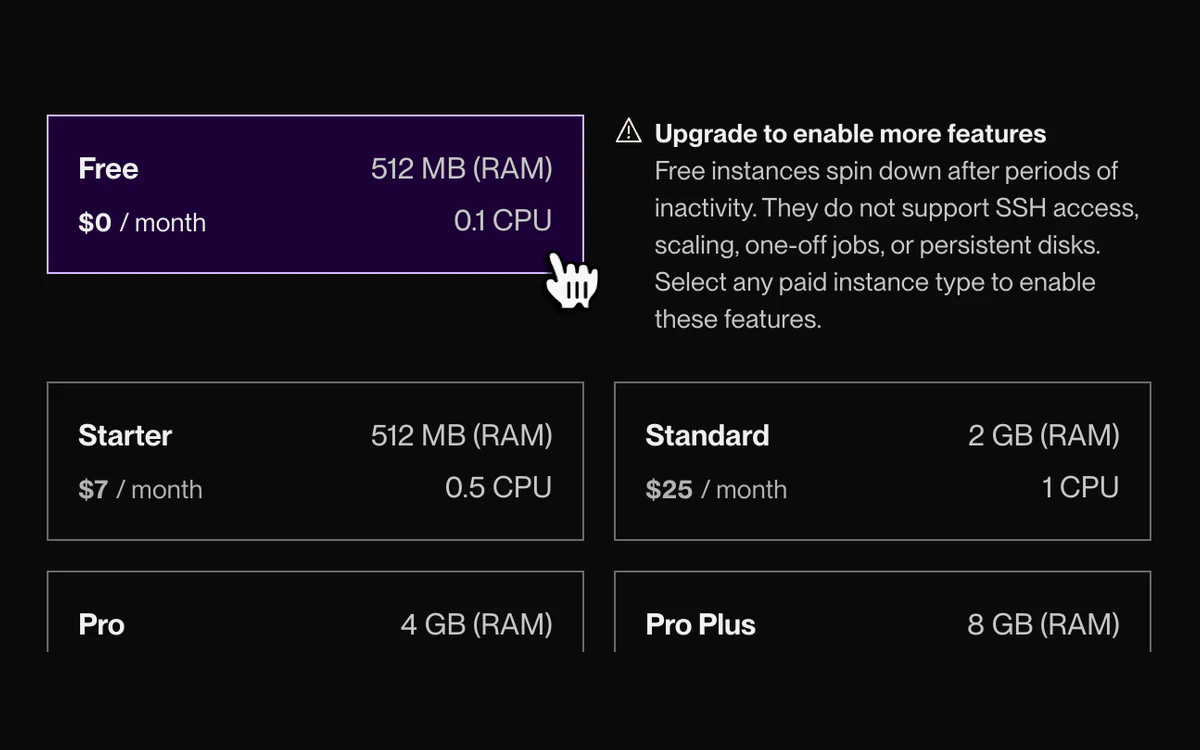
On August 26, 2026 Render renamed its compute plans (previously called instance types) to CPU and RAM IDs. Prices did not change. These are the monthly prices for web services, private services and background workers, with the legacy name in brackets so you can match older guides:
The rename also added in-between sizes: 2c-8g at $135, 2c-16g at $200, 8c-16g at $300, 4c-32g at $350, 12c-24g at $450, 12c-48g at $800, 8c-64g at $1,000 and 12c-96g at $1,500 per month. That finally lets memory-heavy apps avoid paying for CPU they do not use.
Background workers and private services have no free option and start at 0.5c-512mb for $7. Cron jobs are billed per second while they run, for example $0.00016 per minute on 0.5c-512mb and $0.00058 per minute on 1c-2g. Persistent SSD disks cost $0.25 per GB per month and are snapshotted every 24 hours, but a disk can only grow, never shrink, and attaching one turns off zero-downtime deploys for that service.
Render's free tier is generous enough for demos, portfolios and side projects, but it is designed to stop you from running production traffic on it.
A common workaround is an external ping every 14 minutes to stop a free service from sleeping. It works, but a service that never sleeps uses roughly 744 of the 750 monthly hours on its own, so a second always-on free service will run out of hours.

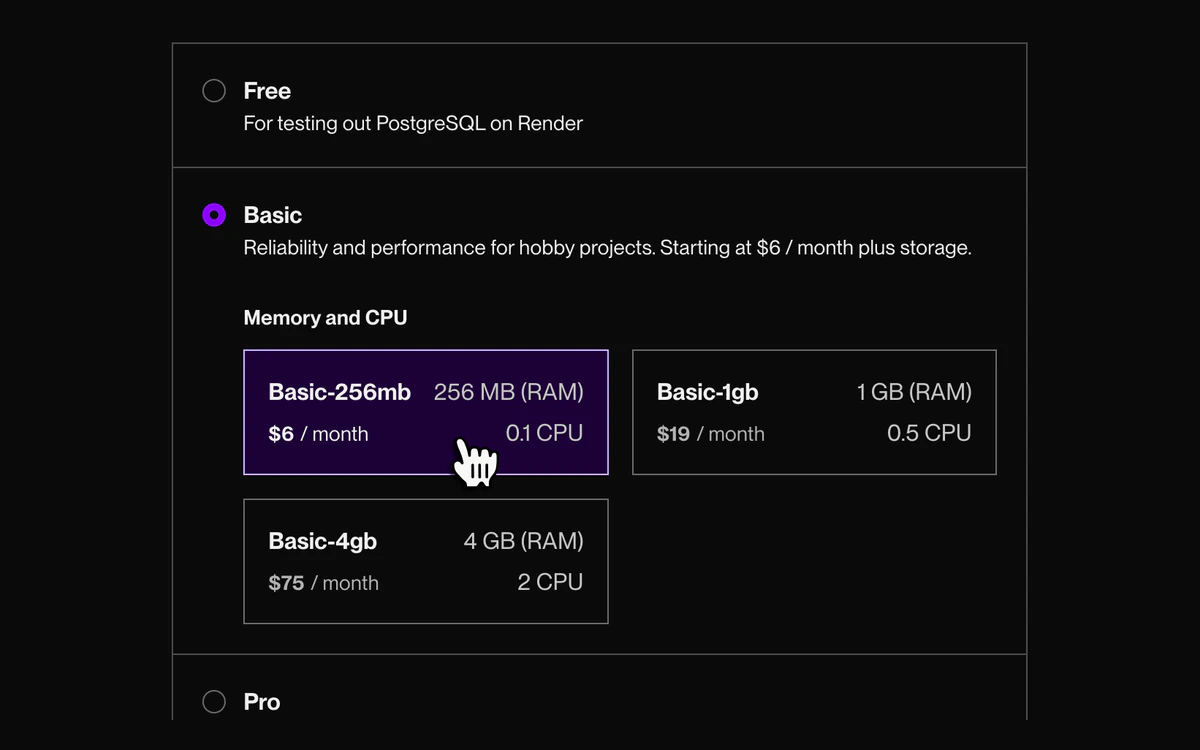
Render Postgres is billed as compute plus storage. Storage costs $0.30 per GB per month, with 1 GB included. Sample monthly compute prices (legacy names in brackets):
Point-in-time recovery covers the past 3 days on Hobby and 7 days on Pro and above, and logical backups are kept for seven days on every plan. High availability requires at least 1 CPU and PostgreSQL 13 or newer, and the standby is billed at the same plan and storage as the primary, so HA roughly doubles the database bill. You can add up to five read replicas, each billed at the primary's plan and storage.
Render Key Value got cheaper on October 1, 2026. Current monthly prices: 256mb $10, 1g $20, 3g $60, 5g $100, 10g $200, 20g (high CPU) $350, 40g $600 and 50g $750.

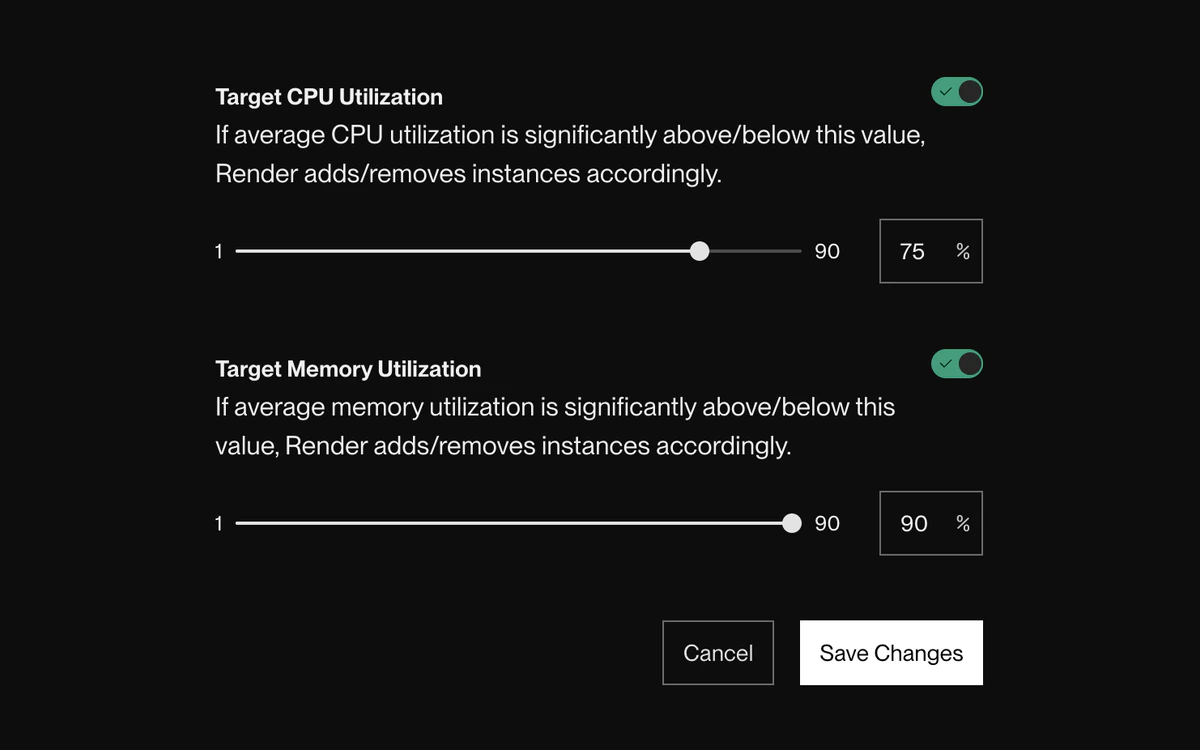
The Pro plan is where Render becomes a team platform. Beyond unlimited seats, it adds full-stack preview environments for every pull request, isolated environments, horizontal autoscaling based on CPU and memory targets, OIDC authentication, AWS PrivateLink and workspace audit logs. SOC 2 Type 2 and ISO 27001 reports are available from Pro upward under NDA; every workspace gets the SOC 3 report and a GDPR DPA.
Scale at $499 per month is about governance: several workspaces, SAML SSO and SCIM provisioning, advanced RBAC roles, inbound IP rules, organization-wide audit logs, longer metrics retention and 1 TB of included bandwidth. HIPAA is only available on Scale or Enterprise, and a HIPAA-enabled workspace pays an extra 20% on all usage, including compute and storage.
Render Workflows, still in beta, runs durable background tasks billed per second at $0.20 per CPU-hour plus $0.05 per GB-hour on flexible sizes, or fixed sizes from $0.40 per hour. Concurrent runs are capped at 20 on Hobby, 50 on Pro and 100 on Scale, with extra blocks of 50 at $10 per month.

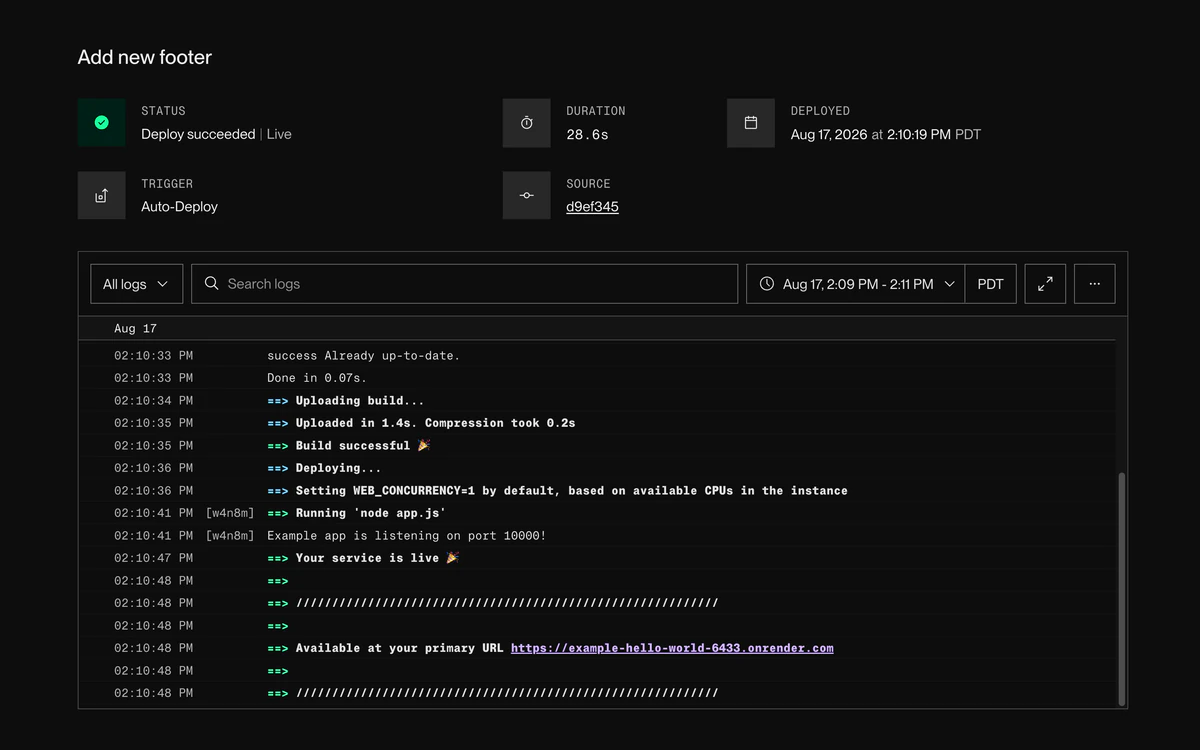
Day-to-day use is where Render earns its reputation. A push to the connected branch triggers a build and a zero-downtime deploy, every deploy has its own log stream, and instant rollbacks keep the last 5 builds on Hobby, 15 on Pro and 30 on Scale. Logs are searchable in a log explorer and kept for 7, 14 or 30 days depending on the plan.
The standard build pipeline runs on 2 CPU and 8 GB RAM. A performance pipeline with 16 CPU and 64 GB RAM is available on Pro and Scale at $25 per 1,000 minutes, with no included minutes. Builds fail if they use more than 16 GB of disk or run longer than 120 minutes, and pre-deploy commands time out after 30 minutes. You can set a monthly spend maximum for build minutes, which is the only spending limit Render offers.

Render runs in five regions: Oregon, Ohio and Virginia in the USA, Frankfurt in Germany, and Singapore. There is nothing in South America, Africa, India, Australia or Japan. A service or database cannot be moved to another region after creation, and private networking only works between services in the same region, so pick carefully at the start. We found no GPU instances.
Render publishes its incidents openly. Recent major or critical events on its status page include Render Dashboard Unavailable (July 15, 2026), GitHub-related deploy failures (July 16 and 19), Service Disruption in Oregon (July 24), Service instability in Singapore (August 31), Build and deploy failures in Oregon (September 25), and builds and deploys not starting in all regions (October 14). Uptime SLAs are contractual only on Enterprise, and Render does not publish an SLA percentage.
These estimates use Render's list prices and exclude tax and bandwidth overage. They are our arithmetic, not quotes from Render.
If you are comparing hosts for a frontend-heavy project, our Vercel review and Netlify review cover the same questions for those platforms.
Choose Render if you want Heroku-style simplicity for full-stack apps, APIs, workers and Postgres, if you run a team that was paying per seat, or if you want clear per-second pricing without managing AWS directly. The flat Pro fee makes it especially good value for teams of four or more.
Look elsewhere if your users are far from the five regions, if you need GPUs, if you need a hard monthly spending cap, if you serve a lot of bandwidth on a small plan, or if you want a production database for free. Hobbyists who need an always-on app should budget at least $7 per month for a paid instance rather than fight the free tier's sleep.
Yes, partly. The Hobby workspace plan costs $0, static sites are free, and you can run free web services, one free Postgres and one free Key Value. Free web services sleep after 15 minutes idle and share 750 instance hours per month, and background workers have no free option.
About one minute, according to Render. Users typically report 30 to 60 seconds, and visitors see a loading page while the service starts.
$25 per month in total, not per person. Since April 23, 2026 the Pro plan is a flat workspace fee with unlimited members, and compute, bandwidth overage and extra build minutes are billed on top.
Yes. Free Postgres expires 30 days after creation. You then have a 14-day grace period to upgrade to a paid plan, after which Render deletes the database. It also has no backups.
Yes, beyond the included amount. Hobby includes 5 GB, Pro 25 GB and Scale 1 TB per month, and extra public traffic costs $0.15 per GB. Unused bandwidth does not roll over.
No. Render's terms state there are no refunds, including on cancellation. Because compute is billed per second in arrears, deleting a service stops its charges straight away.
Only for build minutes. Render documents a monthly spend maximum for build pipeline minutes but no account-wide cap, so set sensible autoscaling maximums and watch bandwidth.
Yes, on Scale or Enterprise only. A HIPAA-enabled workspace requires the $499 per month Scale plan or Enterprise and adds 20% to all usage. Render is also SOC 2 Type 2 and ISO 27001 compliant.
Five: Oregon, Ohio and Virginia in the USA, Frankfurt and Singapore. You cannot change a service's region after creating it.
More in Cloud Computing
Browse Cloud Computing