Servebolt Review (2026): A Speed-First Managed Hosting Platform
A current-state review of Servebolt, the speed-first managed host for WordPress and PHP sites: Pro to Enterprise pricing, the new Servebolt Shield security layer, TTFB benchmarks, support and refund terms.

Servebolt sells one thing above all else: raw speed. The Oslo-based host markets itself as "blazingly fast hosting & beyond" with "insanely fast uncached performance across every request," and it aims that pitch squarely at agencies, SMBs and enterprise teams running demanding WordPress and PHP workloads rather than at hobby bloggers chasing the cheapest plan.
That positioning matters, because Servebolt is not a budget shared host. Entry pricing starts where many competitors' top tiers end, and the platform is built around a custom stack — Servebolt Linux, an in-house CDN, Accelerated Domains and deep Cloudflare integration — rather than a generic control panel bolted onto commodity servers. This review walks through what you actually get across the tiers, the performance numbers Servebolt itself publishes, the new Servebolt Shield security layer, and the support, trial and refund terms you should read before committing.
What Servebolt is — and who it is for
Servebolt is a managed high-performance hosting platform aimed primarily at WordPress and PHP sites. Its homepage frames the audience in three bands: "SMB-ready hosting," "agency-focused hosting" for teams managing entire client portfolios at scale, and "enterprise-grade hosting" for demanding applications that need custom architecture. In the company's own words, it serves everyone "from solo founders to global brands."
The distinguishing choice is the stack. Instead of a stock LAMP setup, Servebolt runs a custom operating system it calls Servebolt Linux, pairs it with its own CDN and an Accelerated Domains layer, and integrates Cloudflare for edge caching and security. The promise is fast responses even on uncached, dynamic requests — the part of a WordPress site that usually slows down under load.
The short version
Servebolt is a premium, performance-obsessed managed host for WordPress/PHP. If page speed and time-to-first-byte are business-critical and your budget starts in the hundreds of dollars per month, it belongs on your shortlist. If you want a cheap starter plan, look elsewhere.

Pricing and plans
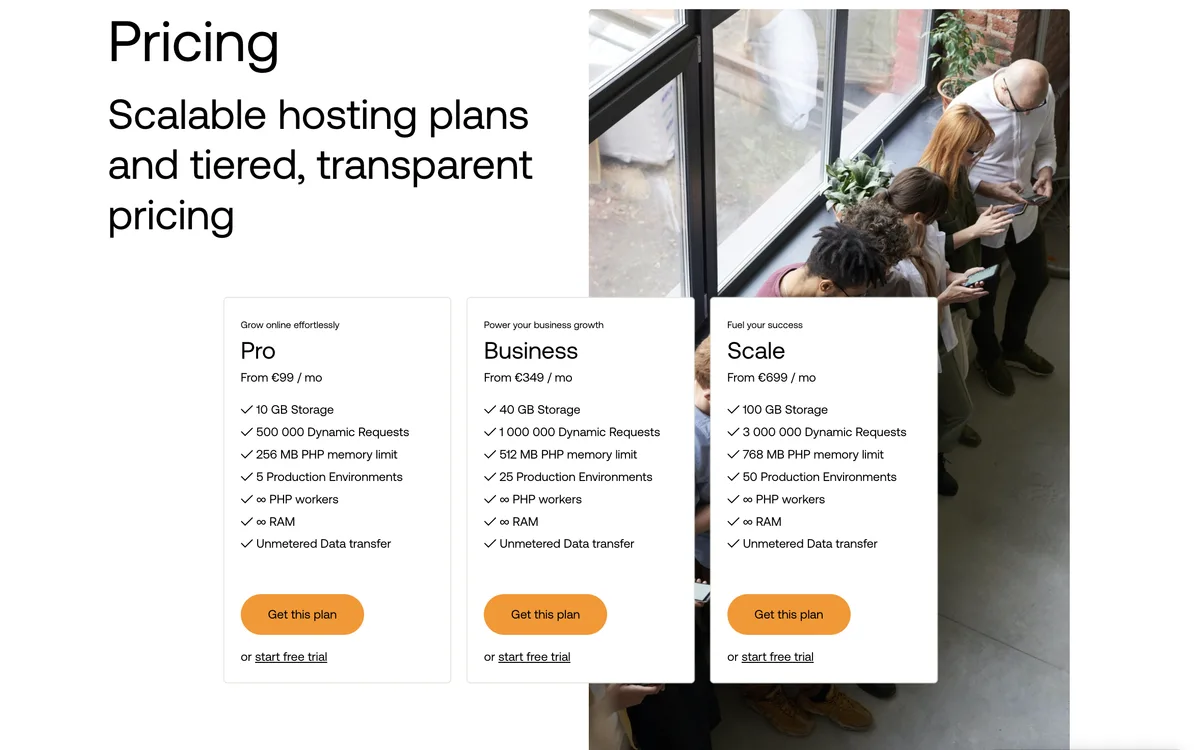
Servebolt publishes three standard tiers plus a custom Enterprise option. Every standard plan includes unlimited RAM, unmetered data transfer, and the same core managed toolset; the tiers differ mainly on storage, dynamic request allowance, PHP memory limit and the number of live sites.
- Pro — from $99/mo: 10 GB storage, 500,000 dynamic requests, 256 MB PHP memory limit, 5 live sites.
- Business — from $349/mo: 40 GB storage, 1,000,000 dynamic requests, 512 MB PHP memory limit, 25 live sites.
- Scale — from $699/mo: 100 GB storage, 3,000,000 dynamic requests, 768 MB PHP memory limit, 50 live sites.
- Enterprise — custom pricing: custom storage, requests and bandwidth; unlimited memory, RAM, domains and visitors; Cloudflare Business or Enterprise; custom security; and a dedicated Customer Success Manager.
Across Pro, Business and Scale you also get automated Git deployments, backups every four hours with 30-day retention, consultative onboarding, a dedicated account management team, Dev/Stage/Prod environments, free migrations, the free Servebolt CDN, online chat support, and SSH and sFTP access.
Cloudflare capabilities are also sold as separate integrated add-on plans: Servebolt Cloudflare Free at $0/mo, Servebolt Cloudflare Pro at $30/mo, and Servebolt Cloudflare Business at $279/mo — worth factoring in if you need higher Cloudflare tiers than your hosting plan bundles.
Budget reality check
At $99/mo entry, Servebolt costs more than most managed WordPress hosts' mid plans. The value case rests on performance and hands-on management, not on price per gigabyte.
Performance and benchmarks
Speed is the whole pitch, and Servebolt backs it with published before/after numbers. In a WordPress agency case it cites, time-to-first-byte dropped from 1,784 ms to 261 ms — a figure it describes as "580% faster." In a multi-region Magento case, TTFB fell from 170 ms to 98 ms, or "70% faster." Servebolt says early adopters of its latest platform saw uncached performance improvements "ranging from 30% to an astounding 580%."
These are vendor-reported figures, so treat the headline percentages as best-case marketing rather than a guarantee for your own site. What lends them weight is independent corroboration: Servebolt points to third-party testing by Kevin Ohashi of Review Signal (wphostingbenchmarks.com), who it says found Servebolt "the fastest in every single location tested."
The practical takeaway: Servebolt optimises for uncached, dynamic response time, which is where WordPress typically struggles. If your bottleneck is a heavy, logged-in or e-commerce workload rather than static pages a CDN can cache anyway, that focus is where the money goes.

Servebolt Shield: the new security layer
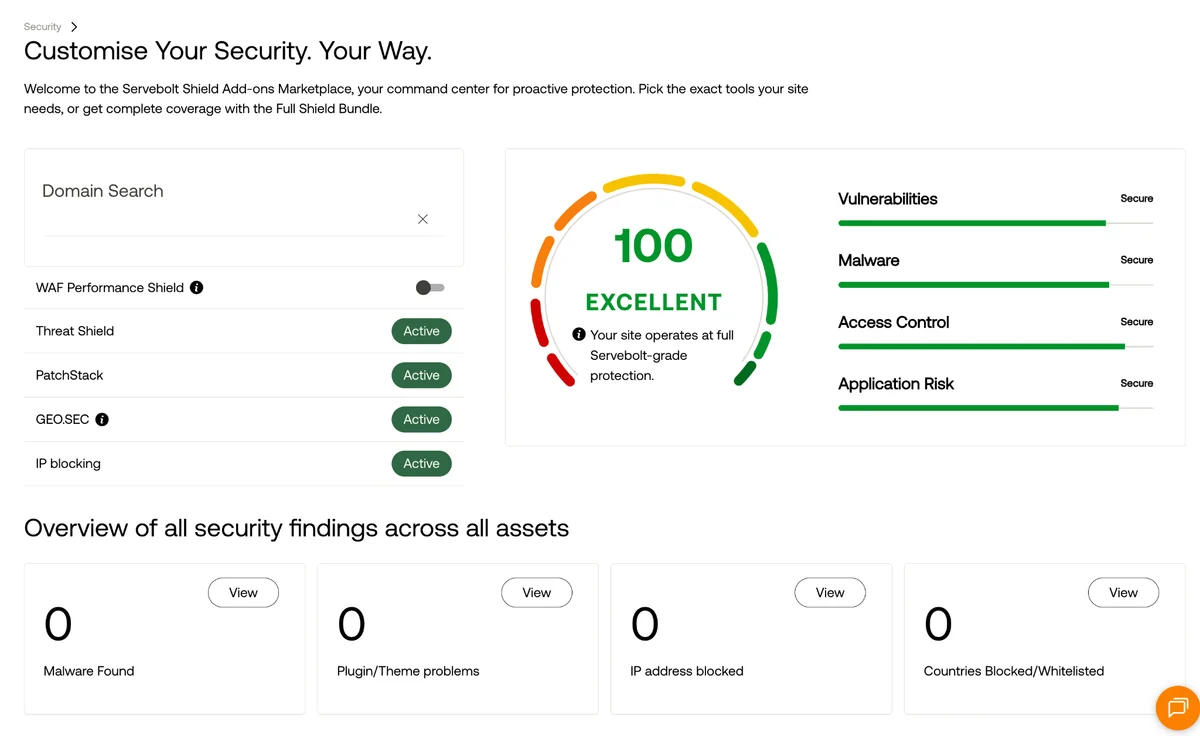
Servebolt Shield is a fully configurable security layer for what the company calls "serious sites," pitched as security without the drag of heavy plugins — "no bloated bundles, no plugin slowdown, and just the tools you need plus Servebolt speed untouched." It bundles several distinct components under one roof.
- Threat Shield — malware detection powered by Monarx, using behaviour-based analysis to catch backdoors, code injection and suspicious PHP.
- Patchstack — protection against known plugin, theme and WordPress vulnerabilities, including automatic updates of vulnerable plugins.
- GEOSEC — country-level access control (requires the Servebolt CDN or Accelerated Domains).
- IP Blocking — block traffic by address.
- Security Scorecard — a readout of your current security posture.
Shield also adds a managed web application firewall. Servebolt describes it as a WAF "that consists of security rules from both Cloudflare and Servebolt — and is fully managed by Servebolt," including rules to mitigate the OWASP Top 10 and to block WordPress-specific vulnerabilities. Because it is managed, you are not left tuning firewall rules yourself.
Features and developer tools
Beyond speed and security, Servebolt is built for developers and agencies who ship regularly. The feature set spans caching, deployment and the database and runtime tooling a modern PHP stack expects.
- Caching and edge: HTML Cache, Servebolt CDN, Accelerated Domains, automatic and smart purging of Cloudflare cache, Gzip, HTTP/2 and HTTP/2 Push, and image optimization.
- Runtime: Servebolt Linux (a custom OS), multiple PHP versions, unlimited PHP workers, load balancing and Supervisor.
- Data services: MariaDB, Redis and Elasticsearch.
- Developer workflow: Git deploy scripts, Composer, WP-CLI and Drush, plus SSH and sFTP access.
- Operations: Servebolt Backups, SSL, and the Servebolt Admin Panel.
The presence of WP-CLI, Drush, Composer and Git-based deployment signals that Servebolt expects code-first teams, not just click-through site builders. Dev/Stage/Prod environments come with the standard plans, so agencies can move work through a pipeline rather than editing production directly.
Support, uptime and account terms
Support is one of Servebolt's stronger selling points. The company reports a 98.8% customer satisfaction score over the past 12 months and a median response time of just 1 minute and 4 seconds, with a team spread across 10 countries. First-party support channels are live chat (listed as "online chat support" on every standard plan) and email at [email protected].
On availability, Servebolt's SLA "guarantees 99.9% uptime on our hosting service and 100% uptime on network and power" — a split worth noting, since the 100% figure covers the network and power layer rather than your site's application uptime.
You can test before you buy: Servebolt offers a three-day free trial, but it requires a valid credit card (with no charges during the trial) and is limited — one site with restricted resources, Servebolt-provided domains only, backups disabled and no email sending. On the money side, refunds are limited to 14 days from your initial paid subscription purchase and exclude free-trial accounts, automatic trial conversions, add-ons, usage-based charges and taxes; outside that window, fees are non-refundable.
Cancellation depends on plan type. Month-to-month plans can be terminated at any time through the customer interface, effective at the end of the current invoice period. Fixed-term plans cannot be terminated early and automatically renew for additional terms on expiration — read the term length before signing.

Frequently asked questions
How much does Servebolt cost?
Standard plans start at $99/mo for Pro, $349/mo for Business and $699/mo for Scale, with a custom-priced Enterprise tier. Cloudflare add-on plans are billed separately at $0, $30 or $279 per month depending on the tier.
Does Servebolt offer a free trial or a money-back guarantee?
Yes to a limited trial: a three-day free trial that needs a valid credit card (no charges during the trial) and runs on one site with restricted resources, a Servebolt-provided domain, no backups and no email sending. Refunds are available only within 14 days of your first paid subscription, and several charge types — add-ons, usage-based fees, taxes and trial conversions — are excluded.
What uptime does Servebolt guarantee?
Servebolt's SLA guarantees 99.9% uptime on the hosting service and 100% uptime on network and power. The 100% figure applies to the network and power layer, not to application-level uptime for your site.
What is Servebolt Shield?
Servebolt Shield is a configurable managed security layer for WordPress/PHP sites. It combines Monarx-powered malware detection (Threat Shield), Patchstack vulnerability protection, GEOSEC country-level access control, IP blocking, a security scorecard, and a managed web application firewall built from Cloudflare and Servebolt rules that targets the OWASP Top 10 and WordPress-specific threats.
How does Servebolt handle backups?
On the Pro, Business and Scale plans, Servebolt takes backups every four hours and retains them for 30 days. Backups are disabled during the free trial.
Does Servebolt offer phone support?
The first-party support channels confirmed on Servebolt's own pages are live chat and email ([email protected]). Phone support is not listed as a standard channel, so plan on chat and email for help.
Key takeaways
- Servebolt is a premium, speed-first managed host for WordPress and PHP, with pricing that starts at $99/mo and scales to a custom Enterprise tier.
- Its edge is uncached, dynamic performance — vendor benchmarks cite TTFB gains up to 580%, with independent corroboration from Review Signal's testing.
- Servebolt Shield adds a managed, low-overhead security layer: Monarx malware detection, Patchstack, GEOSEC, IP blocking and a managed WAF.
- Support is a strength: 98.8% CSAT and a median response near one minute, via live chat and email; the SLA covers 99.9% hosting uptime and 100% network/power.
- Read the fine print before buying: the free trial is a limited three days on one site, refunds are capped at 14 days, and fixed-term plans auto-renew and cannot be cancelled early.
More in Cloud Computing
Browse Cloud Computing