STORYD Review 2026: AI Business Decks in 60 Seconds, With Fine Print to Read First
STORYD turns a few sentences into a scripted business deck. We check its Free, Pro ($18-$24/mo) and Automate ($100-$150/mo) plans against its own terms, exports and trial rules.
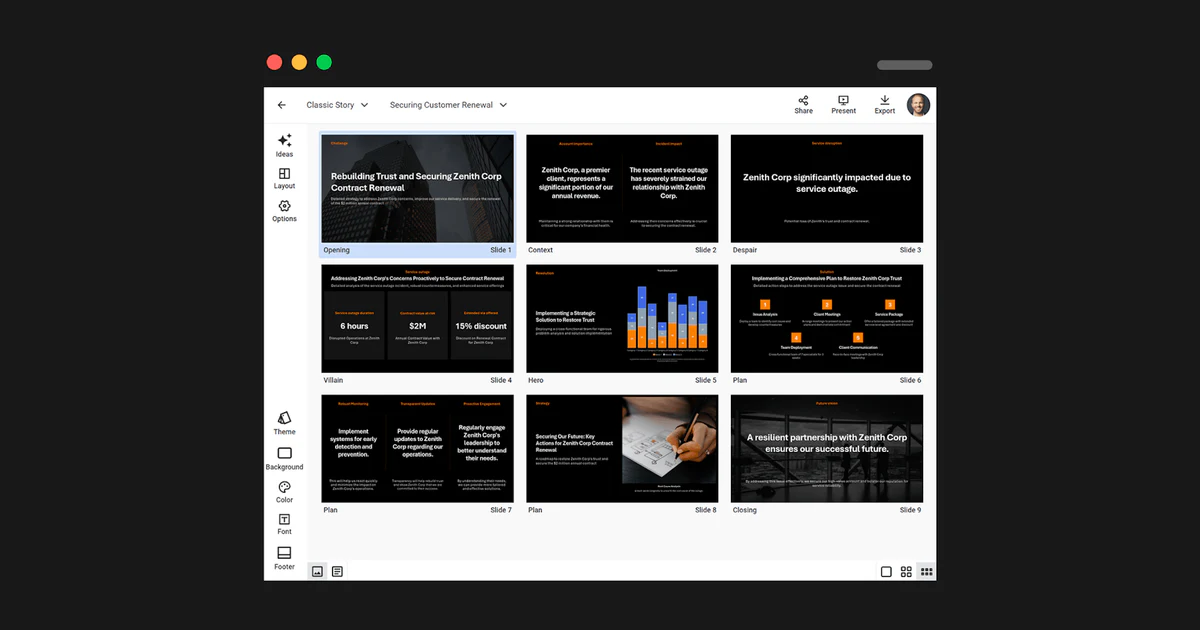
STORYD (storyd.ai) promises "a high-end business deck in 60 seconds". You write a few sentences about your presentation, pick a communication structure, and the app returns a script plus a slide deck built on it. It is made by Data Advantage LLC and sold on three plans: Free, Pro at $18 to $24 a month, and Automate at $100 to $150 a month.
This review checks that pitch against STORYD's own pricing table, Terms of Service, help centre and integrations page. The structure-first idea is genuinely useful for business storytelling, but the vendor's documents contradict each other on credits, exports, trials and billing, and the public changelog has not moved since version 1.0 in October 2023. Here is what you actually get, what it costs and who it suits.
What STORYD is
STORYD is a web-based AI presentation generator aimed at business communication rather than general slide design. Instead of starting from a blank template, you start from a "best practice communication structure", and the app writes a script and slides around your topic. Co-founder Michael Grimm's launch post sums up the division of labour: "you provide the data and topic".
The site describes Data Advantage as "the parent company of the storyd.ai product". Its founders, Zack Mazzoncini (CEO) and Michael Grimm (CTO), met at the University of Washington in 2004 and previously founded Decisive Data and Ignite Intelligence Solutions. That data-and-analytics background shows in the product, which leans toward data-backed business updates more than creative pitch art.
Not the same as Storydoc
STORYD (storyd.ai) is a different product from Storydoc (storydoc.com), which often appears in the same search results. This review covers STORYD only.
How a deck gets made
The homepage lays out a three-step workflow, quoted here verbatim:
- "Write a few sentences about your presentation"
- "Select a best practice communication structure"
- "Get a high-end business deck in 60 seconds"
Inside the app, Setting, Script and Slides tabs separate the brief, the narrative and the visual deck. The privacy policy confirms that the service processes "topics you provide in order to return a script and presentation". Getting an editable script before the slides is STORYD's best idea: you fix the argument first and the layout second, which is the right order for most business decks.
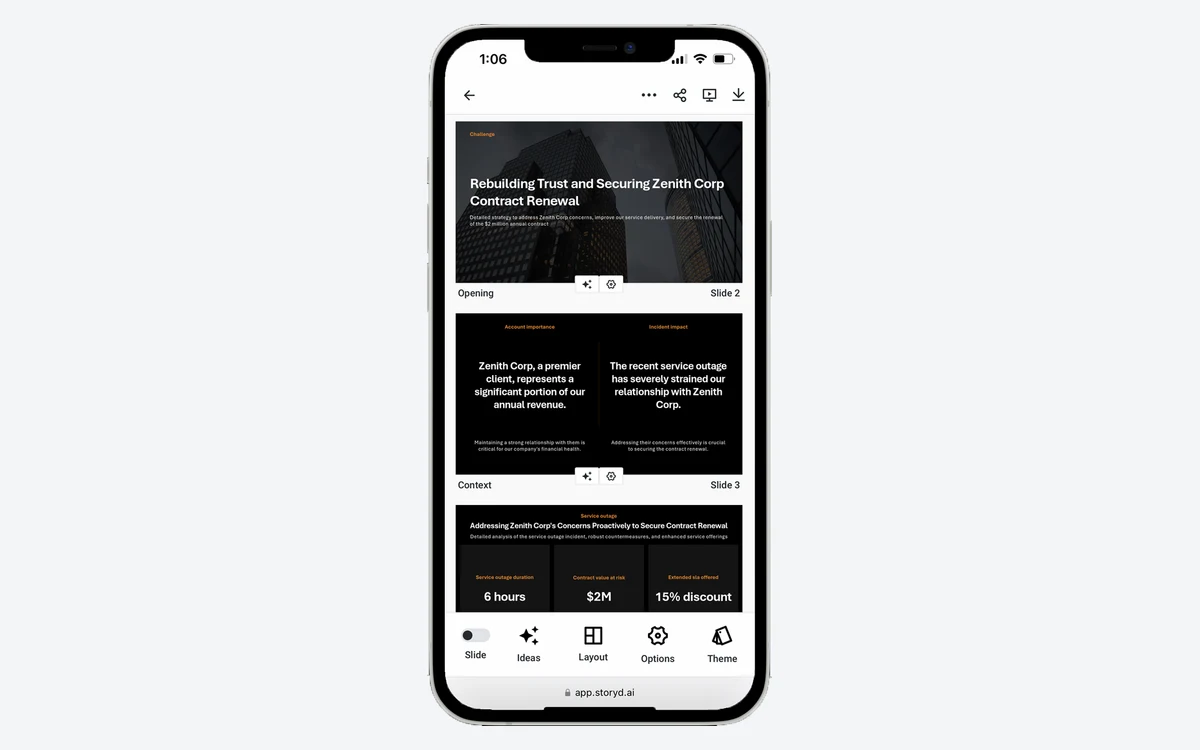
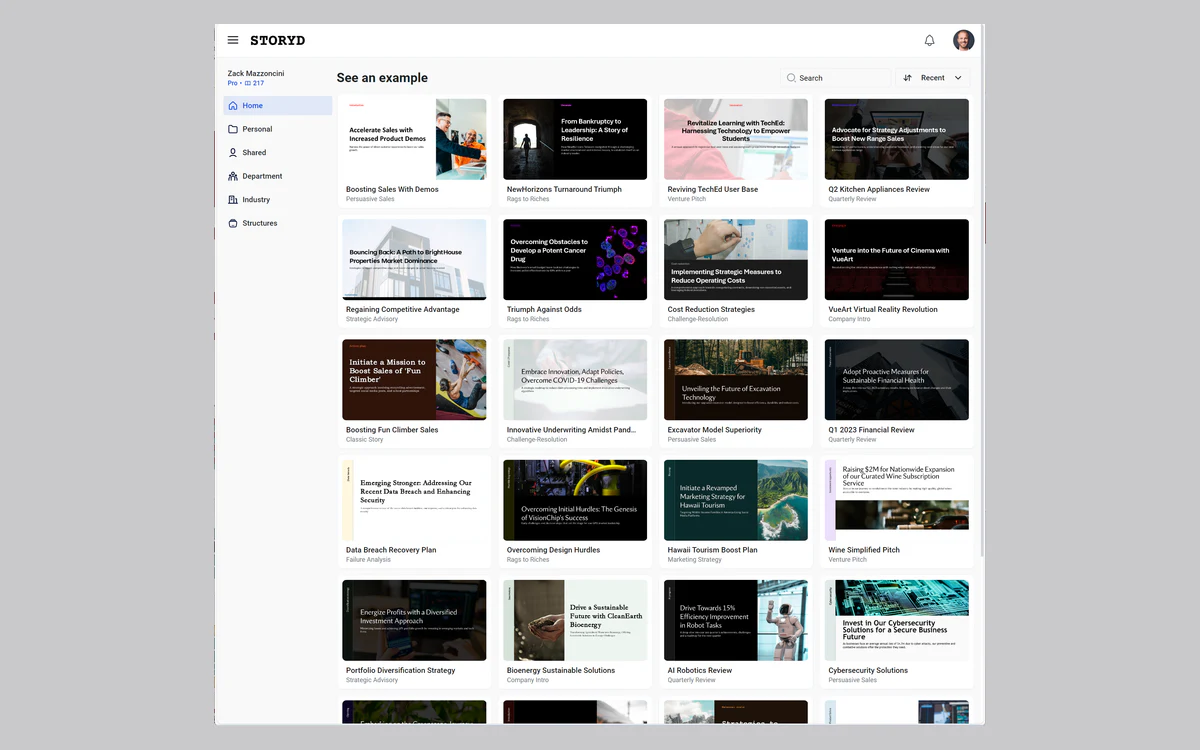
If you would rather not start from a blank brief, Story Starters lets you "Browse by industry or department" for ready-made starting points. The structures in the app carry narrative names such as "Classic Story" and "Rags To Riches".
What STORYD does not document
The site does not say which AI model it uses, which languages it supports, or whether you can feed it a document or URL as source material. Uploading an existing deck is documented only for extracting your theme and font, not your content. PDF export is not listed anywhere.
Editing, branding and collaboration
Once a deck exists, STORYD's AI tools let you "Modify your story with rephrase, brainstorm, shorter and longer". They live in an Ideas pane beside each slide, so you can tighten a headline or pull alternative wording without leaving the editor.
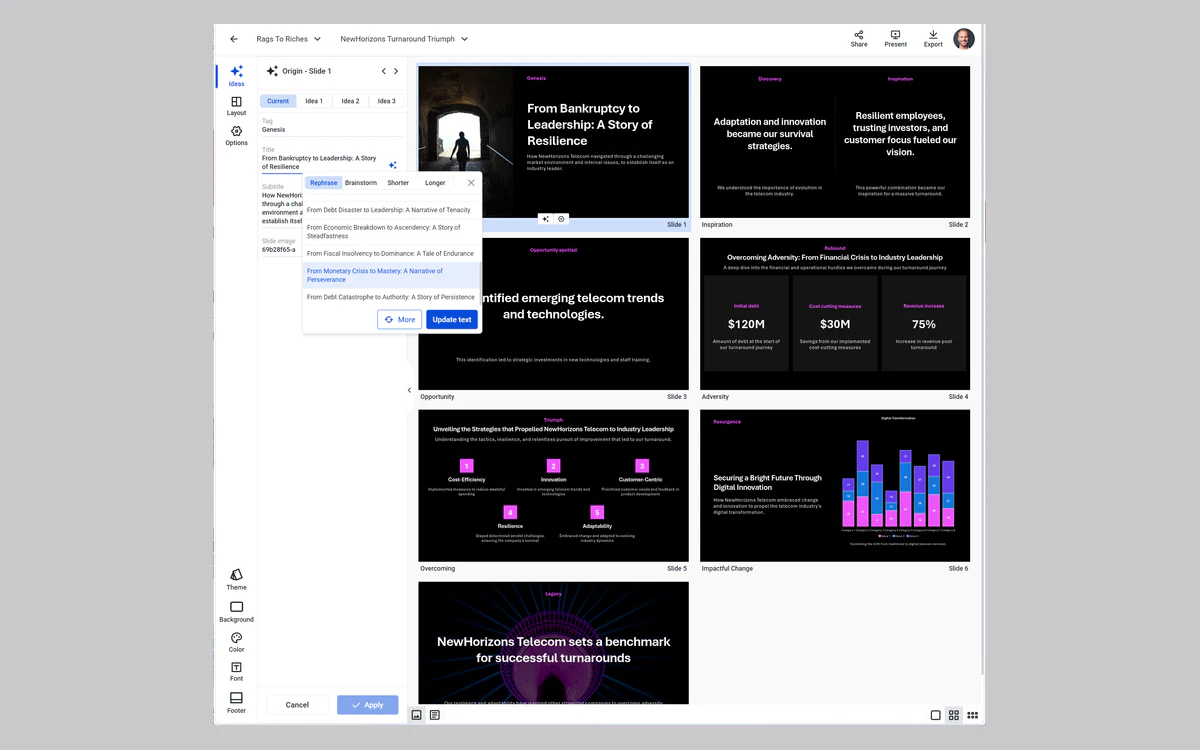
Slides can mix "text, lists, images, charts, and numbers", and STORYD claims "100s of layout options". For branding, you can "Upload an existing deck to have STORYD extract your organizational theme & font", then set "theme, font, colors, logo, footer, date, and page number" yourself. Custom themes and branding are included even on the Free plan, which is unusually generous.
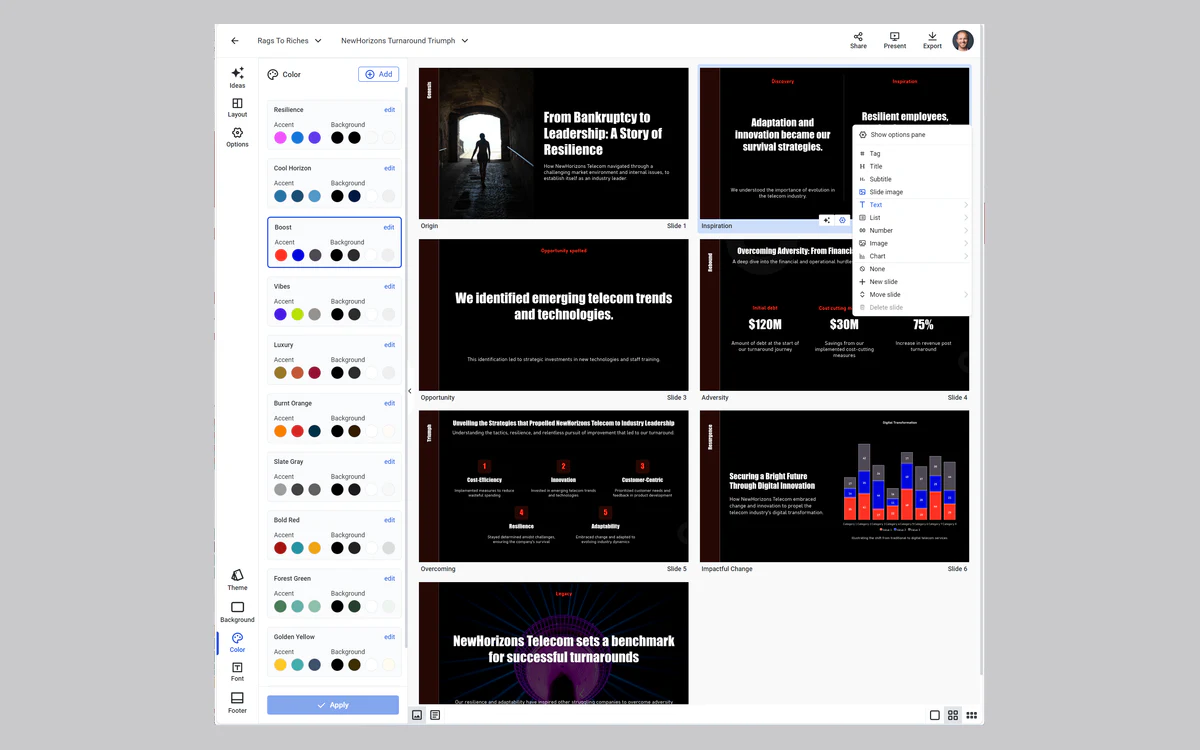
Collaboration is a Pro feature. The plan adds "Team collaboration" and "Real time editing", described on the homepage as the ability to "collaborate live with colleagues in a real-time experience". Presenting from the browser works on every plan.
STORYD pricing in 2026
Pricing lives in the homepage's Pricing section (storyd.ai/pricing returns a 404), with an Annually/Monthly toggle. Prices are listed in dollars. We compared the live page on 31 October 2026 with archived snapshots from January 2025, September 2025, January 2026 and September 2026: the text is identical, so prices have not changed since at least January 2025.
- Free - $0. "5 credits (to create or rewrite)", personalised AI content, professional business templates, custom themes and branding, presenting from the browser, and export to PowerPoint, Google Slides, Keynote and Canva.
- Pro - $18 a month billed annually (marked Save 25%) or $24 billed monthly. Everything in Free, plus "Unlimited credits", priority access, team collaboration and real-time editing.
- Automate - $100 a month billed annually (marked Save 33%) or $150 billed monthly. Unlimited users, "50 presentation credits per month", branded themes and API access, plus "$500/mo per private structure". The button reads Contact us.
In yearly terms, Pro costs $216 on annual billing against $288 paid month by month. Automate costs $1,200 a year on annual billing against $1,800 monthly, before any private-structure add-on.
What a credit is
STORYD never defines a credit. Free says its 5 credits are "to create or rewrite" and Automate says "50 presentation credits per month", but the site does not say whether Free credits reset, whether a rewrite costs as much as a new deck, or whether unused credits roll over. Treat the 5 Free credits as a trial allowance until support tells you otherwise.
Automate is an odd shape. It costs four to six times more than Pro yet caps credits at 50 a month, where Pro says unlimited. What it actually buys is unlimited users, branded themes and the API, so it targets companies that want to generate decks programmatically. There are no public API docs, so expect a sales conversation before you can judge it.
Where STORYD's own documents disagree
The most important part of this review is what happens when you read past the pricing table. STORYD's Terms of Service are dated February 14, 2023 and are based on the Common Paper Cloud Service Agreement v1.0, with Data Advantage LLC as the provider and Washington State law governing. Together with the help centre and the integrations page, they disagree with the homepage on five points.
- Unlimited vs a cap. Pro advertises "Unlimited credits", but the Terms set "A maximum of 250 presentations created per monthly period." That is plenty for almost anyone, but it is a written limit.
- Google Slides export. The pricing table lists "Export to PowerPoint, Google Slides, Keynote and Canva", while the Integrations page still shows "Google Slides Coming soon!". The official YouTube channel has a video titled "Export to Google Slides", so the feature may have shipped without the page being updated.
- Free plan vs card-required trial. The homepage says "Start for free No credit card required". The help centre describes a separate 30-day free trial that requires a card and converts to a paid plan if you do not cancel.
- Monthly plans vs annual terms. Monthly billing is on sale, but the Terms list "Subscription Period: 1 year(s)", "Invoice Period: Annually" and a non-renewal notice of "At least 30 days before the end of the current Subscription Period."
- Discount size. The help centre says annual billing comes "with a 25% discount", which matches Pro, but the pricing table shows Save 33% on Automate.
None of this proves bad faith. The pricing page is simply newer than the legal pages, which have not changed since early 2023. But the documents you would rely on in a billing dispute were not written for the plans being sold today. If you pay monthly, ask support ([email protected]) to confirm in writing that a monthly plan can be cancelled at the end of any month.
Refunds
The help centre has a page titled "Cancellation & Refund Policy", but it states no refund amount, window or method. It only says cancellations "occur at the end of the subscription term". The Terms of Service contain no refund clause either. The Terms also let Data Advantage change prices with at least 30 days' notice, effective from the next subscription period.
Export and integrations
PowerPoint is the dependable route. The Integrations page says decks download "in an easy-to-use pptx format", which you can then open in PowerPoint or import into Keynote. Keynote and Canva are named in the pricing table, but the site does not explain how those exports work, and Google Slides has the conflicting status described above.
Because PowerPoint export is on the Free plan, you can test the thing that matters most - how a STORYD deck survives in your own tools and templates - before paying anything.
Privacy and data handling
The privacy policy (effective 2/28/2023) says STORYD collects "topics you enter, scripts you write, presentation slides you create, presentations you receive, and images and charts you save." It also says service providers analyse examples of presentations "to improve STORYD's presentation generation technologies". There is no explicit statement that your content is excluded from AI training, no opt-out and no stated retention period.
The sub-processor list (last updated 2023-02-28) names Amazon Web Services and Microsoft Azure for infrastructure, plus Google Analytics, Mailgun, Pipedrive and Stripe, all in the US. No AI model provider is named. Analytics run on Google Analytics and Heap. The policy also contains a template leftover - "We'll share personal information outside of Google when we have your consent" - another sign the legal pages were never carefully maintained.
For board packs or financial decks, treat STORYD like any cloud AI tool with an unclear training policy: keep sensitive figures out of the prompt and add them after export.
Product momentum and reputation
The official changelog has exactly two entries: "0.1 6 March 2023 Early beta" and "1.0 10 October 2023 First full release". STORYD launched on Product Hunt on March 14, 2023 and again on October 20, 2023, and its YouTube channel has 15 videos. The site is live and was re-published in October 2026, so this is not an abandoned product, but there is no public record of product updates since late 2023.
There are no independent ratings to lean on. Product Hunt shows no reviews, Trustpilot has no page, and we found no G2 or Capterra listing. The "4.75 rating" on storyd.ai/reviews sits beside placeholder testimonials copied from a website template, so we ignore it. Some directories also wrongly claim STORYD has no free plan; the $0 plan is real.
How STORYD compares with other AI deck tools
STORYD's distinguishing point is structure-first storytelling: it writes the narrative and a script, not just slides, and it is tuned for business communication. Among the tools we have reviewed, SlidesAI is built around Google Slides, which matters if your team lives there, given STORYD's unclear Google Slides export. Pitch is the stronger choice when design polish and team workflow matter more than AI-written narrative. Tome, once the best-known AI storytelling deck tool, has discontinued its slides product, as our Tome review explains.
On price, STORYD Pro at $18 to $24 a month sits in the normal range for a single-seat AI deck tool. The deciding factors are less about price than about whether its structures fit the decks you make and whether you can live with its fine print.
Verdict: who should use STORYD
STORYD suits consultants, analysts and managers who build recurring business decks - updates, renewals, proposals - and want a narrative scaffold fast. The script-first workflow and named communication structures are a real advantage over tools that jump straight to visuals, and the Free plan, with branding and PowerPoint export included, is enough to judge it.
If the free test goes well, Pro is fairly priced. Start on the $24 monthly plan rather than the $18 annual one until support confirms in writing how cancellation works, since the Terms describe a one-year subscription. Approach Automate only after a sales call and a look at the API documentation.
Look elsewhere if you need native Google Slides output today, documented commitments on AI training and data retention, or a visibly active roadmap.
Frequently asked questions
Is STORYD free?
Yes, there is a $0 Free plan with 5 credits "to create or rewrite", and the homepage says no credit card is required. Separately, the help centre describes a 30-day free trial of the full feature set that does require a card and converts to a paid plan unless you cancel.
How much does STORYD Pro cost?
Pro costs $18 a month billed annually ($216 a year) or $24 billed monthly. Those prices have been unchanged since at least January 2025.
Is STORYD Pro really unlimited?
Not quite. The pricing table says "Unlimited credits", but the Terms of Service cap use at "A maximum of 250 presentations created per monthly period." Few individual users will hit it.
Can STORYD export to Google Slides?
The pricing table says yes, but the Integrations page still lists Google Slides as "Coming soon!". PowerPoint (.pptx) export is the documented, dependable option, and a pptx file can be imported into Google Slides.
Does STORYD offer refunds?
STORYD publishes no refund terms. Its "Cancellation & Refund Policy" page only says cancellations take effect at the end of the subscription term, and the Terms of Service have no refund clause.
Can I cancel a monthly STORYD plan at any time?
The help centre says you can cancel at any time, effective at the end of the term, and the trial can be cancelled at app.storyd.ai/user/subscription. Because the Terms describe a one-year subscription with annual invoicing, get written confirmation from support before relying on month-to-month cancellation.
Does STORYD use my presentations to train its AI?
Possibly. The privacy policy says presentations are analysed to improve STORYD's presentation generation technologies, offers no opt-out, and does not name the AI model provider. Keep confidential data out of prompts.
Does STORYD have an API?
Only on the Automate plan ($100 to $150 a month), and there is no public API documentation. You need to contact sales for details.
Key takeaways
- STORYD writes a script and a business deck from a short brief and a chosen communication structure; the script-first approach is its real strength.
- Plans: Free $0 (5 credits), Pro $18/mo annual or $24/mo monthly, Automate $100/mo annual or $150/mo monthly; unchanged since at least January 2025.
- Pro's "Unlimited credits" is capped at 250 presentations a month in the Terms of Service.
- Google Slides export is listed on the pricing table but marked "Coming soon!" on the Integrations page; PowerPoint export is the safe bet.
- The Terms describe a one-year subscription and no refund terms are published, so confirm cancellation rules in writing before paying.
- No public product updates since version 1.0 in October 2023, and no independent user ratings exist yet.
More in Artificial Intelligence
Browse Artificial Intelligence