Synthesia Review 2026: Minutes, Avatars and What It Really Costs
Synthesia turns a script into a video with an AI presenter. We break down the 2026 plans, the 10-minute cap, custom avatar fees and the no-refund policy.
Synthesia sells a simple promise: paste a script, pick a presenter, and get back a finished video without a camera, a studio or a voice actor. In 2026 it is the most widely deployed tool in that category, and it is also one of the easiest to overspend on, because the sticker price and the price of actually using it at work are two different numbers.
The plans are metered in video minutes, and the entry tiers give you ten of them a month. That single constraint shapes everything else about the product — who it suits, what it costs at scale, and where it quietly stops being cheaper than filming something.
This review works through the current plans, the avatar system and its add-on fees, the translation features, the policies that catch people out, and the places where the output still gives itself away. All figures below come from Synthesia's own pricing page, docs and help centre as of 29 August 2026.
What Synthesia actually does
Synthesia is a browser-based video editor built around synthetic presenters. You write or paste a script, choose an avatar and a voice, lay out scenes on a timeline, and the platform renders a video where the avatar speaks your words with matched lip movement. There is nothing to install and nothing to record.
The workflow is closer to building a slide deck than to editing footage. Each scene has a layout, a background, on-screen elements and a script box that drives the narration. You can start from one of the 60+ templates, import PowerPoint slides or a PDF, or begin from a blank scene and let the AI Video Assistant draft the script from a prompt.
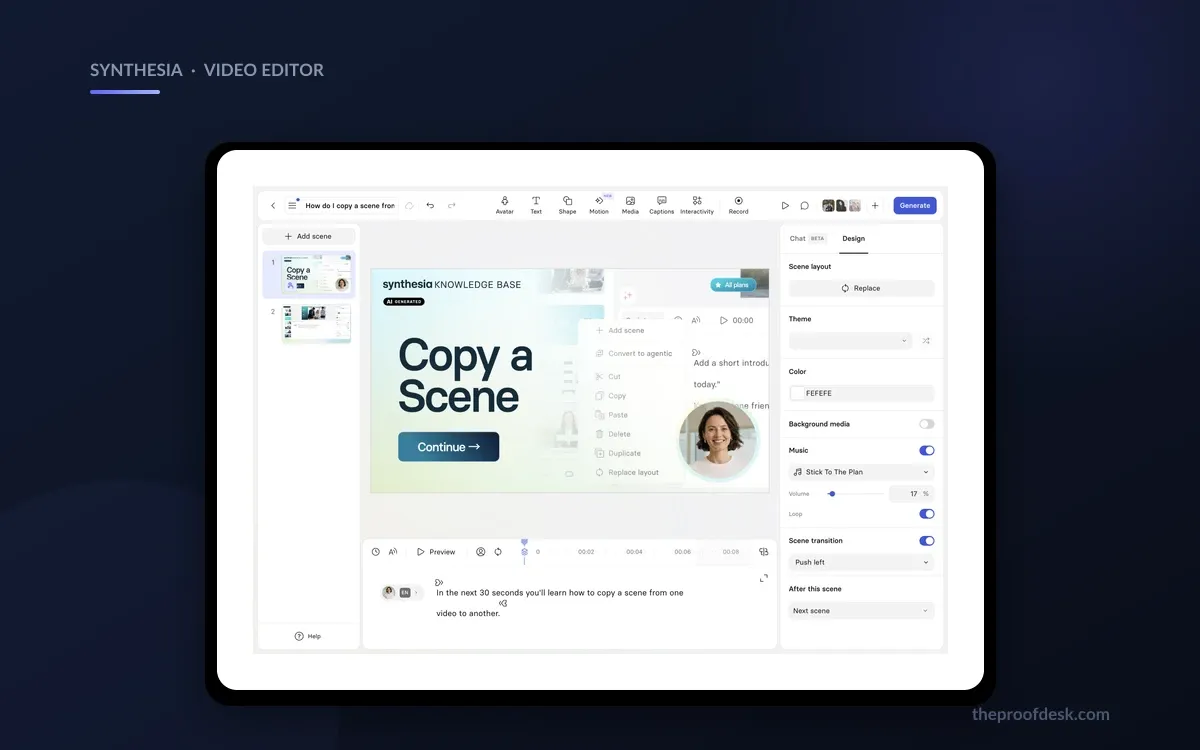
That framing matters when you judge the output. Synthesia is very good at the corporate explainer, the onboarding module and the product walkthrough — formats where a person talks to camera over graphics. It is not a general-purpose video editor, and it is not trying to be one.
Synthesia pricing in 2026
There are four tiers. Prices are in US dollars and the annual rates are billed up front for the year.
- Basic — $0/mo. 1,200 credits a month, usable for up to 10 minutes of video. 9 AI avatars, 25 AI-generated video assets, 1 editor seat, no credit card required.
- Starter — $29/mo, or $18/mo billed annually ($264 for the year). Same 1,200 credits and 10 minutes, but 125+ avatars, 1 editor plus 3 guests, and the Synthesia logo comes off your videos.
- Creator — $89/mo, or $64/mo billed annually ($804 for the year). 3,600 credits, up to 30 minutes of video a month, 180+ avatars, 75 video assets, 1 editor plus 5 guests, API access, interactive videos and multiple avatars per scene.
- Enterprise — custom pricing, billed annually. Unlimited video minutes, 240+ stock avatars, unlimited personal avatars (subject to reasonable consumption and compute), SAML/SSO, brand kits, SCORM export and 1-click translation into 80+ languages.
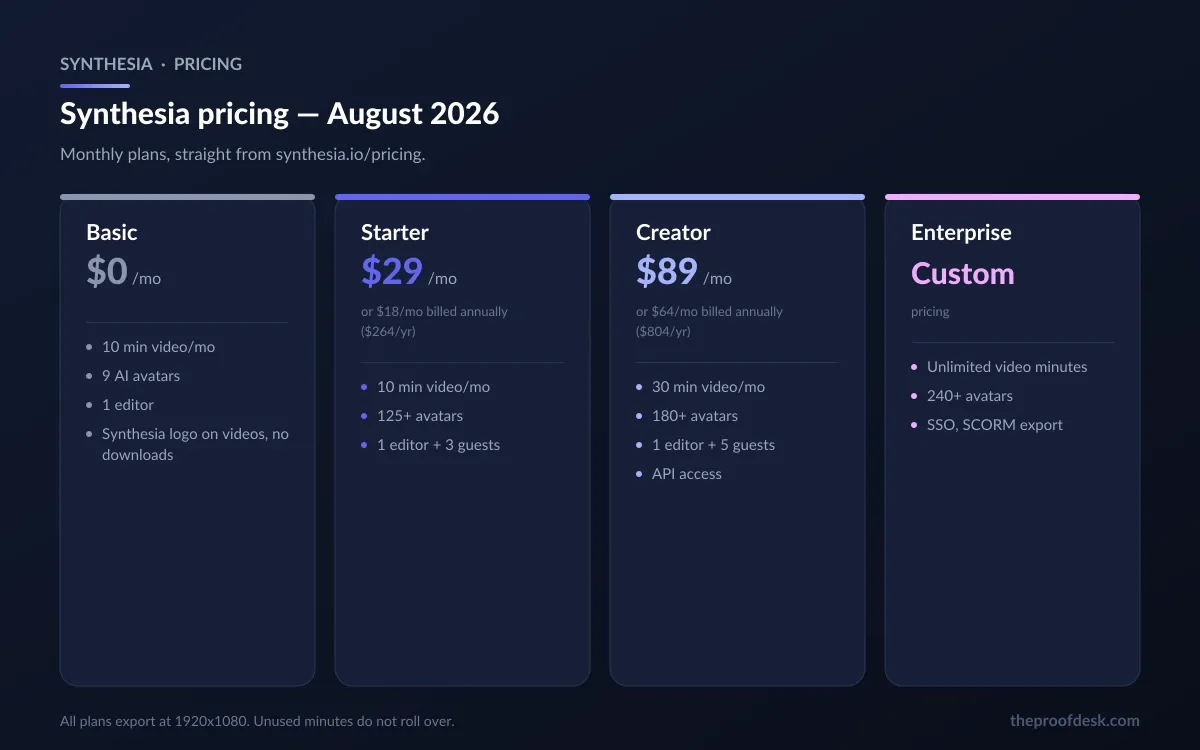
The free Basic tier is genuinely usable for evaluation but not for delivery: you cannot download your videos, so anything you make there stays inside Synthesia and carries the company's logo. Downloads start at Starter, and every plan exports at Full HD 1920x1080. No tier on the pricing page offers 4K.
Unused minutes disappear
Synthesia's own FAQ is explicit: if you are under your video credit limit at the end of a billing period, the unused videos do not roll over. Metering resets monthly whether you used it or not, which makes the annual plans a bet on steady output rather than occasional bursts.
The minute cap is the real product
Ten minutes a month sounds like more than it is. A single three-minute explainer that goes through four rounds of script revision is not three minutes of usage — every render you generate spends credits, so revisions are billed like new videos. Teams routinely burn a Starter allowance on one deliverable.
There is no published overage rate. Synthesia's FAQ says that if you exceed your limit, your usage will be capped until renewal, and that to get more video minutes right away you upgrade your plan. In practice this means the meter is a hard stop rather than a surprise invoice — better for budgeting, worse if you hit it on a deadline.
A few things spend credits faster than you would expect:
- Every regenerated render counts, including small script fixes and typo corrections.
- AI Dubbing draws on the same monthly allowance as video on Starter and Creator.
- Turning on lip sync for dubbing uses 2x credits.
- On Creator, API-generated video is deducted from the same plan usage limit, within a 360 minutes per year ceiling.
The practical advice is to script and proofread outside Synthesia, then generate once. Treat the render button as the expensive step, because it is.
Avatars: stock, personal and studio
Stock avatars are the default and the reason most people can start in ten minutes. The library scales with your plan — 9 on Basic, 125+ on Starter, 180+ on Creator, 240+ on Enterprise — and covers a reasonable spread of ages, appearances and presentation styles, mostly in business-casual settings.
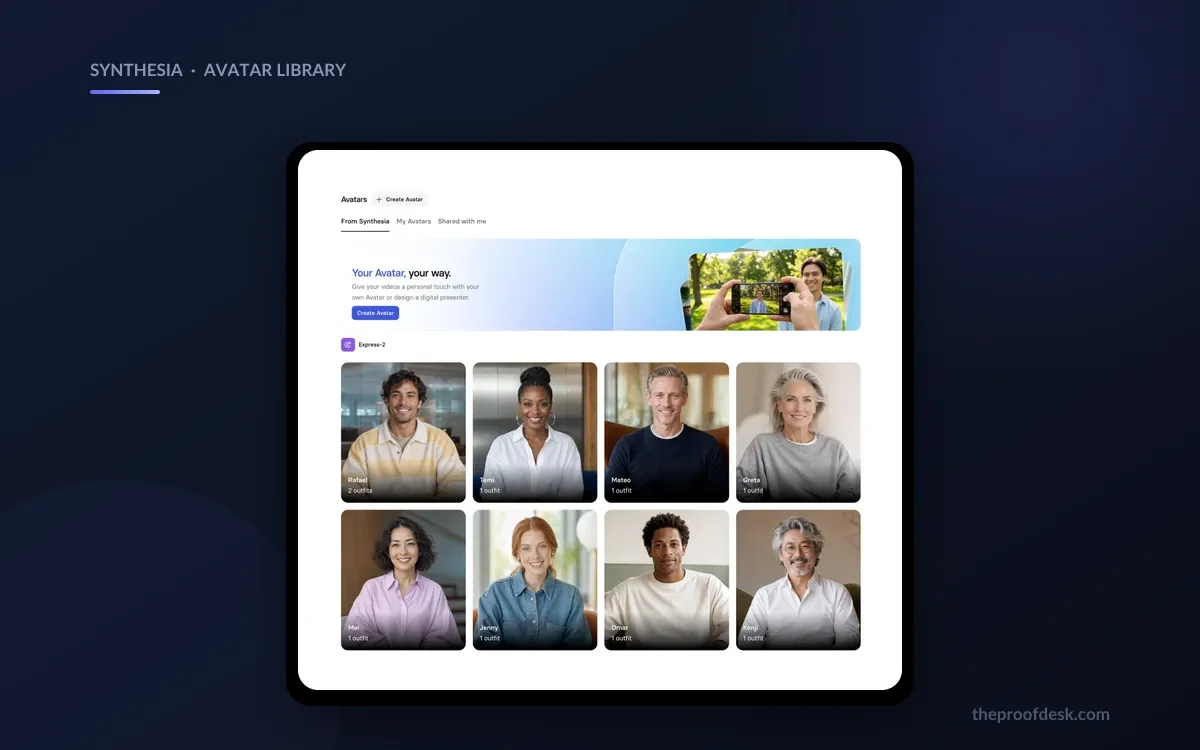
Personal avatars are the version of you. There are two routes. The older video method needs footage that is 1 to 5 minutes long, filmed as a single continuous take with one person in the foreground — no splicing, no multiple takes — and the avatar is ready in about 24 hours. The newer photo method produces an avatar within minutes of the consent step and is available on paid plans only.
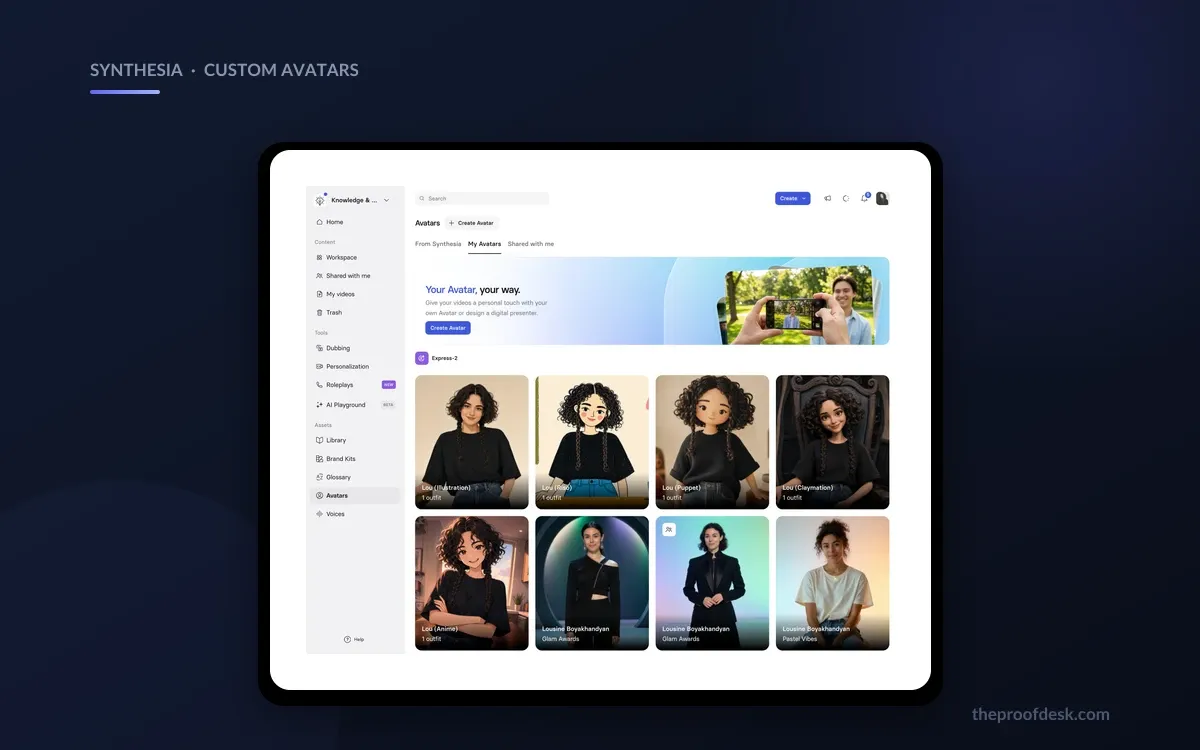
Consent is enforced at the point of creation. The consent video must be recorded live — you cannot upload a pre-recorded one — it must be the same person as the footage, and it includes an on-screen passcode shown at recording time. Synthesia states it will never create a clone of someone without their consent.
The costs stack up above the plan price:
- Personal avatar allowance by plan: 3 on Starter, 5 on Creator, unlimited on Enterprise. Basic gets none.
- Additional personal avatars beyond your allowance: $240/year each (EUR 216, GBP 192, INR 16,499).
- A Studio Express-1 avatar, the higher-fidelity tier, is a paid add-on at $1,000/year, available to annual plan users only, and can take up to 10 days to process.
One number Synthesia contradicts itself on
The comparison table on the pricing page says Starter includes 3 personal avatars. The FAQ on the same page says one custom personal avatar is included with the annual Starter and Creator plans. Both statements are live on synthesia.io as of 29 August 2026. If your purchase decision depends on that allowance, get it confirmed in writing before you pay for a year.
Translation and dubbing
This is where Synthesia earns its keep for anyone shipping the same content to several markets. All plans include 160+ languages and voices for narration, so you can simply write a script in another language and have an avatar deliver it.
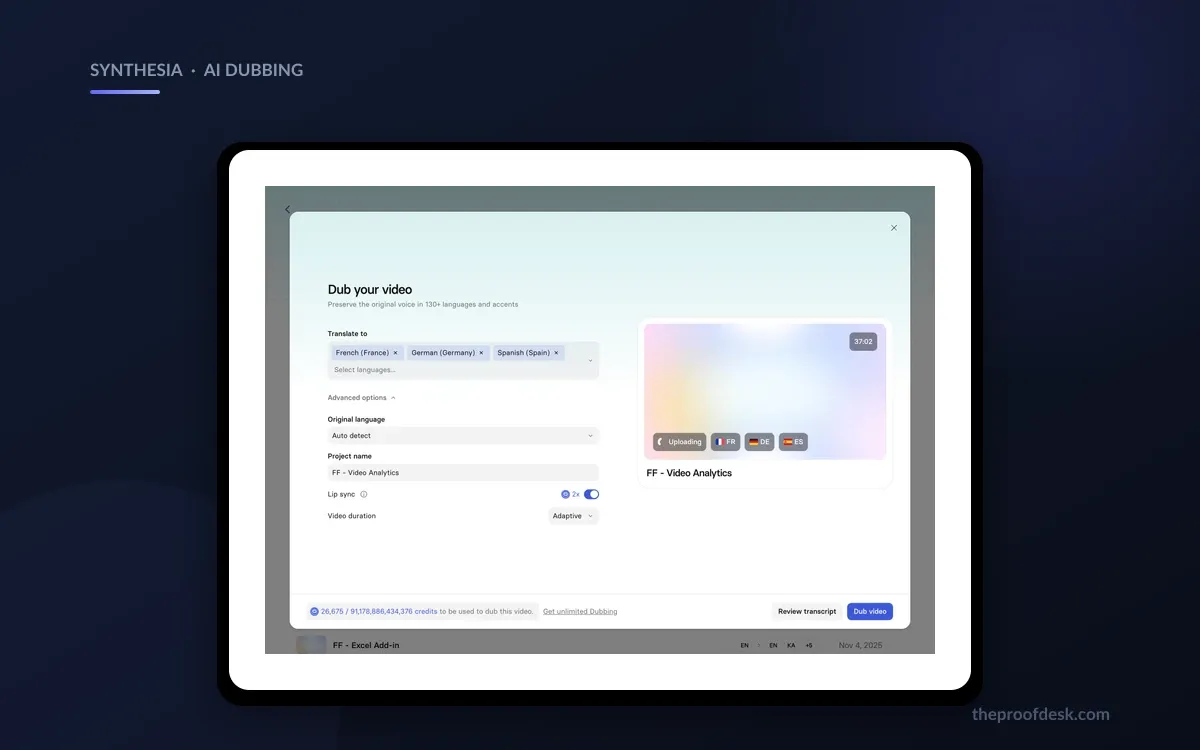
AI Dubbing is the other half: point it at an existing video and it produces a re-voiced version, optionally with lip sync. Coverage and volume are tiered.
- Starter — 10 minutes of dubbing a month, into 70+ languages, shared with your video allowance.
- Creator — 30 minutes of dubbing a month, into 70+ languages, shared with your video allowance.
- Enterprise — unlimited dubbing minutes, into 140+ languages, plus 1-click translation into 80+ languages and a custom glossary for terminology you cannot let the model paraphrase.
The Enterprise gap here is wide and deliberate. If localisation is the reason you are buying, the lower tiers will not carry the volume, and the shared allowance means every dubbed language competes with your original video budget.
Where Synthesia falls short
The avatars are the best in the category and still not people. Reviewers consistently describe the delivery as slightly scripted — eye movement and pacing hold up for a short segment and start to feel mechanical over longer stretches. For a two-minute policy update that is fine. For a fifteen-minute course module, viewers notice.
- Full HD 1920x1080 is the ceiling on every published tier. There is no 4K option listed.
- Deeper avatar control — outfits, gestures, camera framing — is largely reserved for the upper tiers.
- Seats are tight. Starter and Creator both include exactly one editor; everyone else is a guest.
- The editor is scene-based, so anything that needs frame-level timing or complex compositing has to leave Synthesia.
- There is no per-video purchase option. Synthesia's FAQ states plainly that you cannot pay per video.
The billing terms are the other thing to read before you commit. Synthesia's help centre and customer terms both state that all purchases are non-cancelable and, except where the contract expressly states otherwise, non-refundable. You can cancel a subscription from account settings at any time, which stops the next renewal, but that is not the same as getting money back. The documented exception is termination for cause by the customer, where Synthesia refunds prepaid fees covering the remainder of the term. Studio Avatars cannot be refunded once produced and deployed, and there are no student, non-profit or educational discounts.
Security, data and content rules
For a tool that renders a recognisable human face on command, the governance is a real part of the evaluation, and this is an area where Synthesia is unusually forthcoming.
- Synthesia states it undergoes periodic ISO 42001, ISO 27001 and SOC 2 Type II audits, and lists GDPR compliance among its platform features.
- Stored customer data is encrypted using AES-256, held in Irish data centres with backups in Frankfurt.
- The customer terms state that customers own their customer data, and that usage information will not result in the improvement or fine tuning of any AI components unless integrated with the services the customer is using.
- Content moderation covers 16 prohibited and restricted categories, including disinformation and political propaganda, identity-based hate, explicit material, financial fraud, violent extremism and personal privacy violations.
- Stock avatars carry usage restrictions of their own — broadcast, fundraising, political campaigning and polarising commentary require Synthesia's written consent.
The consent flow for personal avatars, with its live recording and on-screen passcode, is the strongest part of this. It is genuinely awkward to work around, which is the point.
How it compares
Synthesia is the enterprise-shaped option: the deepest avatar library, the strongest compliance story, the localisation tooling, and pricing that assumes a company is paying. The alternatives compete mostly on cost per minute, and their advertised rates move often enough that you should check their own pricing pages before deciding.
- HeyGen — the closest direct rival, with a comparable entry price but a credit system rather than flat minutes, and custom avatars bundled higher up the range instead of sold as a four-figure add-on.
- Colossyan — positioned for workplace learning, with a similar template-and-scene model at a lower entry point.
- Elai — cheaper per minute for light, straightforward talking-head output.
- D-ID — the budget end, focused on animating a single photo rather than providing a full studio and editor.
If you need SCORM packages, SSO and 140-language dubbing under one contract, the shortlist is short and Synthesia is on it. If you need six talking-head clips a month for social, you are paying for governance you will never use.
Who should buy it
The tool fits a specific shape of team, and it is worth being honest about which side of that line you are on.
- Buy it if you produce recurring internal video — onboarding, compliance, product updates — that has to exist in several languages and pass a security review.
- Buy it if your bottleneck is scheduling a person on camera rather than the video production itself.
- Skip it if you need under ten minutes a month; the free tier will tell you what you need to know and the paid tier will not change much.
- Skip it if the output has to look filmed, or if more than one person needs to edit and you are not budgeting for Enterprise.
- Start monthly, not annually. The annual saving is real, but so is the no-refund policy, and the minute cap is much easier to judge after two real projects than before the first one.
Frequently asked questions
How much does Synthesia cost?
Starter is $29 a month, or $264 for a year, which works out at $18 a month. Creator is $89 a month, or $804 for a year, which works out at $64 a month. There is a free Basic tier at $0, and Enterprise pricing is custom and billed annually.
Is there a free version of Synthesia?
Yes, and it needs no credit card. The Basic plan gives you 1,200 credits a month — up to 10 minutes of video — with 9 avatars and one editor seat. The catch is that you cannot download anything, so the videos stay inside Synthesia and carry the Synthesia logo. Downloading starts at Starter.
Do unused video minutes roll over to next month?
No. Synthesia's FAQ states that unused videos do not roll over to the next billing period. Whatever you do not spend by the end of the month is gone, on both monthly and annual plans.
Can I get a refund from Synthesia?
Generally no. Synthesia's help centre and customer terms both state that purchases are non-cancelable and, except where the contract expressly says otherwise, non-refundable. You can cancel from account settings to stop future renewals, and prepaid fees are refunded if you terminate for cause, but there is no money-back guarantee and Studio Avatars cannot be refunded once produced.
What does it cost to make an avatar of myself?
Your plan includes an allowance — 3 personal avatars on Starter, 5 on Creator, unlimited on Enterprise, none on Basic. Extra personal avatars beyond that are $240 a year each. The higher-fidelity Studio Express-1 avatar is a separate $1,000-a-year add-on, restricted to annual plans and taking up to 10 days to process. Note that Synthesia's pricing page currently contradicts itself on the Starter allowance, listing both 3 avatars and one included avatar, so confirm it before you buy.
What do I need to record to create a personal avatar?
For the video method: 1 to 5 minutes of footage filmed as a single continuous take, with only you in the foreground and no splicing between takes. It is ready in around 24 hours. The photo method is faster — minutes rather than a day — and is available on paid plans only. Either way you record a live consent video with an on-screen passcode; a pre-recorded one will not be accepted.
Does Synthesia offer an API?
Yes, from the Creator plan upwards. The pricing page caps API output at 360 minutes of video per year, and on Creator that output is deducted from your plan's normal monthly usage limit rather than sitting on top of it. Enterprise includes the same 360 minutes with additional usage sold as a paid add-on.
Key takeaways
- Pricing is metered in video minutes: 10 a month on Basic and Starter, 30 on Creator, unlimited only on Enterprise. Unused minutes never roll over.
- The real cost sits above the plan price — extra personal avatars are $240/year and a Studio avatar is $1,000/year, on annual plans only.
- Purchases are non-refundable. Cancelling stops renewals, it does not get your money back, so start monthly before committing to a year.
- Localisation is the strongest reason to buy, but dubbing shares your video allowance below Enterprise, where it becomes unlimited across 140+ languages.
- Everything exports at 1080p, one editor seat is included below Enterprise, and the avatars still read as synthetic over long runtimes.
More in Artificial Intelligence
Browse Artificial Intelligence