Technology reviews & practical guides
UpCloud review for October 2026: the new Starter (€3), Premium (€5) and Cloud Native (€12) plans, the limits on zero-cost egress, 28-day billing, charges for stopped servers and refund rules.

UpCloud changed its entire Cloud Server lineup on 15 April 2026. Starter replaced the Developer plans, Premium replaced General Purpose, High CPU and High Memory, and the entry prices are now €3/mo for Starter, €5/mo for Premium and €12/mo for Cloud Native, all with zero-cost data transfer.
The headline prices are only half the story. This review covers what each plan includes and where the fine print bites: servers that bill while switched off, a 28-day billing month, a Fair Transfer Limit behind the free egress, and a prepaid balance that ends in data deletion if it runs dry.
UpCloud is a Finnish cloud provider that sells virtual servers, block and object storage, managed databases, managed Kubernetes and GPU servers from 15 data centres. All prices below are in euros, exclude VAT, and are taken from the UpCloud pricing page as listed in early October 2026.
The €5 Premium plan bundles 1 GB RAM, 25 GB MaxIOPS storage, a five-nines SLA and 1000 Mbps networking, and costs less than the €7.6 General Purpose plan it replaced. The catches are in billing: Starter and Premium servers are charged while shut down, and an empty prepaid balance starts a clock that ends with your data being deleted.
On 15 April 2026 UpCloud rebuilt its Cloud Server lineup. The changelog announced "two new Cloud Server plan families: Starter and Premium", where "Starter uses previous-generation hardware" and "Premium plans run on the latest AMD EPYC CPU platforms and include MaxIOPS storage".
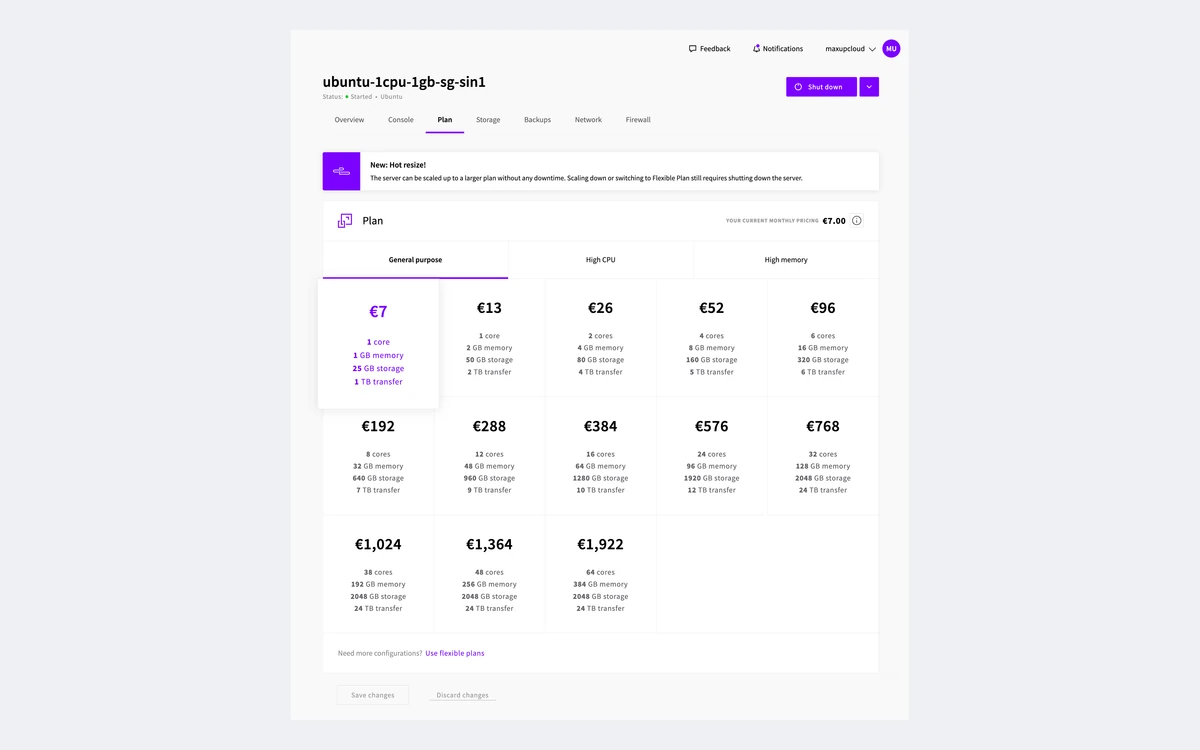
The old Developer, General Purpose, High CPU and High Memory families now sit under a "Previous plans" heading on the pricing page, described as "Discontinued Cloud Server plans no longer available for deployment." If you read an older UpCloud review or tutorial that recommends a General Purpose plan, you cannot order it any more.
At the bottom of the range the change is mostly a price cut. The old 1 GB General Purpose plan with 25 GB of storage cost €7.6/mo (Global) or €7.5/mo (Helsinki); the new 1 GB Premium plan with 25 GB of MaxIOPS storage costs €5/mo at a single global price. The old €3 Developer plan was limited to 2 per customer; the new €3 Starter plan allows 5 concurrent deployments.

Starter is the budget family. UpCloud says the Starter plans "replace our current Developer plans at on average 25% less expensive than previous-generation while offering the same 99.99% SLA." Note the four nines: Starter does not get the 99.999% SLA of the other families.
Port speed is the quiet limiter here: 250 Mbit/s on the four smallest plans and 500 Mbit/s above them, against 1000 Mbps on Premium. Included transfer under the Fair Transfer Policy runs from 0.5 TB on the 1 GB plan to 2.5 TB on the 16 GB, 4 vCPU plan. Storage is fixed per plan and stays small, topping out at 50 GB.
Starter plans are billed by the starting hour, for a maximum of 28 days per month, and they keep billing while the server is shut down. The €3 plan is limited to 5 concurrent deployments per customer.
Cloud Native plans "offer even greater flexibility by decoupling compute and storage pricing", carry the 99.999% SLA, and are the only standard server family where a stopped server is not charged: UpCloud lists "Server stopped, no charges" as a benefit. Storage is billed separately, so that saving applies to the compute line.
The plan card advertises 4 to 512 GB of memory, but only the tiers above had prices on the page we checked. Included transfer runs from 1 TB on the smallest plan to 100 TB on the largest.
A Cloud Native 4 GB, 2 vCPU server (€15/mo) with 50 GB of MaxIOPS storage at €0.22 per GB (€11/mo) comes to €26/mo, exactly the price of the Premium 4 GB, 2 vCPU plan with 50 GB MaxIOPS. Premium adds a free daily backup; Cloud Native stops the compute charge when the server is off. If a server runs around the clock, Premium is the better deal. If it sits powered off for part of the month, Cloud Native wins.
UpCloud docs state: "Cloud Servers are billed hourly and capped at 672 hours (24 h x 28 days) per month." A server that runs the whole calendar month never costs more than its listed monthly price; hours beyond the 672nd are not charged. UpCloud publishes only monthly prices for Starter, Premium and Cloud Native, not hourly rates.
This is the clause most likely to surprise newcomers: "Starter and Premium plan Cloud Servers are billed per hour regardless of whether the server is powered on or shut down. This is due to the discounted bundle pricing … Cloud Native plans are only billed when powered." Managed database clusters behave like Starter and Premium: "A cluster is billed for the duration the instance exists, including while stopped." GPU servers are not billed while stopped, but their storage and public IPs keep charging. On every product, the only way to stop the charges is to delete the resource; UpCloud says "the service charge accumulation will stop the point of deletion."
UpCloud runs on credit: "All UpCloud services are billed by deducting the hourly costs from the user's account balance on an hourly basis." You top up at any time in EUR, USD, GBP or SGD, and non-EUR payments are converted to EUR. Activating an account takes a one-time deposit of at least 10 in your chosen currency.
If the balance runs out, UpCloud publishes a removal schedule:
During that time "IP addresses, storages and backups continue to be charged", and "the account balance is allowed to go below zero if necessary." Running out of credit is also listed as an SLA exemption, so an outage caused by an empty balance earns no compensation. Set up automatic top-ups or a balance alert before putting anything important on the account.
The terms of service, effective 3.7.2026, define a "Post-Pay Model, where the Service usage is charged monthly in arrears" and say new customers who register "after UpCloud has launched the Post-Pay Model" will be on it. We found no launch date, and the billing docs still describe prepaid credit only. Treat post-pay as announced in the contract, not available today.
UpCloud may raise prices "at any time by providing at least 30 (thirty) days' advance notice" (ToS 10.4). Credits "are non-refundable and non-transferable unless otherwise decided by UpCloud" (ToS 11.3). On dormant accounts with no deployed resources and no login or API activity, credits are removed after 3 years and the account after 5 years.
The pricing page lists public outbound and inbound transfer at €0.00 per GiB, and says "Network transfer is included in all product plans at zero-egress cost, Fair Transfer Policy applies." That policy is where the limit sits.
Each plan has a Fair Transfer Limit. Starter allowances run from 0.5 TB to 2.5 TB per month, Premium from 0.5 TB to 23 TB, and Cloud Native from 1 TB to 100 TB. The limit is "global and shared between all data centres". Once you reach it, UpCloud sends a warning email, "after which we may throttle the bandwidth on the cloud services down to 100 Mbit/s."
There is no per-GB overage fee, so a traffic spike cannot produce a surprise bill. The trade-off is that a busy server can be slowed to 100 Mbit/s instead. That is a better failure mode than metered egress for most small projects, but it is not unlimited bandwidth, and a 1 GB server with a 0.5 TB allowance is not the place for a download mirror.
UpCloud also lists a CDN, marked "Releasing soon" and "powered by bunny.net". CDN traffic is excluded from zero-cost egress.
Volumes scale from 10 GB to 4 TB each, with up to 16 volumes and 64 TB per server. Since November 2025 storage can be attached and resized while the server is running. The Archive tier was called HDD until August 2024, which is worth knowing when reading older guides.
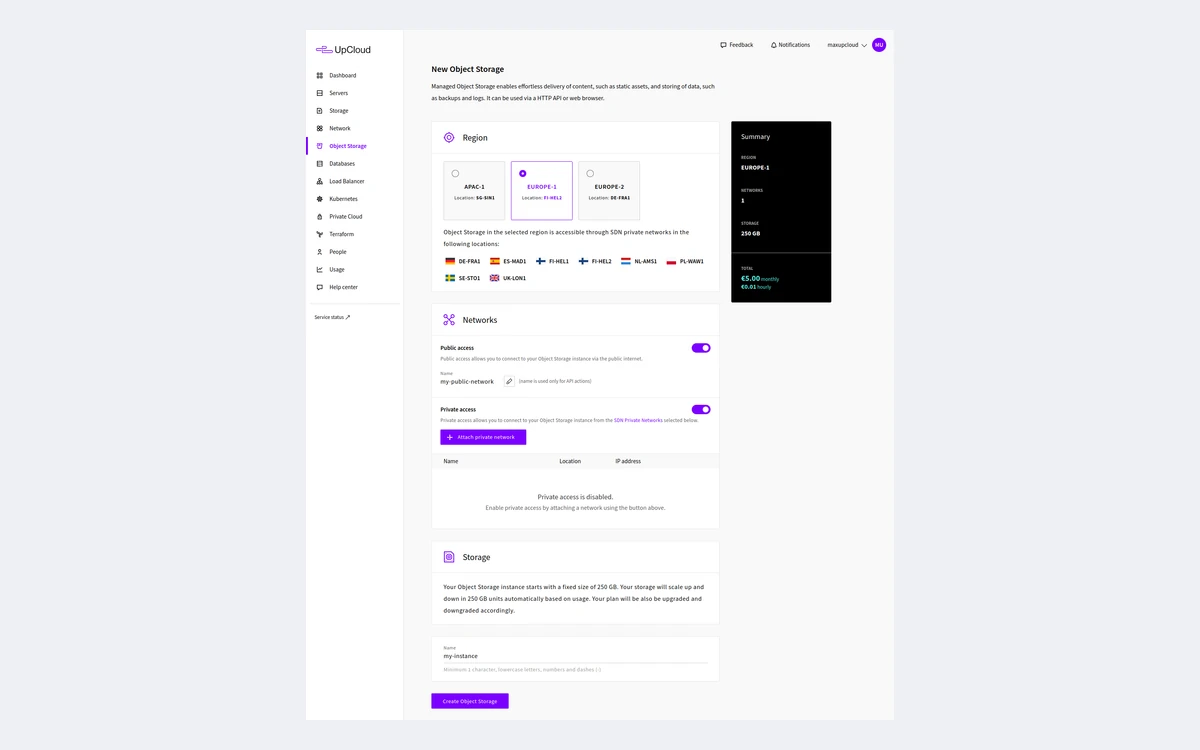
Managed Object Storage costs €5/mo for 250 GB, plus €5/mo for each further 250 GB, and the minimum invoicing unit is 250 GB. File Storage over NFS, added in February 2026, starts at €37.50/mo for 250 GB (€0.15 per GiB).

Simple Backups are priced as a percentage of the server plan: Day +10%, Week +20%, Month +40%, Year +60%. Flexible and on-demand backups cost €0.056 per GB/mo. Premium plans already include a free 24-hour backup of their included storage.
An additional public IPv4 address or a floating IP costs €3.47/mo. Windows Server is licensed per CPU core: €12.00/mo for Standard and €29.02/mo for Datacenter. On a 4-core server that is €48/mo for the Standard licence alone, before the server itself.
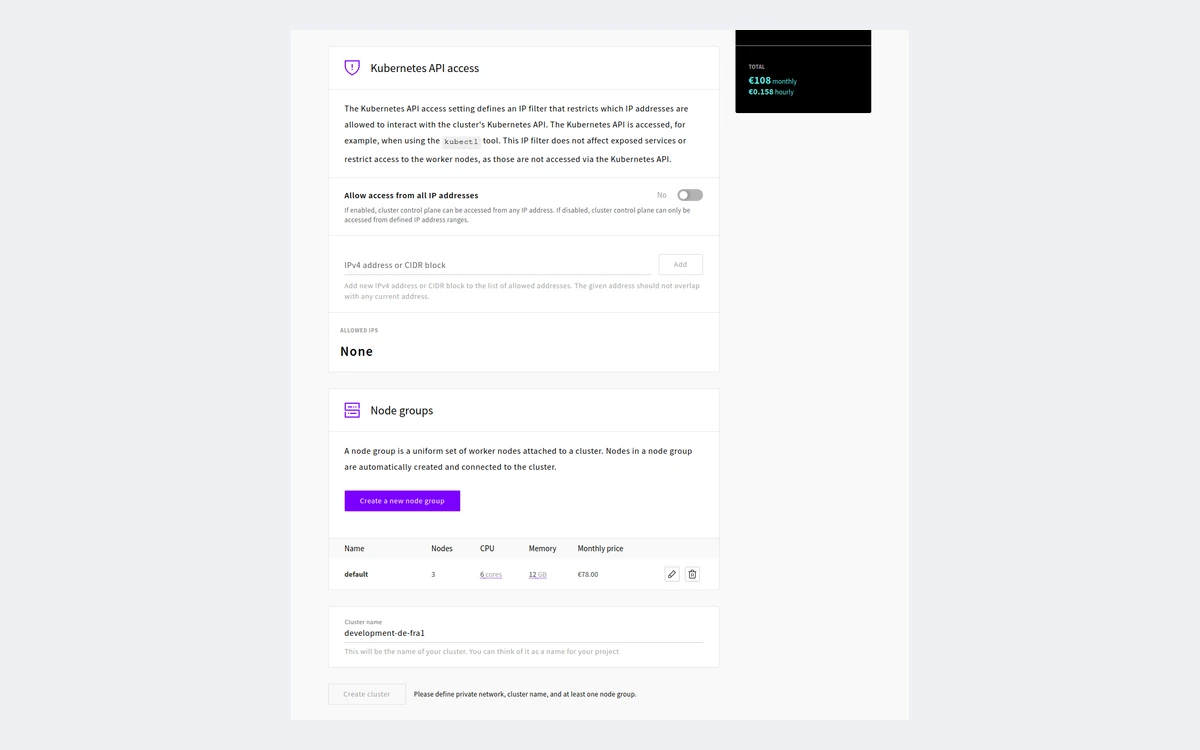
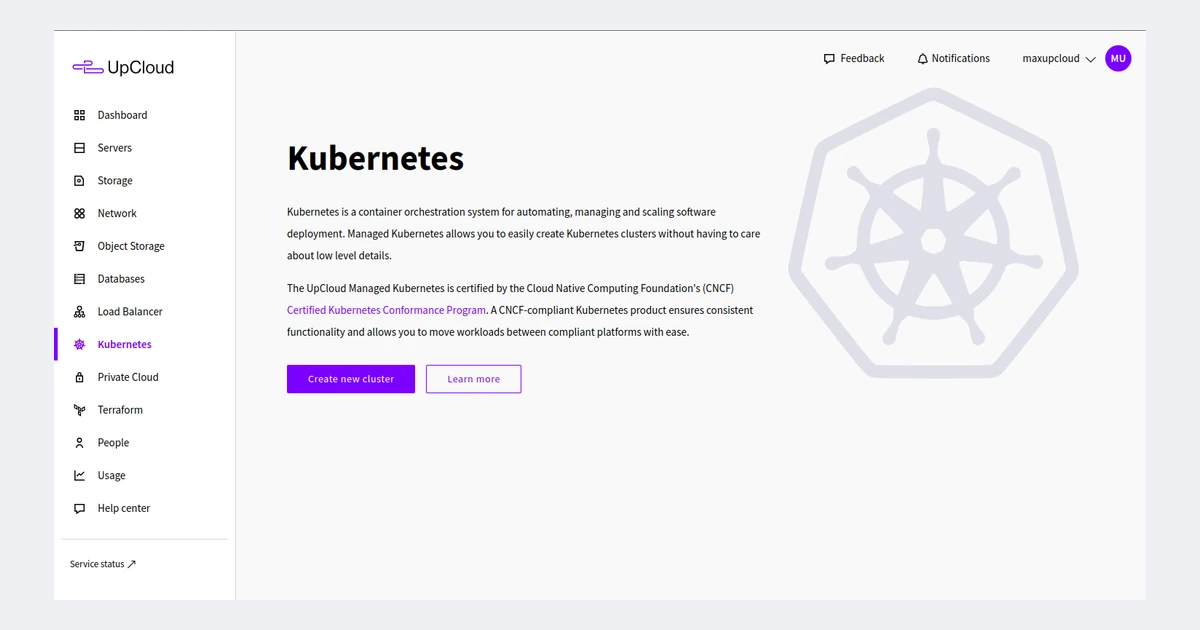
The Development control plane is free for up to 30 nodes, without high availability. The Production control plane costs €60/mo for up to 120 nodes. Worker nodes start from €6/mo. UpCloud notes that Kubernetes resources are charged by the hour and that the monthly figures are "estimates based on a 30-day month", unlike the 28-day cap on Cloud Servers.

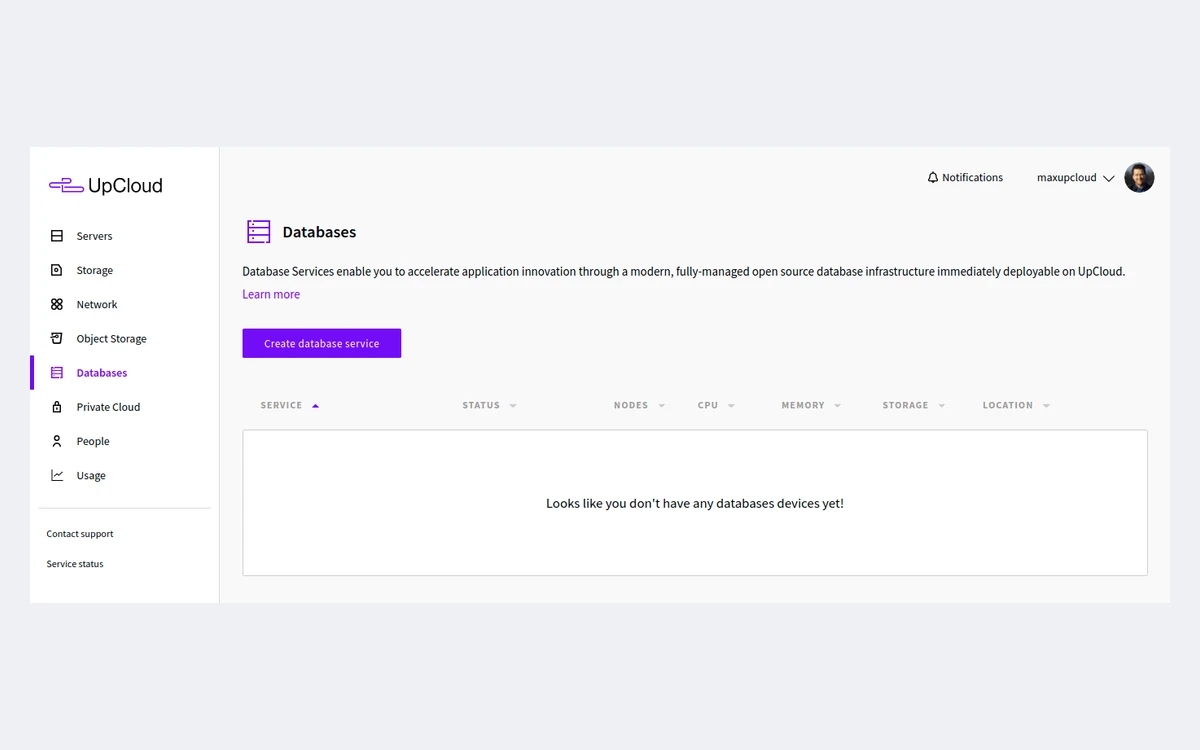
Managed MySQL and PostgreSQL start at €9/mo for 1 GB and 1 core on the Developer tier, then €14/mo for 2 GB and €24/mo for 4 GB. Standard plans start from €60/mo and High Memory from €126/mo. Valkey starts from €8/mo and OpenSearch from €100/mo. Clusters bill for as long as they exist, including while stopped.

Managed Load Balancer tiers are Essentials (€0/mo), Development (€10/mo), Production S (€30/mo) and Production M (€75/mo). NAT/VPN Gateway tiers are Essentials €0, Developer €15, Standard €25, Production €100 and Advanced €300 per month.
A single NVIDIA L4 server with 8 cores and 64 GB RAM costs €0.58/h (€418/mo), or €0.57/h (€410/mo) as a Spot instance. Larger cards start at €0.83/h for L40S, €0.87/h for RTX PRO 6000, €1.78/h for H100, €3.38/h for B200 and €5.00/h for B300. Spot instances, added in July 2026, come "with a 30-second notice before an instance is reclaimed", and the SLA does not apply to them.
The footprint is heavily European. Copenhagen went live in December 2025 and Stavanger in January 2026. Premium prices are the same everywhere; the only regional price difference in the storage table is Archive storage in Helsinki.
Unscheduled interruptions lasting longer than five minutes qualify for compensation of 50 times the fees charged for the interrupted item over that time. Payouts are capped at 30 days of that item's fees per incident and at 2.5 times its average monthly fee over 12 months. You must claim within 15 days, and compensation comes as credits that "may not be exchanged for cash".
The SLA does not cover free trials, the UpCloud website, the APIs or the control panel, and it excludes denial-of-service attacks and outages caused by an insufficient credit balance.
Support is available 24/7/365 by live chat or email, in English, on every account.
UpCloud's docs describe a free trial that "lasts for 7 days from the moment of trial activation"; the pricing page advertises a 30-day trial, so check the sign-up page for the current offer. To start it you give your name, email, phone number, a credit card and a billing address. The card is not charged, but UpCloud makes "a 0 or 1 €/$ temporary authorisation". The card country, IP location and phone country code are also used for sanctions screening.
Trial quotas are 2 cores and 4 GB memory for servers (no Windows), 60 GB each of Archive, Standard and MaxIOPS storage, 2 IPv4 and 2 IPv6 addresses, one 250 GB Object Storage instance, one single-node database, one Development load balancer and one Development Kubernetes cluster. GPUs and Private Cloud are excluded. When the trial ends, everything you deployed is removed but the account stays.
During the trial the firewall is locked to standard ports: 22 and 3389 inbound, 80, 443 and 123 both ways, and 53 outbound. Separately, port 25 (SMTP) "is blocked by default for all accounts", trial or not, so plan for that if you intend to run a mail server.

UpCloud accepts Visa, MasterCard, Amex, Discover and Maestro cards, Apple Pay, Google Pay and PayPal (manual one-time payments only). The first payment comes with a 30-day money-back guarantee of up to €500 / $500. After that, unused balance is not refunded.
The referral programme gives a new user €25 / $25 and the referrer €50 / $50, once the new user has made at least two one-time payments and stayed active for 28 days. Promotional credits are valid for 60 days after sign-up.
After the April 2026 overhaul, UpCloud is a strong choice for production servers in Europe. The €5 Premium plan gets you current AMD EPYC hardware, MaxIOPS storage, a daily backup and a five-nines SLA at an entry price, and egress costs nothing until you hit a generous throttle point. Cloud Native fills the gap for workloads that are not always on.
It is a weaker fit if you want to save money by powering servers off on Starter or Premium plans, if you need cheap mid-size Premium servers (the step from 1 GB to 2 GB more than doubles the price), or if you dislike prepaid billing with a deletion schedule attached.
The cheapest server is €3/mo on the Starter plan (1 GB RAM, 1 vCPU, 10 GB). Premium starts at €5/mo and Cloud Native at €12/mo plus storage. Prices exclude VAT and are billed hourly up to a 672-hour monthly cap.
Yes, on Starter and Premium plans. They bill every hour whether the server is on or off. Cloud Native servers are only billed for compute while powered on, and GPU servers stop billing for the server itself when stopped, though storage and IPs keep charging. To stop all charges, delete the resource.
There is no per-GB charge for inbound or outbound traffic, but each plan has a Fair Transfer Limit, from 0.5 TB on the smallest plans upward. Past it, UpCloud may throttle your servers to 100 Mbit/s after a warning email.
The docs say 7 days from activation, while the pricing page advertises 30 days. You need a credit card, which receives a temporary authorisation of 0 or 1 €/$ but is not charged. Trial services are removed when it ends.
Only on your first payment, within 30 days and up to €500 / $500. UpCloud does not refund unused balance outside that window, and credits are non-transferable.
All servers are shut down immediately. After more than a month the servers are removed and their IPs released, and after more than two months the storage is deleted permanently. Storage, IPs and backups keep charging in the meantime, and the balance can go negative.
Not out of the box. Port 25 is blocked by default on all accounts, so outbound SMTP from a new server will not work until UpCloud lifts the block.
No. Since 15 April 2026 Developer, General Purpose, High CPU and High Memory are discontinued for new deployments. Starter replaces Developer, and Premium replaces the other three.
More in Cloud Computing
Browse Cloud Computing