Technology reviews & practical guides
Vercel review for October 2026: what Pro really costs per seat, what Flat Rate CDN includes, how far the free Hobby plan goes, why the $200 spend budget is not a cap, and the April 2026 security incident.

Vercel is the cloud platform built by the team behind Next.js. You connect a Git repository, every push gets its own preview URL, and production deploys land on a global CDN with serverless compute behind it. It now runs Nuxt, SvelteKit, TanStack Start, FastAPI and, since 15 October 2026, generally available Python as well.
The pricing changed in September 2026. Pro is still $20 a month, but new Pro teams now get Flat Rate CDN by default, the $20 fee comes back as $20 of usage credit, and a $200 default spend budget sits on every new team. This review explains what you actually pay, where the free Hobby plan stops, how the spend budget really behaves (it is not a hard cap unless you turn pausing on) and what the April 2026 security incident means for customers.
Vercel is still the easiest way to ship a modern frontend or full-stack JavaScript app. Preview deployments on every push, zero-config framework detection, Fluid compute and a large first-party toolbox (Blob, Global Config, Workflows, Sandbox, AI Gateway) make the developer experience hard to beat.
The catch is that almost everything above the included allowances is metered, and the rates on the pricing page are the cheapest-region starting prices. Flat Rate CDN on Pro takes much of the surprise out of bandwidth bills, but compute, builds, image optimization, seats and add-ons are still billed per unit. Teams that set a spend amount and switch on pausing get a predictable bill; teams that do not can still be surprised.
Best for: Next.js and frontend teams who value preview deployments and fast iteration. Think twice if: you serve heavy media, need a contractual SLA without going Enterprise, or want a single fixed monthly price for everything.
Vercel sells three plans. Prices are in USD and exclude VAT.
Pro is a hybrid of a seat price and a usage price. A three-person team that deploys is paying $60 a month in seats before any usage beyond the $20 credit. The credit does not roll over: it expires at the end of the month if you do not use it and resets at the start of the next one.
Paid teams also get one free first-year domain on .app, .dev, .online, .site, .space, .store, .tech or .website. Trial teams do not.

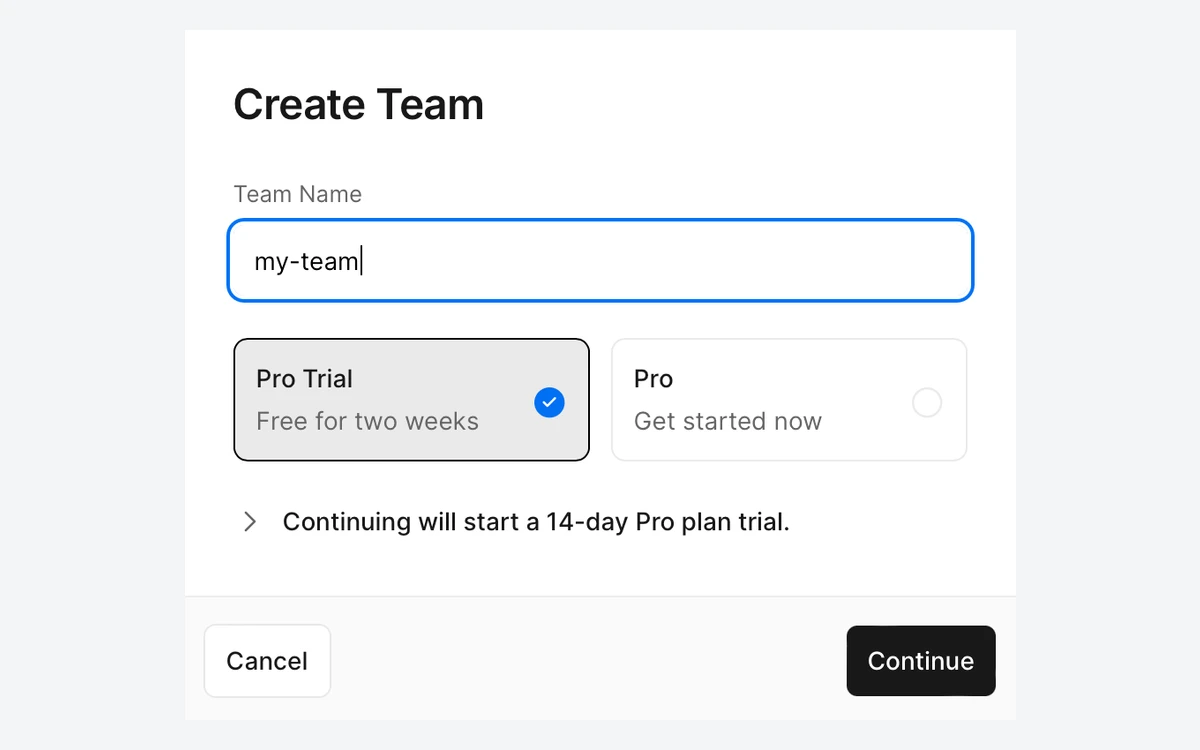
New teams can try Pro for 14 days with $20 in credits. There is one Pro trial per user account. The trial is capped at 10 team members, 200 projects, 16 CPU-hrs of Active CPU, 1,440 GB-hrs of provisioned memory and 1,000,000 function invocations, and it ends after 14 days or when those limits are exceeded, whichever comes first. If the trial ends and you have not set a payment method, you are not charged.
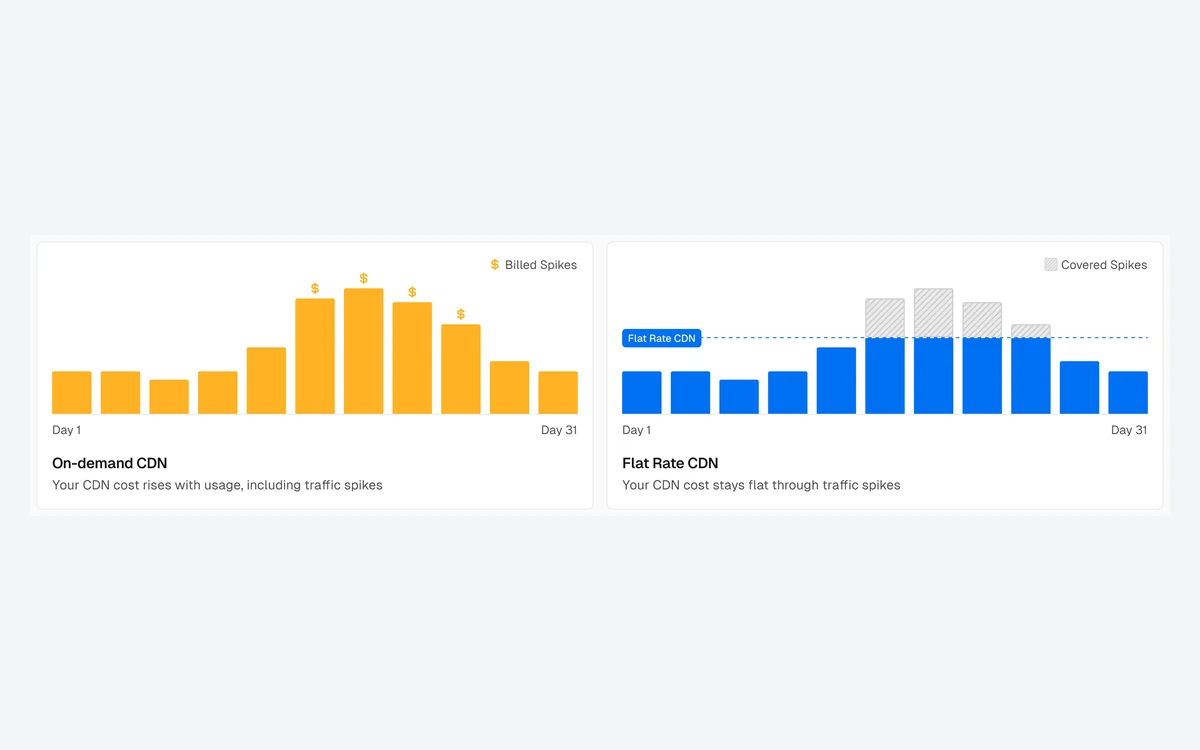
Flat Rate CDN became generally available for Pro teams on 8 September 2026. New Pro teams have it on by default; existing teams can switch in Billing settings. Instead of paying per GB and per request, you pick a capacity tier.
Note the request count. Base Pro includes 1M CDN requests, the same number as Hobby; the bigger difference is transfer (1 TB versus 100 GB). Older guides that say Pro includes 10M requests describe a pricing model that no longer applies; 10M is now the first paid tier.
Spike protection is the main selling point. Traffic above your tier's capacity is served normally and is not billed, subject to Vercel's fair use guidelines. If you consistently exceed the highest tier, Vercel moves you to on-demand pricing. Flat Rate CDN is not meant for bulk file distribution or media-heavy delivery.

Everything outside Flat Rate CDN is metered. The figures below are the starting rates from Vercel's pricing page, which are the cheapest-region prices. Vercel prices usage across 19 regions, and the most expensive regions cost noticeably more: Fast Data Transfer ranges from $0.15 to $0.35 per GB and Active CPU from $0.128 to $0.221 per hour.
Several team features cost extra on Pro: SAML SSO $300 per month, HIPAA BAA $350 per month, Password Protection $20 per protected project per month, Flags Explorer $250 per month, Preview Deployment Suffix $100 per month, Static IPs $100 per project per month plus private data transfer, Observability Plus $1.20 per 1M events, Web Analytics Plus $10 per month and Speed Insights Plus $10 per project per month plus $0.65 per 10,000 events. A team that needs SSO and a BAA adds $650 a month before usage.
Databases are not first-party. Postgres, Redis and similar stores are provisioned through Vercel Marketplace partners such as Neon, each with its own pricing.
Hobby is generous for side projects, but it has two hard rules. First, it is restricted to non-commercial personal use. Running ads, building an affiliate-first site, taking payments or being paid to build the site all count as commercial and require Pro or Enterprise. Asking for donations does not.
Second, Hobby never bills you. When a project exceeds the included free usage, it is paused, and you wait until 30 days have passed to use that feature again. You cannot buy additional usage on Hobby.
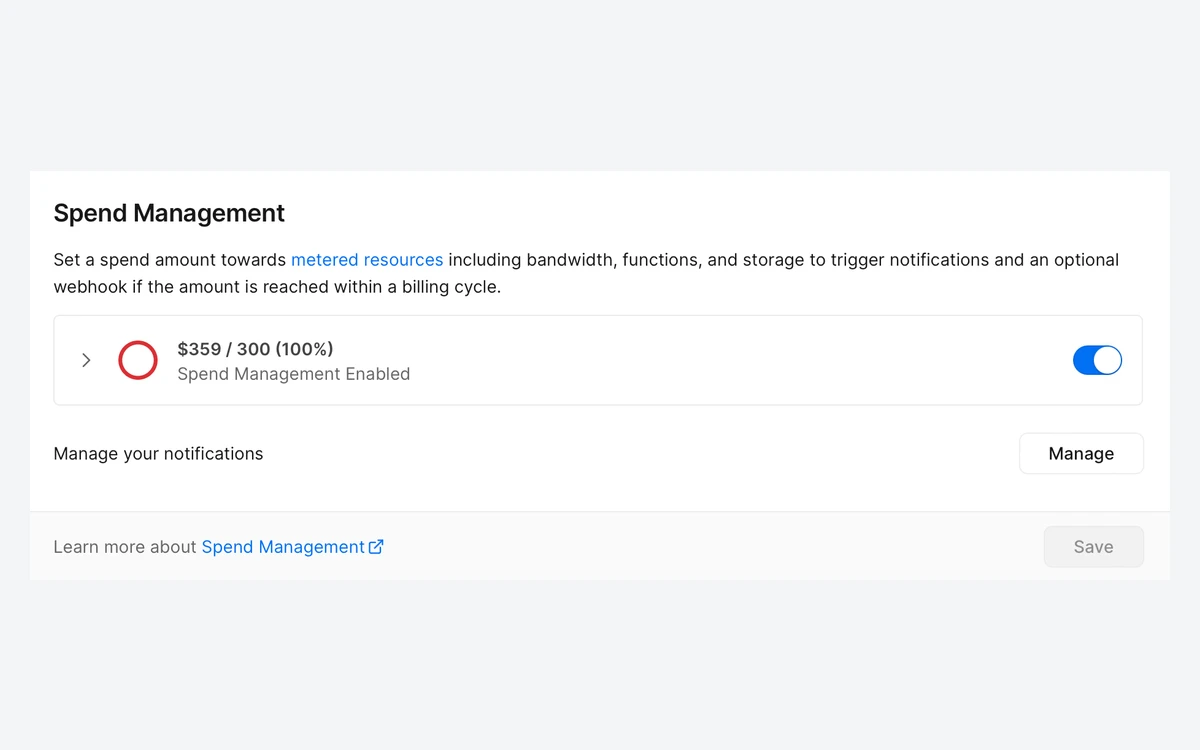
Every new team gets a default on-demand usage budget of $200, which you can change, with email, web and SMS notifications at 50%, 75% and 100%. This is the part most often misunderstood.
Setting a spend amount does not stop usage on its own. On Pro and Enterprise, reaching 100% does not stop deployments automatically. To stop costs above the amount, you have to turn on Pause Production Deployments. Even then, there are gaps worth knowing:

In team Billing settings, lower the spend amount to what you can tolerate, enable Pause Production Deployments, and set separate limits for AI Gateway keys and v0, which the pause does not cover.
Vercel detects and builds Next.js, Nuxt, SvelteKit, Nitro, Turborepo, TanStack Start, FastAPI and more. Every Git push gets a preview deployment with its own URL, which is the feature most teams end up depending on for review and QA.
Fluid compute is Vercel's serverless model for Node.js and Python. It reuses instances with optimized concurrency, pre-warms functions on production deployments and fails over across regions and availability zones. You pay for active CPU time rather than for idle wall-clock time spent waiting on I/O, which suits AI and API workloads that spend most of a request waiting.

Vercel's Ship 2026 event ran in London, Berlin, New York, Sydney and San Francisco. At the final stop on 15 October, Vercel announced Python GA, Vercel Drives, Daemons in public beta and Vercel for Enterprise. Drives and Daemons are new enough that we have not evaluated them for this review.
AI Gateway routes requests to many model providers through one API. Vercel charges no markup and no platform fee on tokens, includes $5 of free usage a month, and supports bring-your-own-key on the paid tier.
v0, Vercel's AI app builder, lives at v0.app and is billed separately. The free plan allows 7 messages a day, Plus includes $30 of monthly credits per user and Business is $100 per user per month. Vercel Agent, in beta, costs $0.25 per million tokens plus pass-through token cost.
Remember that neither AI Gateway key usage nor v0 usage is stopped by pausing production deployments, so give them their own limits.
Vercel holds a SOC 2 Type 2 attestation for Security, Confidentiality and Availability, is ISO 27001:2022 certified, has PCI DSS SAQ-D and SAQ-A attestations, supports GDPR through standard contractual clauses and lists EU-U.S. DPF and TISAX. A HIPAA BAA is available as a $350 per month Pro add-on. Automated DDoS mitigation is included on every plan, and BotID basic checks are free with Deep Analysis at $1 per 1,000 checks.

According to Vercel's bulletin, the incident began with a compromise of Context.ai, a third-party AI tool used by a Vercel employee, which the attacker used to take over that employee's account. A limited subset of customers had non-sensitive environment variables exposed, meaning variables that decrypt to plaintext. Vercel contacted affected customers, recommended immediate credential rotation and validated that its npm packages were not compromised.
Vercel says all remediation actions were complete and the incident was closed on 16 October 2026. The practical lesson for customers: mark secrets as sensitive in project settings so they cannot be read back as plaintext, and rotate anything that was stored as a non-sensitive variable. Deleting a project does not rotate its credentials.
Only Enterprise carries an SLA: 99.99% availability, with service credits of 10% below 99.99%, 25% below 99% and 50% below 95%. You must claim in writing within 30 days. Hobby and Pro have no SLA listed.
$20 per month, which includes 1 deploying seat and $20 of usage credit. Each additional Owner or Member seat is $20 per month, Viewer seats are free, and usage beyond the credit is billed on demand. The credit expires at the end of each month.
No. Hobby is for non-commercial personal use only. Ads, affiliate-first sites, taking payments or being paid to build the site all require Pro or Enterprise. Asking for donations is allowed.
Your project is paused rather than billed. You wait until 30 days have passed to use that feature again, and Hobby cannot buy extra usage.
Not by default. It only sends notifications unless you enable Pause Production Deployments. Even with pausing on, checks run every few minutes, and AI Gateway, v0, storage, seats, Marketplace and add-ons keep billing.
With Flat Rate CDN, base Pro includes 1M CDN requests and 1 TB of data transfer a month. Paid tiers go to 10M, 50M or 150M requests with 50 TB for $20, $100 or $300 a month, and spikes above the tier are not billed under fair use.
Yes. Pro has a 14-day trial with $20 in credits, one per user account. It ends early if you exceed the trial limits, and you are not charged if no payment method is set.
Fees are non-refundable except where Vercel's terms say otherwise, such as Vercel terminating your account without cause. You can cancel or downgrade to Hobby by contacting Vercel Support, effective at the start of the next renewal period.
Only a limited subset of customers had non-sensitive environment variables exposed, and Vercel contacted them directly. Vercel says npm packages were not compromised and closed the incident on 16 October 2026. Rotating any credentials stored as non-sensitive variables is still sensible.
Only on Enterprise, at 99.99% availability with service credits of 10% to 50%. Hobby and Pro have no SLA listed.

More in Cloud Computing
Browse Cloud Computing