Writesonic Review 2026: AI Search Visibility From 79 Dollars
Writesonic is not the 16 dollar writing tool people remember. It now tracks brand mentions across ten AI engines, and the cheapest paid plan is 79 dollars a month billed yearly.
Anyone who bookmarked Writesonic around 2023 remembers a cheap AI writing tool: a wall of templates for product descriptions and ad copy, a chatbot called Chatsonic bolted on the side, and a paid plan that cost roughly the price of two coffees. Open writesonic.com in August 2026 and the headline reads The AI Search Growth Engine. Same domain, different company.
This review looks at what the product actually is now, what the four plans cost and cap, what the terms say about refunds and renewal, and which jobs it still suits. Prices and limits below were read from the vendor's own pricing, product and terms pages on 17 August 2026.
From AI Writer to AI Search Platform
Writesonic now sells a loop rather than a text box. Track where your brand appears in AI answers, prioritise the gaps worth closing, act on them with content and technical fixes, then measure whether traffic and pipeline moved. The writing tools survived, but they sit inside the act stage of an SEO product instead of being the product. Chatsonic is folded into that too: it drives task agents for SEO analysis, content and LinkedIn posts, with an auto mode that routes a question to whichever agent fits.
The repositioning explains the bill. The template generator that once sold for about 16 dollars a month is gone, and the cheapest paid plan is 79 dollars a month on annual billing. Writesonic claims more than 10,000 marketing teams, coverage of over 50 markets and languages, and a dataset drawn from more than two billion AI conversations. Those are vendor figures, not audited ones, but they describe the ambition accurately: the competition it is pricing against is Semrush and Ahrefs, not a browser extension.
Check which product you are shopping for
If you came looking for a low-cost way to draft social captions, this is no longer that tool and the free tier will not change your mind. If you came looking for a way to find out why an assistant recommends a competitor instead of you, it is aimed squarely at you.
What the Visibility Tracker Actually Watches
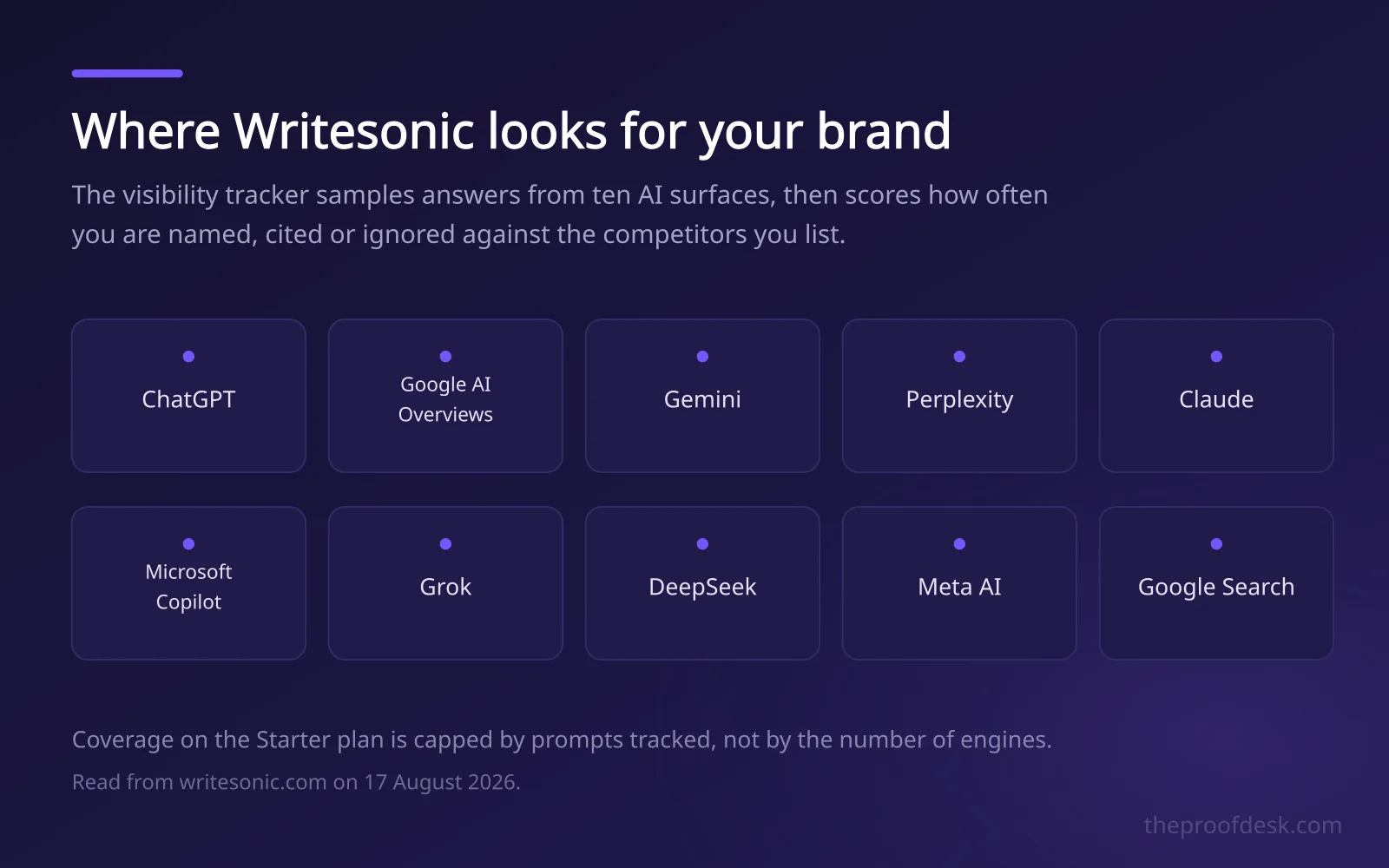
You supply prompts, meaning the questions you think buyers type into an assistant, plus a list of competitors. Writesonic runs those prompts on a schedule across ten AI surfaces and records what comes back: whether you were named, which sources the model cited, how the mention was framed, and how often a rival won the answer instead. Alongside that it reads your server-side crawler activity, so you can see when the AI bots actually fetched a page rather than guessing.
- The meter is prompts tracked, not engines: every plan reaches the same platforms, but the Starter tier only follows 50 questions.
- The Action Center converts gaps into a task list, split between on-page work and off-page citation outreach, and the number of actions is itself capped below Enterprise.
- Site audits are bundled but sized by tier, from 10 crawls of 100 pages on Starter up to 50 crawls of 2,500 pages on Growth.
- Answers are sampled daily, from 50 a day on Starter to 600 on Growth, so a small allowance spread across many prompts gives you a thin sample.
- Identical prompts return different answers run to run, so read the output as a trend line rather than a rank position. Any vendor promising a stable number here is overselling.
Pricing, Quotas and the Refund Window
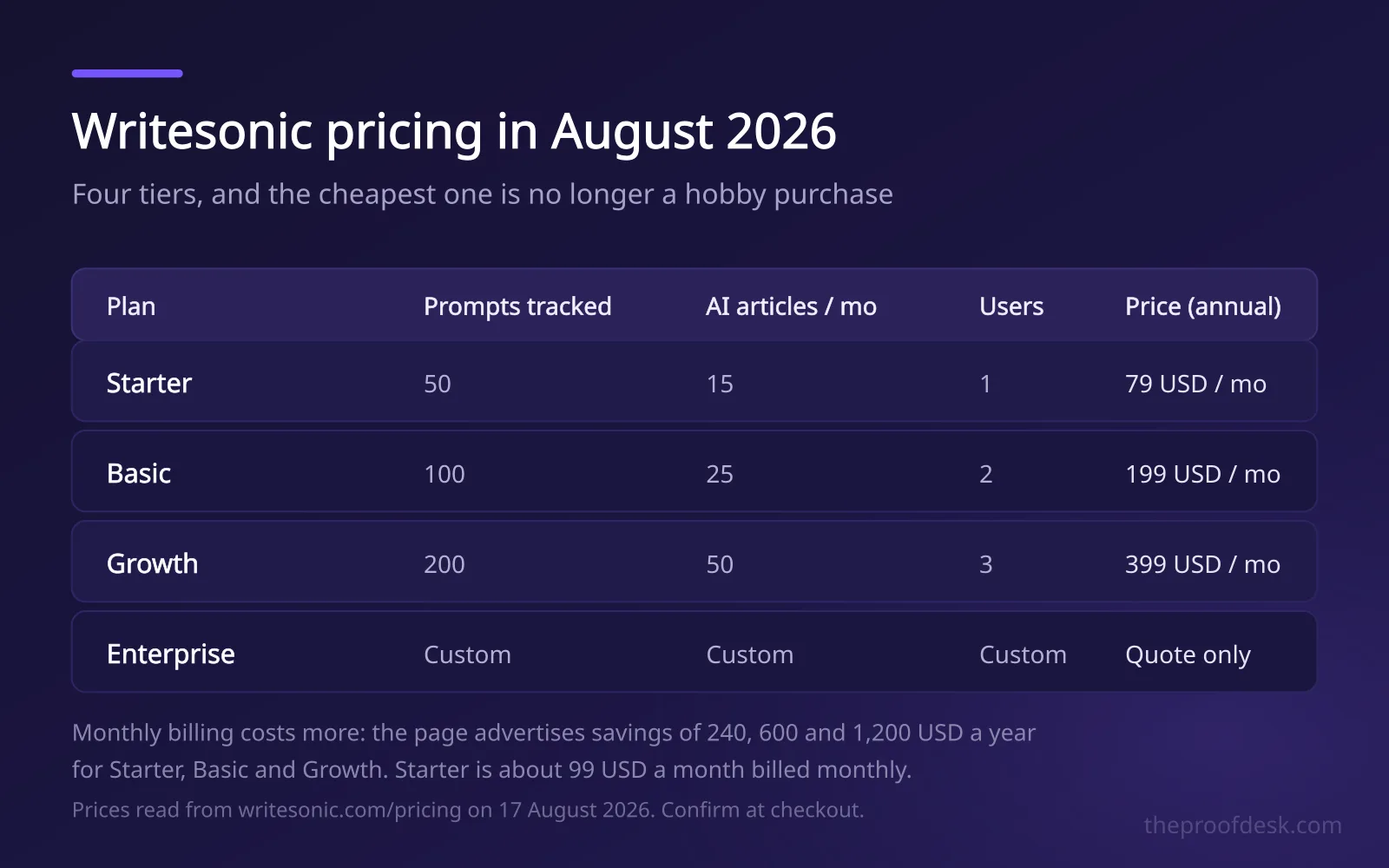
Four tiers, three of them self-serve. Starter is 79 dollars a month on an annual term and buys 50 tracked prompts, 15 AI articles a month, 10 site audits and a single user. Basic doubles the prompts to 100 for 199 dollars and adds a second seat. Growth is 399 dollars for 200 prompts, 50 articles, three seats and two projects. Enterprise is quote-only and lifts the caps. Monthly billing costs more: the pricing page advertises annual savings of 240, 600 and 1,200 dollars on the three self-serve tiers, which puts Starter near 99 dollars and Basic near 249 dollars if you pay month to month. There is a free entry point with no card required, useful for seeing the interface and little else.
What the terms commit to
Buy through the online checkout and you can request a full refund of the initial subscription fee within seven days of first purchase. Enterprise contracts are non-refundable except where law requires otherwise. Subscriptions renew automatically for a term equal to the one you bought, either side can stop that with 30 days written notice, and self-serve plans can be cancelled from the account page with effect at the end of the current cycle. Fee changes at renewal need 30 days notice. Outputs belong to you, subject to the underlying model providers' terms.
The Article Writer, and Who It Fits
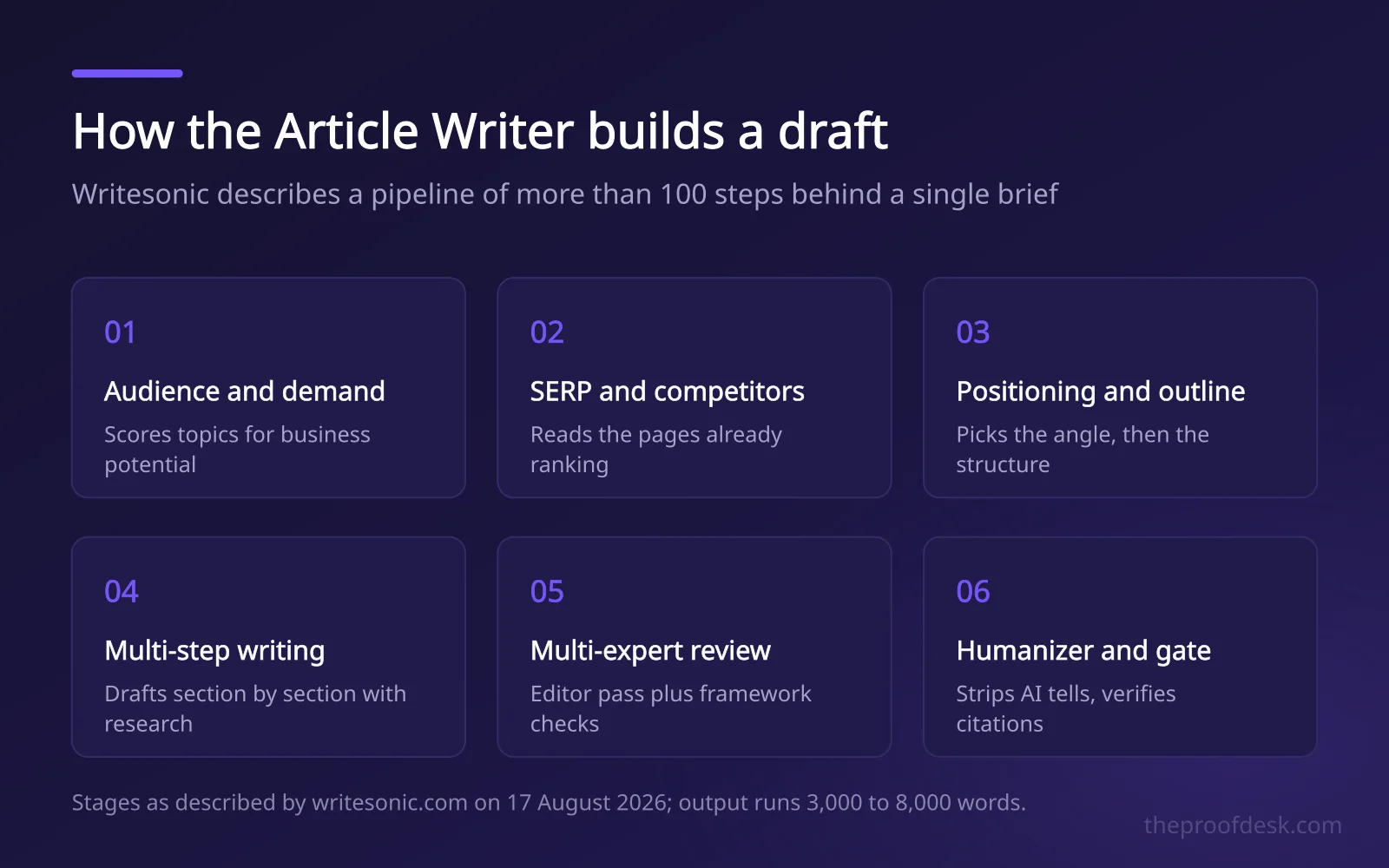
The Article Writer is the piece most buyers will judge. Writesonic describes it as an agentic pipeline of more than a hundred steps rather than a prompt wrapper: it scores topics for business potential, reads the pages already ranking, sets an angle and outline, drafts section by section with research, runs an editor pass against a set of internal frameworks, then strips the obvious AI tells and checks citations before handing the draft over. Output is long, 3,000 to 8,000 words, with FAQ schema and internal links informed by Search Console and Ahrefs data, and it pushes straight into WordPress, Contentful, Sanity, Contentstack, Notion, Drupal, Google Docs or an API. The quotas tell you how to use it: 15 to 50 articles a month is a pillar-page budget, not a content mill.
- Good fit: an in-house marketing team that already ranks in Google and now wants evidence of how assistants describe the brand.
- Good fit: agencies that can bill the tracking work, since the Action Center output maps neatly onto a retainer.
- Poor fit: freelancers and small shops who only wanted cheap drafting, because that tier no longer exists here.
- Poor fit: teams larger than three people, who hit the seat ceiling and land in an Enterprise conversation quickly.
- Try before committing: run the free tier and the seven-day refund window against prompts you genuinely care about, not demo topics.
Key takeaways
- Writesonic is an AI search visibility platform now, and the old budget writing plans are not coming back.
- Paid access starts at 79 dollars a month on annual billing, or roughly 99 dollars month to month.
- Plans are metered by tracked prompts, daily answers, audits and seats rather than by which AI engines you reach.
- Direct online purchases carry a seven-day refund on the first subscription fee, and every plan renews automatically.
- AI answers vary between identical runs, so treat the visibility scores as a trend and verify long drafts before they go live.
More in Artificial Intelligence
Browse Artificial Intelligence